



This post may contain affiliate links. If you buy thru these links, we may earn a commission at no additional cost to you.
Handling an estate coin collection (or a slew of old coins that have been passed on to you) can be one of the most difficult things you’ll ever have to do.
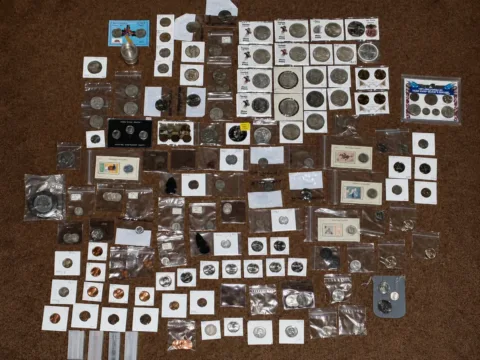
However, being responsible for securing the sale or disbursal of a large coin collection doesn’t have to be hard.
While I’m not a lawyer and have no training in legal issues, I’m a longtime coin collector and would like to offer you some tips that you may find helpful if you’re in a situation where you’re having to handle issues surrounding an estate coin collection.
The advice I offer assumes you have already taken into consideration any directives or wills, have little to no experience with coins, and you are simply seeking tips for looking through a large coin collection and possibly selling some (or all) of them.
How To Go Through An Old Coin Collection
Estate coin collections don’t have to be big — though they often are.
The term estate coin collection simply means a collection of coins belonging within an estate.
While handling an estate itself can be arduous, having to deal with matters of a coin collection in an estate can make things even more complicated. After all, many coin collections are made up of coins that can be individually worth hundreds — even thousands — of dollars!
An old coin collection put together over the many decades of an avid coin collector’s life can mean the accumulation of seemingly countless coins, each having potentially great value.
How should you handle those coins?
Tip #1: Look it up.
Before setting aside time to go through and catalog or evaluate each coin, it’s really important that you pick up a book that will help you understand what each of the coins in the coin collection is worth.
Two of the best books I can suggest for you to buy are good reference guides that provide great, detailed information but aren’t be too over the top if you’re not familiar with coins:
- If you’re dealing mainly with United States coins, be sure to check out A Guide Book of United States Coins, commonly known as “The Red Book.”
- If you have to go through foreign coins or a mix of different types of coins, look for a copy of The Standard Catalog of World Coins, which hasn’t been printed since 2020 but remains a staple for world coin collectors.
Tip #2: Don’t clean any of the coins.
You might be thinking that cleaning the coins would make them look better — and possibly make them worth more money. While you may wash a car before you sell it, you do not want to clean your coins!
The natural patina on all those coins is highly valued by coin collectors and shouldn’t be altered in any way. When you clean coins, you permanently alter their original surfaces — which are often an extremely scarce attribute, especially on older coins.
You will always get more money for uncleaned, unaltered coins than those that have been cleaned or “improved.” Trust me. Don’t touch those coins for any other reason than to inspect them!
Tip #3: Divide and conquer.
It’s time to start seeing what you have. If you already have directions set in place, be sure you organize and distribute according to what you have been directed to do.
If, however, you have a ton of coins laying around and have no orders and you don’t know what’s valuable and what’s not, I have some general guidelines for you.
Keep all of these U.S. coins:
- Pennies made before 1959 (these include Wheat pennies, Indian pennies, and several rare dates)
- Nickels made before 1955 (these include Buffalo nickels, Liberty nickels, and several scarce dates)
- Dimes made before 1965 (these are silver dimes and include Mercury dimes)
- Quarters made before 1965 (these are silver and include several scarce dates of Washington quarters as well as older designs, plus modern rare quarters and old rare quarters)
- Half dollars made before 1971 (these are silver half dollars)
- Dollar coins made before 1936 (these are silver, including Morgan dollars and several scarce dates)
- Sets of coins already assembled in albums, folders, or packages
- All gold coins and silver coins
- Any coins in holders or those already identified
If you’re having to go through jars, boxes, or bins of coins and none of them within fall into the categories of coins listed above, there’s a pretty safe bet that what you have found is not so much a coin collection, per se, but simply a hoard of spare change kept without regard to date or condition.
Certainly the possibility exists that error coins may be found within. But generally, jars or hoards of common pocket change are most commonly found in estates. These coins often have no more value than the face value of the coins themselves.
Tip #4: Safely protect and store all of the coins.
Coins found in estates are often stored using one of two possible coin storage extremes:
- Either all the coins are inventoried and properly kept in good coin storage materials
- Or the coins are poorly stored in jars and such, and left uncatalogued
Of course, the coin collection you’re handling may have be kept using a combination of the above methods.
At any rate, there’s a good chance you’re going to need to at the very least partly modify the storage of the coins you’re going through for transport to a selling location or disbursal.
Whatever you do, be sure to follow all guidelines set forth in directives. If directions include the coins not being removed from their present storage method, then by all means abide. However, if there are no such directives in place and you need an efficient and safe way to keep the coins you’re going through, I’ve got some helpful ideas for you.
The best way to protect and store U.S. coins:
- Use inert plastic coin tubes to store large quantities of coins of similar denomination
- Purchase coin folders or coin albums for organizing runs of coins of the same designs
- Put presently unpackaged rare or valuable coins into individual air-tite coin holders
- Mylar coin flips and 2×2 coin holders are other great, cheap ways to store loose coins in individual holders
- Make use of a coin storage box to organize all coins that are in 2x2s and mylar flips
Tip #5: Sell the old estate coins.
So long as there are no directions as to where coins in the estate must go and everybody involved decides that the coins left behind should be sold, then it’s time to sell the coins (assuming that’s what is agreed upon).
The 3 most profitable ways to sell coins are:
- Selling coins to a coin dealer.
- Using an auction service to sell the coins for you.
- Listing the coins on eBay.
While auction houses are a good way to sell expensive coins or very large coin collections, coin dealers are often a more convenient way to sell coin — especially if the material you’re handling isn’t necessarily very expensive. There are many well established coin dealers who are well-accustomed to handling very rare and expensive coins.
eBay is another method employed by those selling coins today — because eBay is an online auction website that grants you the advantage of placing your coins in front of, potentially, millions of bidders who will compete to pay the highest price for your coins.
One big issue with eBay, however, is that listing fees can erode a significant (10% or more) amount of the final selling price. Also, you must be sure to package the coins safely, be prepared to communicate with buyers, and ship the sold coins promptly and to the correct winners.
However, if the only thing that makes you nervous about listing the coins on eBay is the issue of fees, bear in mind that traditional auction houses also impose fees.
In the same sense, you must remember that selling coins to a coin dealer means getting less than the retail value of your coins. Coin dealers, after all, have to cover expenses and make a profit — so they will likely offer somewhere between 50% to 75% of the values you see listed in most coin price guides.
This video has even more great tips:


Leave a Comment