

You may not see large-size silver dollars too often these days, but as recently as the mid-1970s, they were still being made on a regular basis.
Eisenhower dollars were the last big silver dollars to be produced for circulation.
- The obverse bears a head profile of World War II general and 34th president Dwight D. Eisenhower.
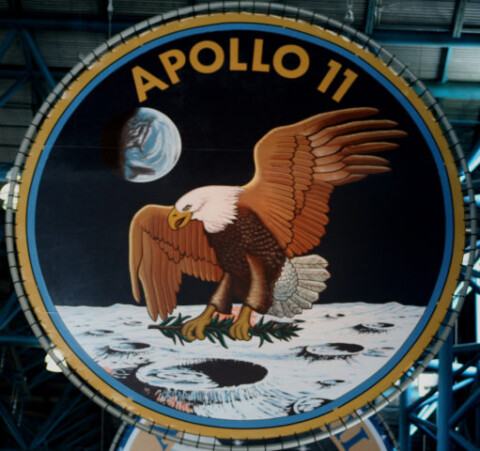
- The reverse shows a modified take on the Apollo 11 emblem, which depicts an eagle clutching an olive branch as it lands on the surface of the moon.
Eisenhower dollars are not at all rare.
The fact you don’t see them in circulation (and only seldomly at banks) has only to do with the fact that these coins weren’t too popular with many people as a circulating coin. After all, Eisenhower dollars are large, heavy coins that weigh about 23 grams — nearly as much as an old silver dollar and just as wide!
While silver dollars may have circulated well back in the days of the Wild West, carrying around big Eisenhower dollars just didn’t go over too well with people in the inflationary times of the 1970s. Even then, a dollar didn’t go too far.
In fact, it was the relatively immense size of Eisenhower dollars that prompted the United States government to opt for the nearly quarter-size Susan B. Anthony dollar that took over in 1979.
Some interesting facts about Eisenhower dollars:
- They were made from 1971 to 1978.
- They measure 38.1 millimeters in diameter.
- Some were struck with a copper-nickel clad composition.
- Special Eisenhower dollars have a 40% silver composition.
- The Philadelphia and Denver mints produced circulation strikes.
- The San Francisco mint made 40% silver Eisenhower dollars and proofs.
- The Eisenhower silver dollar was designed by Frank Gasparro – he also designed the Lincoln Memorial on the back of Lincoln cents made from 1959 to 2008 and the Susan B. Anthony dollar.
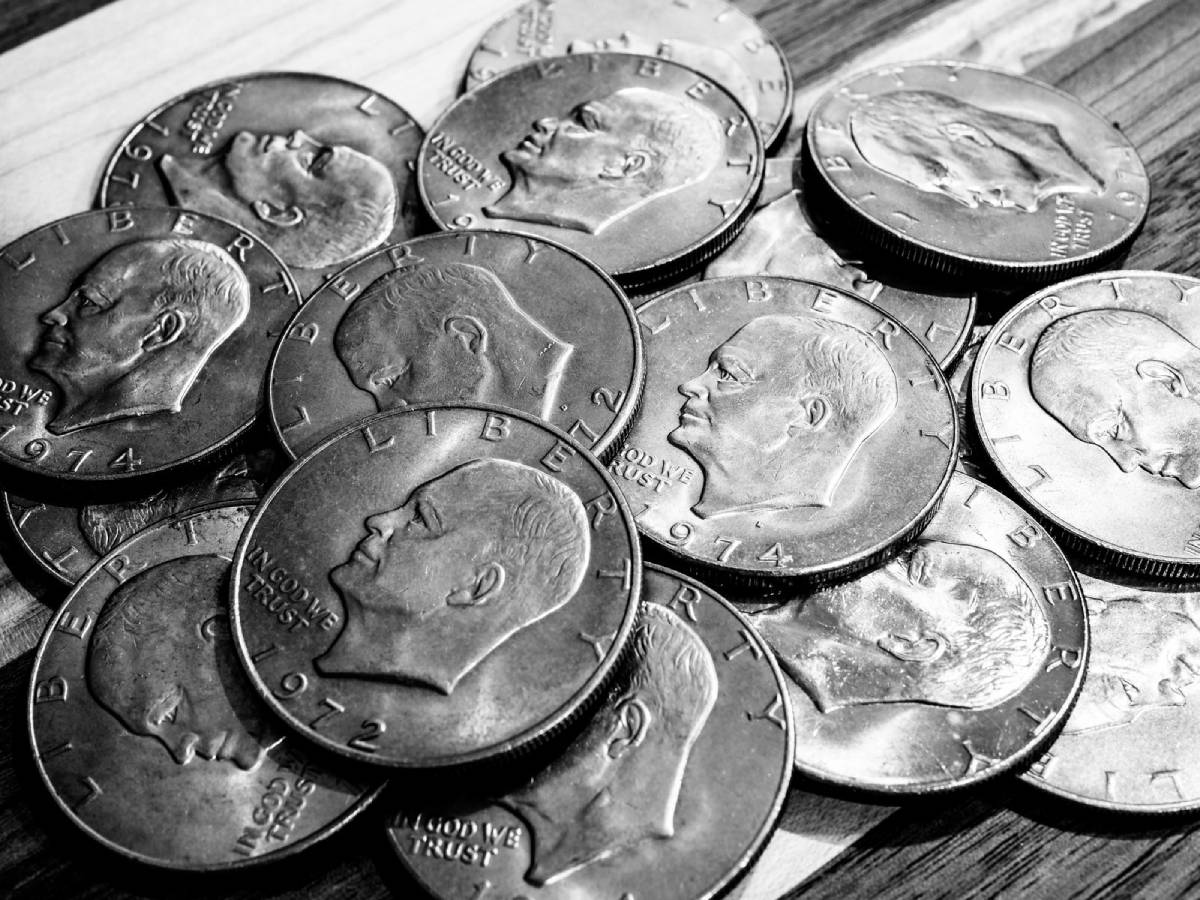
Tips For Collecting Eisenhower Dollars
Something many coin collectors like about Ike dollars is that, compared to other coin series, they really aren’t very expensive to collect!
There are just 32 coins to an entire set — and that includes all the different strikes in both copper-nickel clad and silver. That also includes all the Bicentennial metal and design varieties.
In fact, it’s currently possible to complete an entire set of Eisenhower dollars for well under $300!
While the last Eisenhower dollars were minted all the way back when disco was king and gas cost less than $1 a gallon, Eisenhower dollars really haven’t become any scarcer (or harder to find) than when they were minted.
Eisenhower Dollar Coin Values
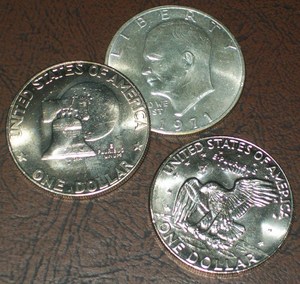
Here’s the information you’re looking for regarding Eisenhower dollar coin values:
- The most expensive among all the Eisenhower dollars is the 1973-S 40% silver proof. It costs between $40 and $50 to purchase at most coin dealers. Other silver proof and uncirculated Eisenhower dollars are priced at around $20 to $30.
- Uncirculated copper-nickel clad Eisenhower dollars generally cost under $5 each.
- Proof copper-nickel clad Eisenhower dollars can be had for less than $10 each.
Now let’s talk about the different types of Eisenhower dollar coins and how to identify which version of the coin you have — Blue Ikes vs. Brown Ikes and Variety 1 vs Variety 2 Bicentennial Eisenhower dollars.
Blue Ikes vs. Brown Ikes: The Differences
You’ll probably hear about Brown Ike dollars and Blue Ike dollars during your coin collecting journey.
Blue and brown don’t refer to the colors of the Eisenhower dollar coins themselves. Instead, they describe the color of the packages within which the U.S. Mint sold special Eisenhower dollars from 1971 to 1974 for collectors.
- Blue Eisenhower dollars are uncirculated 40% silver Eisenhower dollars which are packaged in a blue envelope.
- Brown Eisenhower dollars are proof 40% silver Eisenhower dollars sold in a brown-colored, faux-woodgrain box.
How To Identify Blue Ikes vs. Brown Ikes
Both types of Eisenhower dollars have identical mintage years: 1971-S, 1972-S, 1973-S, and 1974-S. The key difference is in the packaging of these coins — based on whether the coin was a business strike (for circulation) or a proof strike coin (for collectors).
🔵 The “Blue Ike” (Business Strike)
- The finish on an uncirculated business strike Eisenhower dollar has a soft, satin-like luster and a standard satin finish — just like a freshly minted coin pulled straight from a bank bag.
- The coin came sealed inside a clear, soft plastic pliofilm packet — which is a clear, waterproof, and heat-sealed rubber-based plastic wrap. Inside is a small blue round token printed with “U.S. MINT.” The sealed packet was tucked inside a distinctive dark blue envelope with gold lettering stating: “United States Mint / Eisenhower Uncirculated Silver Dollar” (hence the nickname “Blue Ike”).
How to spot a “loose” raw Blue Ike: If someone cracked it out of its original pack, look at the back (reverse) side of the coin. An uncirculated Blue Ike will show cartwheel luster across the surface — but no mirror reflections or frosted relief. On a coin scale, it will weigh 24.59 grams (compared to 22.68 grams for a standard clad Ike). It will also have a clean silver edge with no copper band.
🟤 The “Brown Ike” (Proof Strike)
- The finish on a proof strike Eisenhower dollar reflects that fact that it was struck twice under high pressure on hand-polished planchets. This gives the coin mirror-like reflective backgrounds (fields) and heavily frosted details on Eisenhower’s bust and the Apollo 11 eagle landing on the moon reverse.
- This coin came inside a heavy, hard-plastic clear capsule with a black velvet-lined interior ring. That capsule rests inside a sturdy, woodgrain brown slipcase box with a gold presidential seal on the cover (hence the nickname “Brown Ike”).
How to spot a “loose” raw Brown Ike: If removed from its plastic slab or capsule, a Brown Ike is immediately obvious because of its mirror finish. If you hold a pencil above the coin’s surface, you will clearly see the pencil reflection mirrored in the silver field.
MUST READ: Blue Ike vs. Brown Ike Values
Variety 1 vs. Variety 2 Eisenhower Bicentennial Dollars
 There are two different types of Eisenhower Bicentennial dollars:
- Bicentennial Dollar Variety 1
- Bicentennial Dollar Variety 2
The two varieties were created due to a change in the font style of the lettering on the reverse side of these 1976-dated Eisenhower dollars.
These Eisenhower dollar coins show a picture of the Liberty Bell superimposed over a profile of the moon, designed by Dennis R. Williams.
The U.S. Mint actually started production on Bicentennial dollars early in 1975 using the Variety 1 master die. But because the lettering was so wide and low-relief, the coin presses caused the lettering to strike up poorly and look mushy — especially on the clad planchets.
Mid-year in 1975, the Mint re-engraved the master hub to create Variety 2. They sharpened up the lettering and added “fine” serifs.
While both varieties were struck at Philadelphia (no mintmark) and Denver (“D” mintmark), 1976-D Variety 1 dollars saw a much lower mintage than Variety 2 — making them a relatively accessible variety that you could pull out of bank teller trays or estate collections!
How To Identify Variety 1 vs. Variety 2 Bicentennial Eisenhower Dollars:
The key to telling Variety 1 from Variety 2 Eisenhower Bicentennial dollars comes down to the lettering style (font) used for “UNITED STATES OF AMERICA” and “ONE DOLLAR” on the reverse:
Variety 1 (Bold / Thick Lettering)
- The letters are noticeably fat, thick, and blocky.
- The letters have low-profile, low-relief depth that almost blends into the flat surface field.
- The letters are sans-serif (there are no “little feet” at the ends of the letters) — instead, they have practically flat, blunt ends. For example, the letter “N” in UNITED ends in broad, flat square corners.
Variety 2 (Thin / Sharp Lettering)
- The letters are much thinner, delicate, and razor-sharp.
- The lettering stands up higher in relief off the surface field.
- You’ll see distinct, delicate serifs (tiny feet or flares) on the ends of the letter strokes. For example, the top and bottom of the letter “I” or the letter “N”.
If looking at the thickness of the words seems tricky, there is one other fail-proof way to tell the difference.
Focus on just a single letter — either the letter “R” in “AMERICA” or the letter “T” in “STATES”:
- Variety 1 “R” — The vertical leg or tail of the “R” comes straight down or curves out slightly with a blunt, square bottom tip.
- Variety 2 “R” — The leg of the “R” has a very distinct, elegant flared curve at the bottom (a prominent tail serif).
- Variety 1 “T” — The horizontal crossbar across the top of the “T” is broad, thick, and completely flat on both ends.
- Variety 2 “T” — The crossbar on the “T” is slender, with small downward-pointing serifs on the far left and right tips.
The best part about Eisenhower dollar coins: They’re cheap and fun coins to collect!
Which Eisenhower dollars do you own? Which is your favorite?
READ NEXT: Rare Eisenhower Dollar Coin Errors
Leave a Comment