


Coin grading is the standardized process of evaluating a coin’s condition — which ultimately dictates its collector value.
Coin grade refers to a coin’s physical condition, as determined by analyzing its:
Coin grades are evaluated using the 70-point Sheldon Scale (1 being the lowest, 70 being numismatically perfect).
Read on to see what all of the coin grade letters and numbers mean…
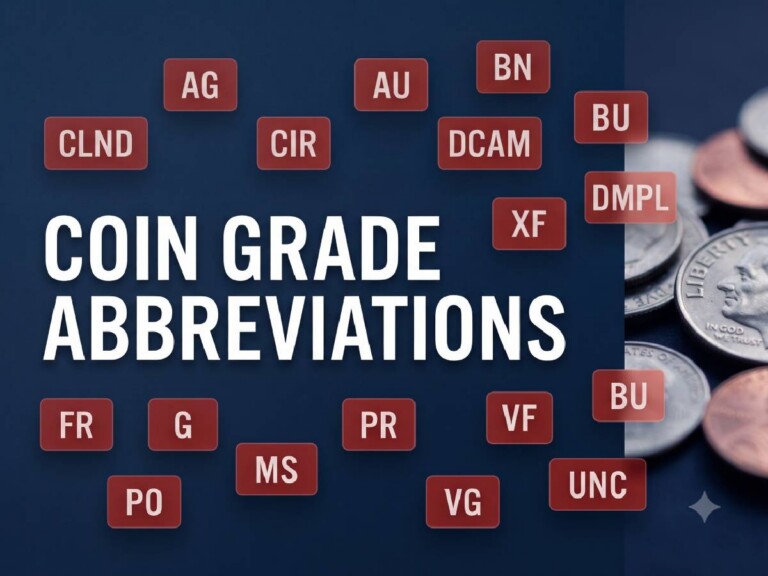
While the following abbreviations and acronyms are not the only ones that you will stumble upon when collecting coins, these are the most common ones when it comes to discussing coin grades.
Coin Grade Letters Explained
The letters represent the circulated grade of the coin and various strike characteristics.
These are the most common coin grades:
| Grade | Definition | Description |
|---|---|---|
| AG | About Good | A grade that refers to a coin with very heavy wear. Most collectors do not generally collect coins with this amount of wear, except for coins which are considered rare. |
| AU | About Uncirculated | A coin which has only slight wear on its highest points. |
| BN | Brown | Refers to brownish hues or toning seen on copper coins. |
| BU | Brilliant Uncirculated | An uncirculated coin which has notable luster quality and, sometimes, refers to an uncirculated coin with particularly good strike. |
| CIR | Circulated | A coin which has seen wear through circulation, or use as spending money. |
| CLND | Cleaned | A coin which has been cleaned or otherwise altered to perhaps appear better than it really is. |
| DCAM | Deep Cameo | Refers to a proof coin on which the designs are heavily “frosted” (white). |
| DMPL | Deep Mirror Proof Like | A coin, usually a Morgan dollar, that is not actually a “proof” specimen but has reflectivity and mirrored surfaces which resemble proof quality. These coins are highly appreciated by collectors and investors alike. |
| EX or XF | Extremely Fine | A coin with light wear and has all basic details and most minor details visible. Higher-level “EF” or “XF” coins often show light traces of luster. |
| F | Fine | A coin with moderate wear. “Fine” coins usually have full rims and all major details are intact. |
| FR | Fair | A coin with very heavy wear. Some people will collect “Fair” examples in cases of very rare coins, such as early large cents from the 1790s. However, many collectors prefer Fair coins for building so-called low-ball sets — collections where the goal is to have coins in the lowest-possible grades. |
| G | Good | A coin with considerably heavy wear. This is generally deemed the lowest grade collectible for “common” coins. |
| MS | Mint State | A coin that has no wear and is otherwise considered “uncirculated.” |
| PO | Poor | A coin that exhibits extreme wear and can often be identified only by denomination and type. Dates, lettering, and detail are often worn beyond recognition on Poor coins. Low-ball collectors deem Poor as the ideal grade for their sets, which aim to have the lowest-graded examples that can be obtained. |
| PR | Proof | A coin that has been struck specifically to produce an exquisite strike and surface quality. These are usually marketed by the Mint as collector coins and often are intentionally struck multiple times to bring up even the most minute of details. Modern-day proof coins generally show cameo — or frosty — designs, lettering, and other inscriptions contrasted against deeply mirrored fields (flat surfaces). |
| RB | Red-Brown | Refers to the mixture of red-orange and brown hues seen on copper coins. |
| RD | Red | Refers to the deep (and original) orange and reddish hues and toning seen on copper coinage. |
| UNC | Uncirculated | A coin that has never seen any wear through circulation. |
| VG | Very Good | A coin with moderately heavy wear. A “Very Good” coin typically has full lettering near the rims of the coin. The word “LIBERTY,” when it appears on late-19th and early 20th century coins on a headband, will often show approximately 3-4 letters. |
| VF | Very Fine | A coin with moderate wear. All major and many minor details are seen. All lettering should be complete on most coins. |
Coin Grade Numbers Explained
There are also numerical levels on the 70-point coin grading scale.
These numbers always correspond to the same grade / definition.
The most common coin grades are:
- Poor = 1
- Fair = 2
- About Good = 3
- Good = 4, 6
- Very Good = 8, 10
- Fine = 12, 15
- Very Fine = 20, 35
- Extremely Fine = 40, 45
- About Uncirculated = 50, 53, 55, 58
- Uncirculated (Mint State) = 60 to 70
The Official U.S. Coin Grading Scale Explained
Each coin grading organization uses a coin grading scale that is based on the Sheldon Coin Grading Scale.
This is a 70-point scale — where a coin that grades a “70” is thought to be worth 70x as much as a coin that grades a “1.”
More specifically:
- Circulated coins (coins that show some wear) range from a low of 1 to a high of 58 points.
- Uncirculated coins (coins that have never been used as money and show no wear) range from a low of 60 to a high of 70 points.
Confusing Letters & Numbers Explained
The letter-and-number combinations can be a bit difficult to grasp at first — especially if you’re a brand new coin collector.
I’m here to help!
Here’s a detailed explanation for 3 unique coin grade letter & number combos that every collector needs to know about…
Why “MS70” Isn’t 70x Better Than “MS1”
Beginners usually assume the 1-to-70 numerical coin grading scale was designed as a simple percentage score — like getting a 70/70 on a school test. But it wasn’t!
In 1949, a famous numismatist named Dr. William Sheldon created the scale specifically for large cents.
He noticed that a heavily worn coin in “Poor-1” (PO-1) grade was generally worth about $1 on the market — while a pristine, uncirculated “Perfect” coin was worth roughly $70 (exactly 70 times as much). So the numbers were originally created as a relative dollar value multiplier, not a grade percentage.
Today, market values are completely disconnected from that math, but we still use Dr. Sheldon’s price-ratio scale for every coin slab issued today!
Proof vs. Mint State Coins Simplified
One of the biggest misconceptions new collectors have is thinking that “Proof” (PR or PF) is just a fancy grade higher than “Mint State” (MS).
However, PR is not a grade — it’s a manufacturing process!
A coin made at the U.S. Mint for everyday pocket change is a business-strike coin that is graded on the MS-60 to MS-70 scale.
A proof coin is (at least) twice struck under high pressure on specially polished blanks using polished dies. These coins are made specifically for collectors. You can actually have a heavily damaged, circulated proof coin graded PR-12!
Just remember: the letters MS or PR tell you how a coin was born, while the numbers tell you how well it survived.
Decoding Copper Color Designations (RD, RB, BN)
On copper coins, third-party grading services add one of these 2-letter color codes right after the grade number: RD (Red), RB (Red-Brown), or BN (Brown).
Here’s what those copper color codes mean:
- RD (Red) — Retains 95%+ of its original, bright mint copper color.
- RB (Red-Brown) — Retains between 5% and 95% of its original red copper color.
- BN (Brown) — Retains less than 5% original red (fully oxidized brown patina).
Why does it matter?
Because the jump from RB to RD in high grades could mean a difference of thousands of dollars!
But don’t be fooled into thinking BN means a coin is “bad.” A problem-free, chocolate-brown Lincoln Wheat penny with full details is often far more stable over the long-term than a shiny red coin that’s just waiting to spot or tarnish in humid air.
Here is the NGC’s coin grading scale.
Here is the PCGS’s coin grading scale with examples of each coin grade.
How to Grade Coins Yourself
Grab a coin magnifier and a copy of the U.S. Coin Grading Standards book. Then, watch this video to see how to grade coins yourself at home:
These are the best coin grading apps that will make grading coins yourself much easier.
Looking For A Coin Glossary?
Here are some detailed coin dictionaries and guides that include the coin terms most frequently used by professional coin collectors:


Leave a Comment