

Start Here

Values

Buying & Selling

Rare U.S. Coins

How To's

Myths & History

U.S. Coin Identifier: Get To Know The Important Parts Of A Coin (Diagrams + Photos)

by Lynnette Walczak

Ezoic/Google Ad Code Here

Coins Parts & Diagrams

Those of us who don’t necessarily collect coins but happen to have found some interesting coins in our pocket change (or have inherited a hand-me-down coin collection), we need some of the most basic parts of a coin spelled out for us. Right?

Like… what’s the difference between the edge of a coin and the rim of a coin? (You can find that answer in great detail here.)

What follows are some coin diagrams and photos that will help you describe your coin to others — say, if you’re trying to sell it online.

Plus, you will find coin glossaries and definitions that will be helpful as you learn more about your coins.

Okay, let’s dive in and get to know the various parts of a coin…

#1 – Definitions Of The Most Important Coin Parts

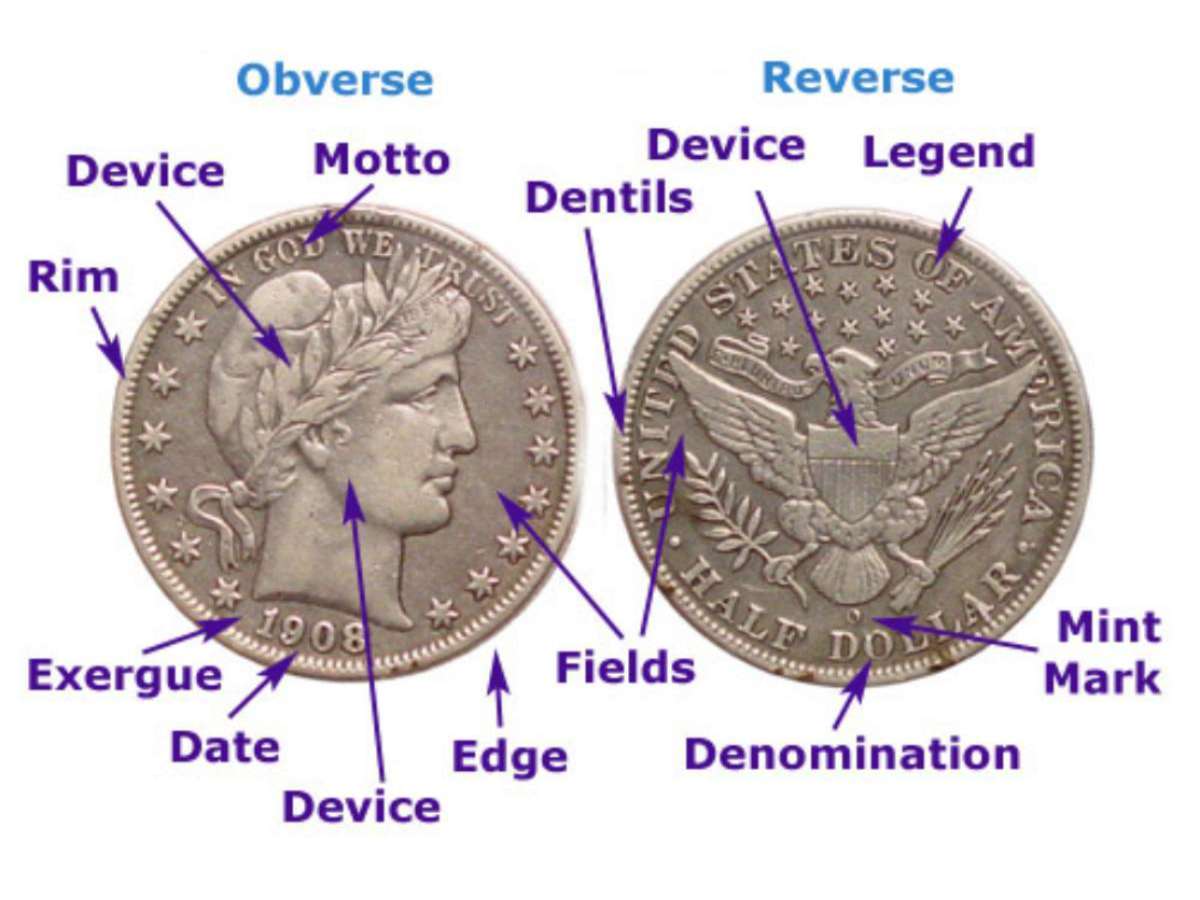
This first photo helps you learn about each of the key parts of a coin, including:

  • Device – any raised element on the surface of a coin
  • Rim – the raised border around each side of a coin
  • Edge – the outer surface of a coin that runs around the entire circumference
  • Dentils (or Denticles) – the tooth-like raised design around the rim of some earlier U.S. coins
  • Obverse – the “heads” side of a coin
  • Reverse – the “tails” side of a coin
  • Legend (or Inscription) – the main words or lettering on a coin
  • Motto – secondary lettering that conveys a short phrase (such as “In God We Trust”)
  • Denomination – the face value of a coin
  • Mintmark – a small letter struck onto the coin to indicate where the coin was made
  • Date – the year that identifies when the coin was struck
  • Exergue – the space on a coin below or around the design, often used for the date
  • Field – the smooth, flat “blank” area that appears behind a coin’s raised design (“relief”)
  • Relief (not shown in this image) – the markings on a coin that are raised above the coin’s smooth, flat surface (“field”)
#2 – Diagram Of The Basic Coin Parts

This next photo from the U.S. Mint highlights the most basic parts of a coin, including:

  • The obverse vs. reverse sides of a coin
  • The difference between the edge and rim of a coin
  • The location of the inscription and mint mark on a coin
  • Where the bust, date, and artist/designer’s initials might appear on a coin
  • An example of “relief” vs. “field” on a coin
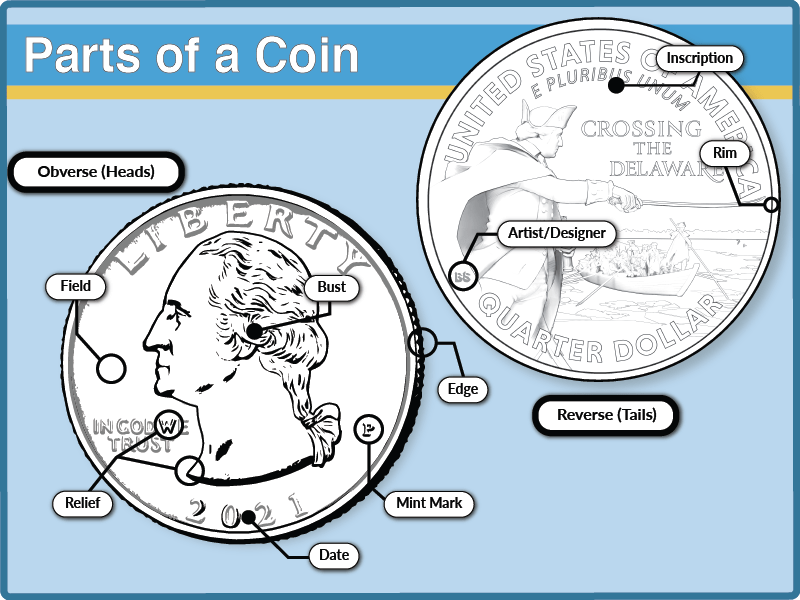
The U.S. Mint website for kids expands more on this diagram.

It’s a great place for beginners to start!

Looking For A Coin Glossary?

Here are some detailed coin dictionaries and guides that include the coin terms most frequently used by coin collectors:

PUBLISHED July 23, 2026
UPDATED August 25, 2026

Lynnette Walczak

Founder / Publisher

I like to help people find unique ways to do things in order to save time & money — so I write about “outside the box” ideas that most people wouldn’t think of. With regard to coins, I’m an amateur collector of U.S. coins. Mostly I look for valuable coins in my everyday pocket change, and keep a tally of how much my small-but-growing collection of coins is worth.

9 responses to “U.S. Coin Identifier: Get To Know The Important Parts Of A Coin (Diagrams + Photos)”

  1. Regina Braddee Avatar
    Regina Braddee

    My family inherited my step fathers coin collection in Jan.2009 after his death. There are alot of very beautiful, well kept coins in hard, clear plastic cases and laying in velvet. How do we find the value of these coins or anyone interested in purchasing them? We are uninterested in collecting them and would like to see them in the hands of someone who would apprieciate them as much as my step-dad did. Any time and info you can give me would be greatly apprieciated.

    Thanks,
    Regina

    1.  Avatar
      Anonymous

      Hi Regina,

      Condolences to you and your family…

      ~

      As for your step father’s coin collection, if you are not interested in collecting coins or keeping them in the family, I recommended you consider selling your coins to a coin dealer or maybe consign them to an auction.

      It sounds like those coins may be (perhaps) in what we call “slabs.” If that’s so, you may have some very valuable coins in your hands and I would be very careful that you sell them for what they are worth.

      Unfortunately, without either seeing photos or reading descriptions of the coins (date, denomination, etc.), I won’t be able to help you right here, but I urge you to check out some of the other articles and posts here at The Fun Times Guide to Coin because you should be able to find some information here that will give you a better idea as to the coins you have and some approximation as to value.

      Should you decide to sell, I hope you have at least 2 or 3 coin dealers in your area – that way you can ‘shop around’ and get the best price for your coins.

      *Don’t go to the people who advertise on the side of the street that they buy gold — they certainly won’t pay you the value of your coins as rarities or collectibles. Also, avoid jewelers and pawn shops — they generally know little about coins and will not pay you what those coins are worth.

      Here’s a list of coin dealers verified by the American Numismatic Association (ANA) – this would be a good place to start generating some ideas as to dealers you should consider selling your coins to: https://www.money.org/ana_custom/dealer_search/dealer_search.cfm

      I hope this helps aim you in the right direction. Please always feel free to check back with more questions, and make sure you skim the posts here to get some idea as to what those coins are worth.

  2. Chalacha Avatar
    Chalacha

    I have come across a large copper coin in very rough shape – on one side it has inscribed 1/2 SHILLING over two arrows which “X” over the entire face of the coin. On the bottom, between the arrow feathers is a date which is VERY hard to read (possibly 1803?) The opposite side has a crown on the top center above the letters G and A which are on top of each other. To the right of the GA are the Roman Numerals IV. To the left of the GA is another crown… I am stumped…

  3. Cjbmongo Avatar
    Cjbmongo

    have a 1838 one cent liberty on head, 1824 same seems high relief,1774 british penny, 1818 liberty head penny, lots of 1800s indian head pennies worth anything?

    1.  Avatar
      Anonymous

      Hi Cj,

      The large cents are each worth from between $15 to $30 in typical grades, though they’ll be worth less if they are porous, bent, cleaned, or otherwise damaged.

      To give you a better idea on the value of the Indian cents, I’ll need to have a list of each date, or you can just check out this piece on Indian penny values if you’d like: https://uscoinsguide.com/indian_heady_penny_value/

      Unfortunately, I’m not too experienced with British pennies, so I can’t say for certain specifically on the 1774, but I do know that British pennies from that era are often sold for anywhere from between $10 to over $100 based on condition. The key, though, is ensuring its authentic. After all, many counterfeits and replicas exist.

      If you’re inclined, sending the coin to a third-party coin grader is a good idea. Here’s some more info on third-party coin grading: https://uscoinsguide.com/slabbed_coins/

  4. TheCollector Avatar
    TheCollector

    Try taking a picture of your coin with the Collector’s Eye visual search tool.

    https://play.google.com/store/apps/details?id=com.CollectorsEyeFree

    1. JoshuaTheFunTimesGuide Avatar
      JoshuaTheFunTimesGuide

      Hi, Doris —

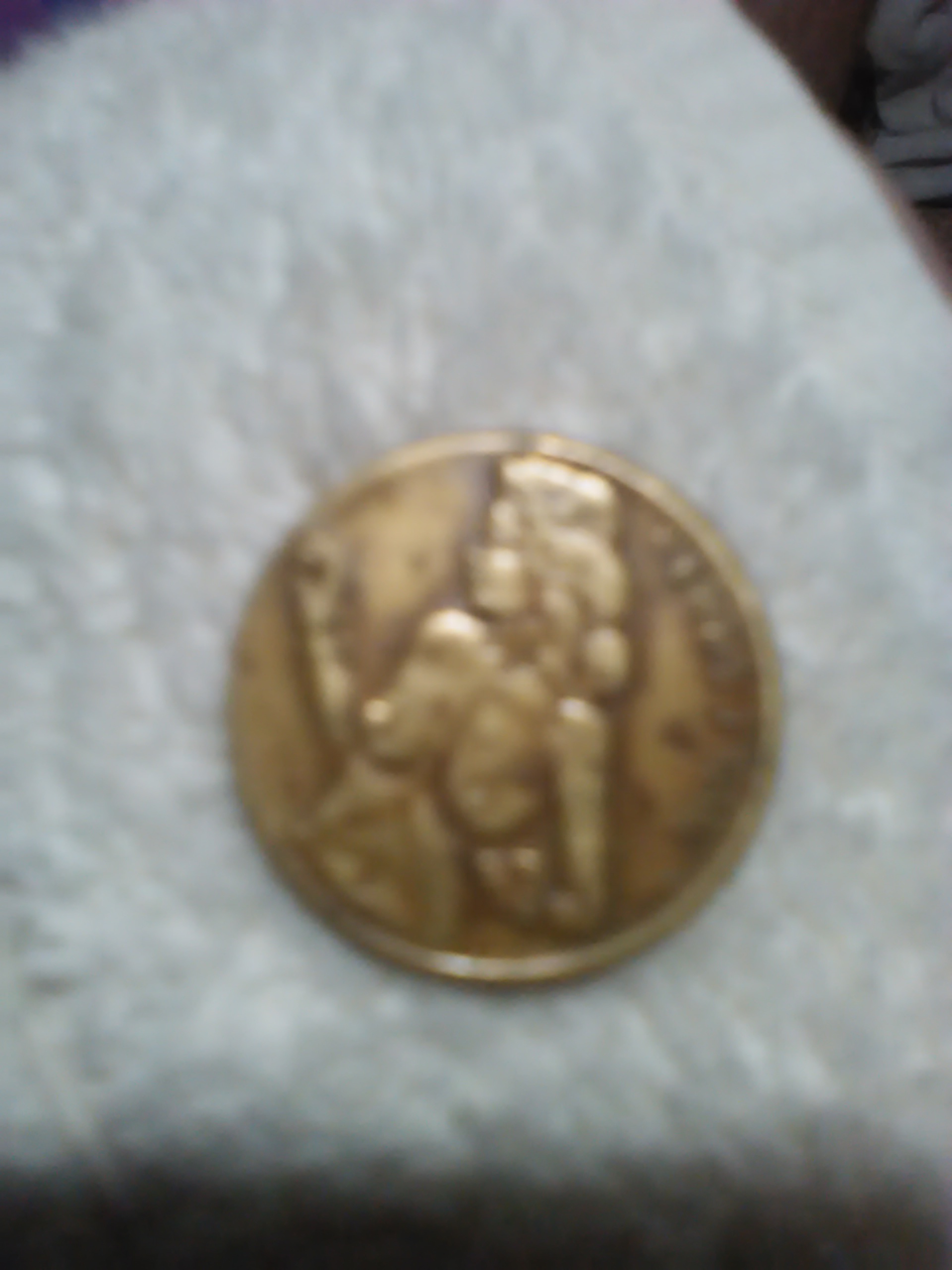
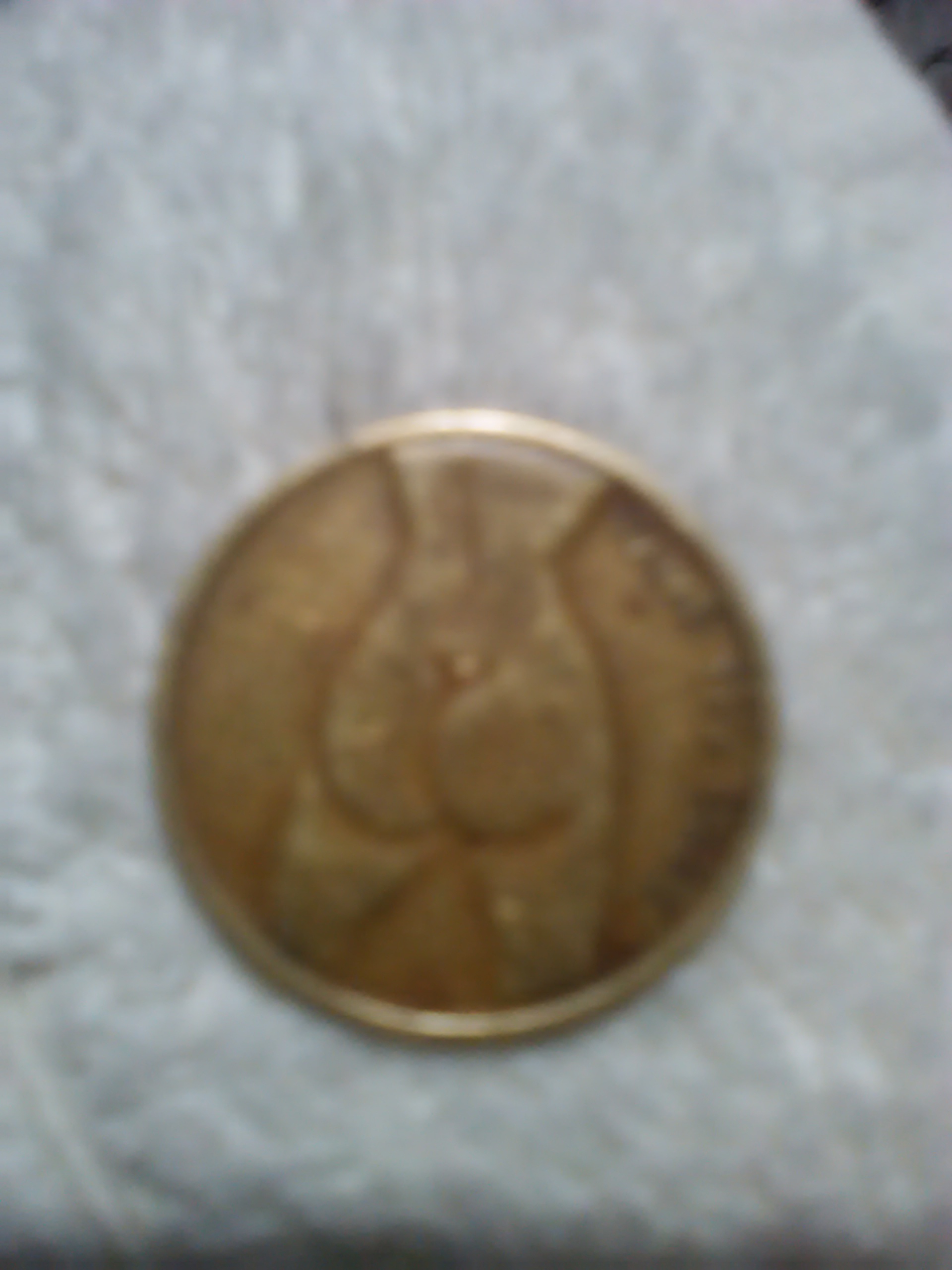
      A token like this would have most appeal to novelty coin collectors; similar pieces tend to sell for $2 to $3.

      Thank you for your question,
      Josh

  5. Doris Cockman Avatar
    Doris Cockman

    Can anyone tell me anything about this coin it says heads I win on front and tales you lose on back

Leave a Comment

Ezoic/Google Ad

300x250

Content Widget

Ezoic/Google Ad

300x600 Sticky