




The Great Depression (which roughly spanned from the Stock Market Crash of 1929 until the beginning of World War II in 1939) affected hundreds of millions around the world.
It was a prolonged period of economic devastation with high unemployment rates, mortgage defaults on homes and family farms, incalculable investment losses, and other fiscal crises. It affected virtually every aspect of life for most Americans.
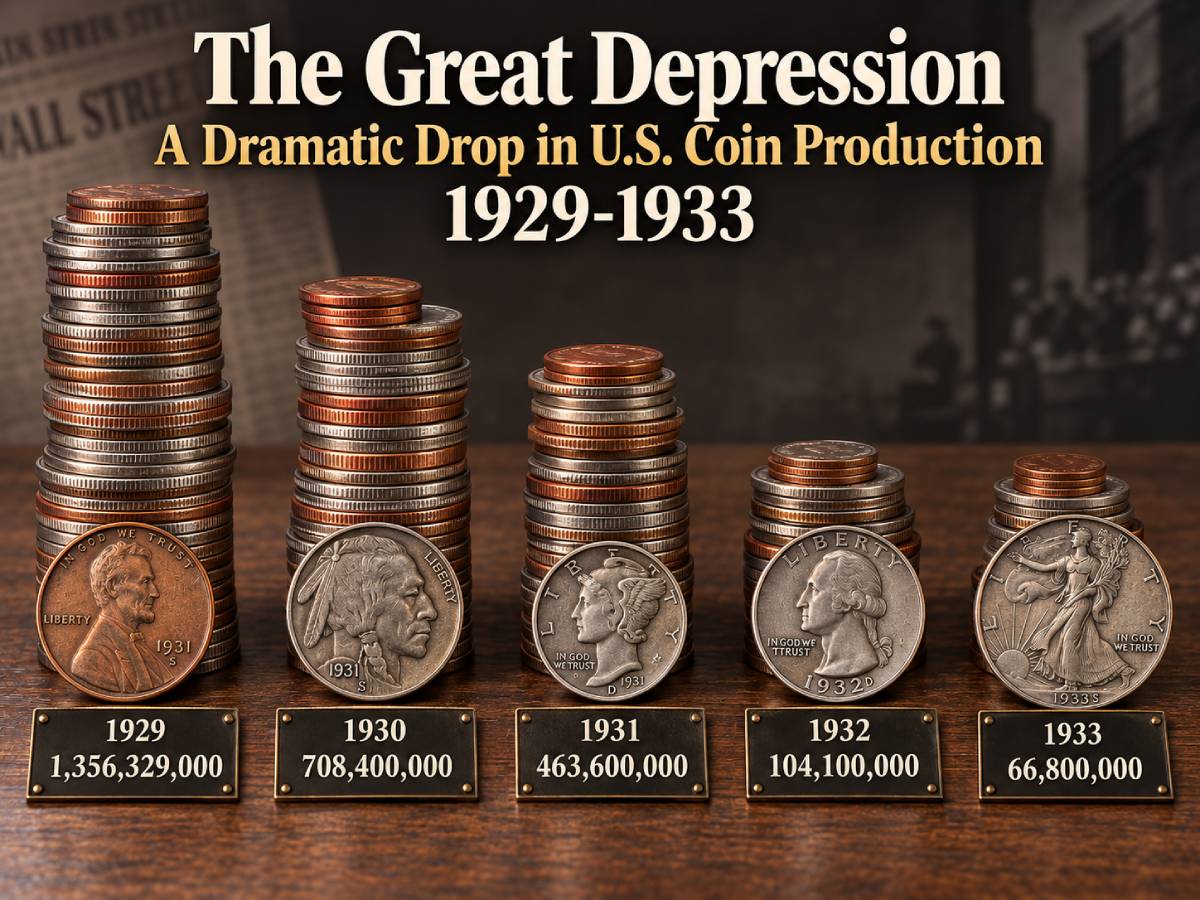
As consumer spending collapsed, businesses stopped requesting new change, and unused coins began piling up in Federal Reserve vaults.
Because there was virtually no commercial demand for fresh currency, the U.S. Mint drastically slashed production or paused most coin series entirely.
The U.S. Coins That Were Most Affected
The ripple effects were so pervasive that there was simply little need for many new coins in circulation at the time. Coin production decreased greatly in many nations — including the United States.
In fact, the economic pangs of the Great Depression were so grievous that the need for most circulating coinage in the United States had all but come to a halt!
The U.S. Mint suspended production on almost all denominations for at least one year during the Depression. In fact, during the absolute worst points of this economic crisis, multiple denominations were completely frozen at the same time, leaving the Mint to run on a skeleton schedule.
These are the coin series that the U.S. Mint put “on pause” during the worst years of the slump:
- Buffalo nickels — None struck in 1932 or 1933
- Mercury dimes — None struck in 1932 or 1933
- Standing Liberty quarters — None struck in 1931 (series discontinued)
- Washington quarters — None struck in 1933
- Walking Liberty half dollars — None struck in 1930, 1931, or 1932
- Peace dollars — None struck from 1929 through 1933; series officially discontinued after 1935
- Gold coins ($2.50, $5, $10) — No $2.50 or $5 pieces were struck after 1929; the $10 face saw no production in 1931
I want to further emphasize just how dire the economic situation had become…
You see, even among coins that were struck during the most critical years of the Great Depression, mintages were very small.
These were the only U.S. coins struck from 1930 to 1933:
| Coin | Mintage |
|---|---|
| 1930 Lincoln penny | 157,415,000 |
| 1930-D Lincoln penny | 40,100,000 |
| 1930-S Lincoln penny | 24,286,000 |
| 1931 Lincoln penny | 19,396,000 |
| 1931-D Lincoln penny | 4,480,000 |
| 1931-S Lincoln penny | 866,000 |
| 1932 Lincoln penny | 9,062,000 |
| 1932-D Lincoln penny | 10,500,000 |
| 1933 Lincoln penny | 14,360,000 |
| 1933-D Lincoln penny | 6,200,000 |
| 1930 Buffalo nickel | 22,849,000 |
| 1930-S Buffalo nickel | 5,435,000 |
| 1931-S Buffalo nickel | 1,200,000 |
| 1930 Mercury dime | 6,770,000 |
| 1930-S Mercury dime | 1,843,000 |
| 1931 Mercury dime | 3,150,000 |
| 1931-D Mercury dime | 1,260,000 |
| 1931-S Mercury dime | 1,800,000 |
| 1930 Standing Liberty quarter | 5,632,000 |
| 1930-S Standing Liberty quarter | 1,556,000 |
| 1932 Washington quarter | 5,404,000 |
| 1932-D Washington quarter | 436,800 |
| 1932-S Washington quarter | 408,000 |
| 1933-D Oregon Trail Half Dollar (commemorative) | 5,008 |
| 1933-S Walking Liberty half dollar | 1,786,000 |
| 1930-S Indian $10 Gold | 96,000 |
| 1932 Indian $10 Gold | 4,463,000 |
| 1933 Indian $10 Gold (virtually all melted) | 312,500 |
| 1930-S Saint-Gaudens $20 Gold | 74,000 |
| 1931 Saint-Gaudens $20 Gold | 2,938,250 |
| 1931-D Saint-Gaudens $20 Gold | 106,500 |
| 1932 Saint-Gaudens $20 Gold | 1,101,750 |
| 1933 Saint-Gaudens $20 Gold (virtually all melted) | 445,500 |
What This Means For Coin Collectors
With virtually no demand from businesses for fresh currency, the Mint slashed production across all denominations, creating some of the century’s most sought-after rarities!
These low figures generated some of the 20th century’s greatest “key dates” (the rarest, most valuable dates in a series).
| Coin | Mintage | Why It Matters to Collectors |
|---|---|---|
| 1931-S Lincoln penny | 866,000 | The 2nd rarest regular-issue Lincoln cent of the 20th century (surpassed only by the legendary 1909-S VDB Lincoln cent with a mintage of 484,000) |
| 1931-S Buffalo nickel | 1,200,000 | The 2nd rarest regular Buffalo nickel (behind the 1926-S Buffalo nickel); the only nickel struck in 1931 |
| 1931-D Mercury dime | 1,260,000 | The lowest-mintage Denver dime in the series (outside of the ultra-rare 1916-D Mercury dime, of which 264,000 were struck) |
| 1931-S Mercury dime | 1,800,000 | The final S-mint dime before a 2-year dime production blackout in 1932 and 1933 |
| 1932-D Washington quarter | 436,800 | The premier key date of the entire Washington quarter series |
| 1932-S Washington quarter | 408,000 | The absolute lowest regular mintage of any Washington quarter from the 20th century |
| 1933-S Walking Liberty half dollar | 1,786,000 | Struck only in San Francisco; ended a 3-year half-dollar freeze |
| 1933 Saint-Gaudens $20 gold coin | 445,500 | Virtually all melted; a multi-million-dollar ultra-rarity |
Also worth noting…
There was no 1933 U.S. quarter. Due to massive coin surpluses piling up in Federal Reserve vaults, the U.S. Mint produced zero quarters in 1933 across all facilities.
After a heavy run in the 1920s, no Peace dollars were minted from 1929 through 1933. The silver dollar briefly returned in 1934 and 1935 under the Silver Purchase Act before the denomination was effectively abandoned for circulation. While the Mint briefly struck over 316,000 silver dollars in 1965 (dated 1964), they were all melted before being released — meaning no circulating silver dollars legally reached the public again until the 1970s.
Early in 1931, the San Francisco Mint struck only 194,000 Buffalo nickels before halting production altogether — due to zero commercial demand. In November, Assistant Mint Director Mary Margaret O’Reilly realized that releasing such a small number of nickels would trigger massive collector hoarding and speculation. Therefore, she ordered the Mint to push the total mintage of the 1931-S Buffalo nickel up to 1.2 million to stave off speculators!
The 1934 Pivot Point
By 1934, pockets of the economy were beginning to see slight improvements. Plus, after years of interrupted coin production, the need for new coins was growing by the mid-1930s.
Mintages drastically increased across the board from 1934 on.
By the way, this is why numismatists often use the year 1934 as a dividing line between scarce, low-mintage “early” dates and highly abundant “later” dates among coins series that were in production at that time.
The era also permanently shifted American coin design.
For example, the Washington quarter (originally intended as a 1-year commemorative in 1932 to honor George Washington’s 200th birthday) was permanently adopted in 1934. It replaced the allegorical Standing Liberty quarter design, and effectively marked a shift toward honoring historical presidents rather than allegorical figures of Liberty on circulating coinage.
The Great Depression’s War On Gold Coins
The economic collapse also spelled the end for circulating U.S. gold coinage.
To combat severe banking panics and widespread gold hoarding, President Franklin D. Roosevelt issued Executive Order 6102 in April 1933. It required American citizens to surrender most of their privately held gold coins, gold bullion, and gold certificates to the Federal Reserve.
The catastrophic impact on numismatics was perfectly captured by the legendary 1933 Saint-Gaudens Double Eagle $20 gold coin. Even though the Mint struck 445,500 of these magnificent pieces, the sudden halting of gold circulation meant almost the entire mintage was instantly ordered melted down into generic gold bars! Only a tiny handful of them secretly survived, rendering the lone specimen that is obtainable by private collectors to become a multi-million-dollar ultra-rarity that ranks as the most valuable coin in existence today.
The following year, the Gold Reserve Act of 1934 permanently abolished the minting of circulating U.S. gold coins, drawing a final curtain on a golden era.
The Bottom Line
For modern coin collectors, the Great Depression serves as a fascinating reminder of how closely numismatics is tied to history!
The next time you hold a scarce 1931-S Lincoln cent, a 1932-D Washington quarter, or a rare 1933-S Walking Liberty half dollar, you aren’t just holding a key date. You’re holding a physical artifact from a time when the American economic engine ground to a halt.
These coins survived a decade of brutal budget cuts, massive vault surpluses, and literal melting pots — making them some of the most historically significant and deeply prized treasures in all of American coinage.
Leave a Comment