

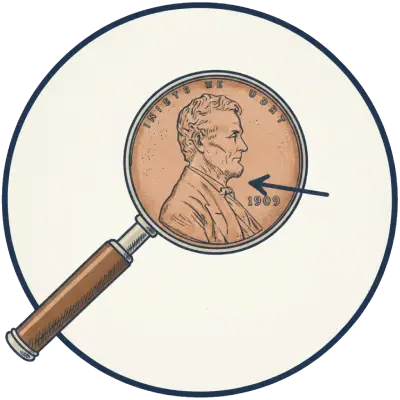

You’ve probably heard about the valuable 1909 VDB and 1909-S VDB pennies.
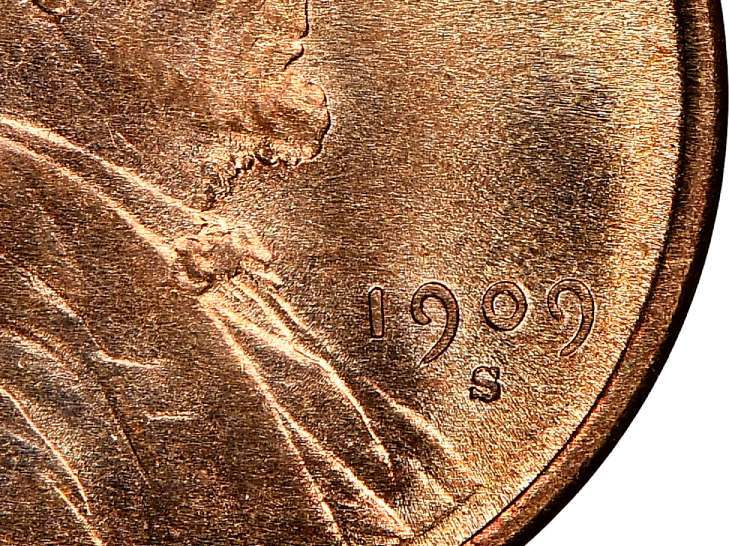
You probably know that the “S” is the mintmark (meaning it was struck at the San Francisco Mint).
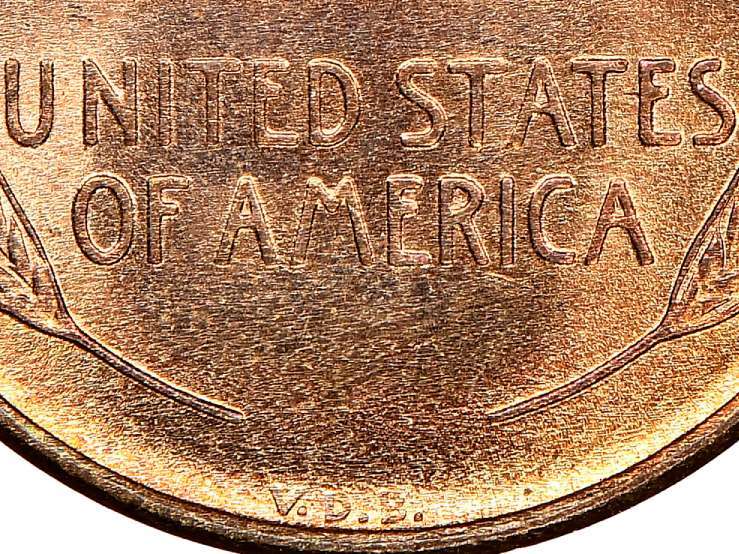
But did you ever wonder what the VDB stood for? V.D.B. actually refers to the designer of the Lincoln cent: Victor David Brenner.
Of course, all 1909 VDB pennies without the “S” mintmark were struck at the Philadelphia Mint.
Following is the story behind the controversial 1909 VDB cents (both, with and without the “S”) — and their designer, Victor David Brenner.
I’ll also be mentioning their current values, and how to spot counterfeits!
How Much Are 1909 VDB Pennies Worth?
What would it cost you to get ahold of a V.D.B. penny?
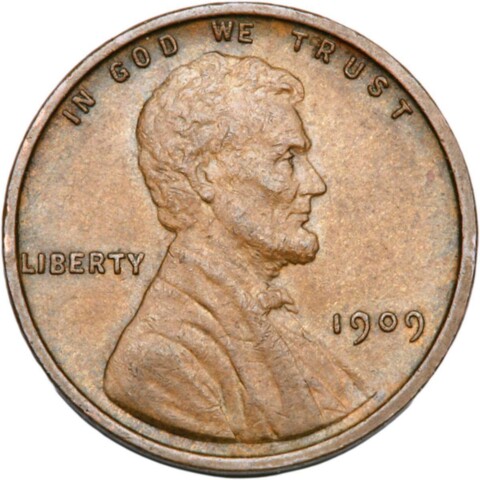
Well, you can actually buy a 1909 VDB penny for as little as $10 to $20!
The Philadelphia Mint produced almost 28 million 1909 pennies with the large V.D.B. on the reverse, and the Philadelphia VDB penny happens to be relatively common.
Even though Philly released 28 million of them, finding one with original mint red (RD) color or a sharp MS65 grade is a major win!
Most of what you’ll dig up in old coin jars will be deep chocolate brown (BN) with heavily smoothed wheat ears — but they’re still a blast to hold!
Here’s what those coin grade abbreviations really mean.
How Much Are 1909-S VDB Pennies Worth?
It’s the San Francisco version of the 1909 VDB penny that is so well known among coin collectors, investors, and the general public. Only 484,000 1909-S VDB pennies were struck at the San Francisco Mint.
While nearly half a million may sound like a large number of pennies… when you consider the great demand for this particular coin, it then becomes no surprise why this coin easily commands $750 and up in well-worn grades.
Buying or selling old coins like the 1909-S VDB penny is quite a business! One that requires lots of skill to do it right and make money in the process without getting burned by fake rare coins.
How To Spot Fake 1909-S VDB Pennies

You can identify authentic 1909-S VDB pennies by the placement of the “S” mint mark.
Authentic 1909-S VDB pennies are classified into 4 distinct “types” — based on the 4 unique obverse working dies used by the San Francisco Mint.
These types are defined strictly by the position and alignment of the “S” mintmark relative to the date digits “1909”.
The 4 Authentic Mintmark Positions On 1909-S VDB Cents
- Position 1 (High “S”) — The mintmark sits very high, with the top of the “S” visibly above the bottom loops of both the first “9” and the “0” of the date.
- Position 2 (Medium-High “S”) — The top of the “S” is roughly flush with the bottom loops of the “9” digits, but the mint mark is positioned horizontally closer to the first “9”.
- Position 3 (Medium-Low “S”) — The top of the “S” is flush with the bottom loops of the “9” digits, but it is shifted horizontally to the right, sitting centered in the space between the first “9” and the “0”.
- Position 4 (Low “S”) — The mintmark is placed at the lowest position, completely below the bottom loop of the “9” digits. It sits to the right, underneath the space between the first “9” and the “0”.
Key Diagnostic Markers On 1909-S VDB Cents
An authentic 1909-S VDB Lincoln cent matching one of those 4 positions must also feature these 3 very specific original die characteristics:
- The “S” Mintmark — Counterfeiters love taking a common 1909 VDB Philadelphia penny and gluing a fake “S” onto it. However, the Mint hand-punched the “S” on working dies for 1909 — meaning it will appear crisp and naturally integrated in the surrounding surface. Genuine “S” punches feature clear, parallel serifs that align vertically in the same direction. Authentic examples also feature a tiny raised metal dot inside the upper curve loop of the “S”. If you notice a tiny seam line running around the base of the letter “S,” you’re looking at an electroplated or glued counterfeit “S” rather than an original San Francisco strike.
- The V.D.B. Initials — The designer’s initials on the reverse at the bottom center feature specific angles. Most importantly, the central crossbar on the letter “B” must slant downward — from left to right. Also, the bottom base of the letter “D” shows a noticeable slant (rather than being perfectly flat or horizontal). Counterfeiters like to take a standard 1909-S penny and try to engrave the initials “V.D.B.” onto the back of the coin. So check the center crossbar of the letter “B” in V.D.B. closely!
- Reverse Die Crack — Many genuine examples of the 1909-S VDB penny feature a subtle, faint vertical die crack running straight through the letter “O” in the word “ONE” on the reverse wheat side. This tiny imperfection occurred when the heavily stressed steel minting die began to fracture under immense pressure during production. Because this specific diagnostic marker is incredibly difficult for counterfeiters to replicate convincingly, its presence serves as a highly sought-after “fingerprint” that helps experts instantly confirm a coin’s absolute authenticity.
The VDB Penny Designer’s Interesting History
Victor David Brenner’s story is as interesting as the coin he later would become famous for designing.
Brenner was born Viktoras Barnauskas on June 12, 1871 in Shavli, Lithuania.
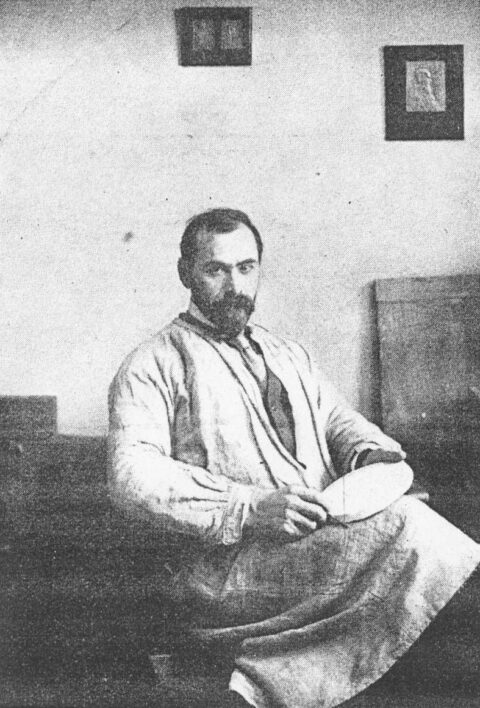
He arrived in America in 1890 as an immigrant and eventually became a New York City jewelry engraver. However, he had long been interested in medals and sculpting, and he pursued opportunities to use his incredible sculpting and engraving skills.
Brenner went to Paris in 1898 and spent his 3 years there studying art. Upon returning to America, he created hubs and dies to make medals, but in 1904 he again returned to Paris.
By 1906, Brenner was back in New York City. In 1907, his fame was growing, and one of his most popular pieces was a plaque of President Abraham Lincoln.
In 1908, President Theodore Roosevelt chose Brenner to design a medal commemorating the Panama Canal. With the death of the famous artist and coin designer Augustus Saint-Gaudens in 1907, the U.S. Mint was looking for new designers to take over the work that Saint-Gaudens was slated to complete. President Roosevelt and the U.S. Mint knew who to contact when it came time to redesign the penny for the commemoration of the centennial of Lincoln’s birth: Victor David Brenner.
That very popular Lincoln plaque that Brenner designed a couple years earlier was a significant model that Brenner used for designing the new Lincoln cent. On August 2, 1909, the Lincoln cent was released to the public, to much fanfare.
However, there were some complaints about the prominence of Brenner’s initials (V.D.B.) on the back of the Lincoln cent. The initials are located under the wheat stalks.
The U.S. Mint responded to the criticism by removing the initials. Thus, the result is some 1909 Lincoln cents bear the V.D.B. initials, and others do not.
In 1918, the U.S. Mint restored Brenner’s initials to the Lincoln cent, but this time in a more discreet fashion — tiny initials under Lincoln’s shoulder on the obverse.
Whatever happened to Brenner? The Lincoln cent would be the only circulating U.S. coin he would ever get to design, though he did try multiple times to obtain other U.S. coin designing duties. He continued his work as a renowned artist and sculptor.
Brenner passed away on April 4, 1924, but his famous Lincoln cent is a lasting tribute that lives on.
More About 1909 Pennies
Your Turn…
Have you been lucky enough to pull a genuine 1909-S VDB straight out of an old estate collection? Or are you still searching bank rolls hoping to cross a common Philly VDB off your bucket list?
Drop a comment below and tell me how your luck has been with the 1909 VDB penny!
If you think you’ve found a “slanted-B” or want me to check out the mintmark placement on your coin, snap a clean, close-up macro shot and share it in the comments.


Leave a Comment