






This post may contain affiliate links. If you buy thru these links, we may earn a commission at no additional cost to you.
Price guides are an essential part of coin collecting — whether you’re a beginner or an expert.
Not only do they provide current prices for all of your U.S. coins, but they’re also loaded with tons of useful information about coins.
Where do you think I learned everything I know today?
Only half of what I know came through the actual experience of owning coins. The other half is from reading through several price guides, coin books, and articles on coins!
The Top Price Guides For U.S. Coins
Following are some of the differences between the most popular U.S. coin price guides.
There are several U.S. coin price guides out there made by different companies, however only a handful of them stand out from the rest.
The one I use the most is the Red Book by Whitman Publishing.
Whitman is one of the most popular distributors of coin supplies, and they are frequently referred to by coin dealers as a reliable source of information about U.S. coins and American currency.
Official Red Book Coin Price Guide
The Red Book, published by Whitman, is updated every year.
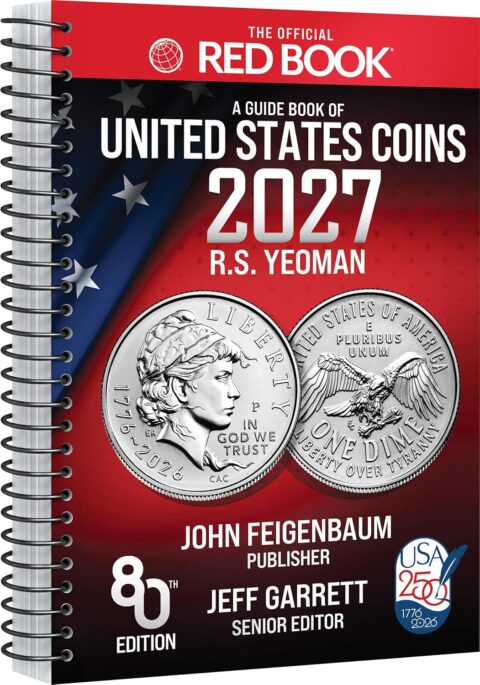
The Red Book provides coin prices as well as hundreds of high-resolution full-color coin photos (including crisp close-ups for detecting errors), clear mintmark location diagrams, exhaustive historical write-ups for every coin series, and explanations of how to grade your coins.
It’s a book that has been trusted by coin collectors for over 8 decades due to its historical data, current prices for all U.S. coins — including:
- Colonial / early American coins and tokens
- Early Mint issues
- Regular Mint issues
- Proofs
- Private, state, and territorial gold
- Silver and gold commemorative issues
The prices represent retail value – the average price you can expect to pay when buying a coin from a coin shop, online dealer, or coin show. Therefore, prices include the dealer’s profit margin, overhead costs, and store markup.
The Red Book price guide is best used when you’re:
- Budgeting for your collection
- Insuring your coins
- Checking if a dealer’s asking price is fair
Official Blue Book Coin Price Guide

There is also a Blue Book, published by Whitman (just like the Red Book).
The difference between the Red Book and the Blue Book is:
- The Red Book shows what you should expect to pay for a coin you’re interested in buying — thus it’s best used as a “buying guide.”
- The Blue Book shows what you should expect to receive if you sell a coin — thus it’s best used as a “selling guide.”
So, if a specific silver coin is listed in the Red Book for $50, you will likely see that exact same coin listed in the Blue Book for around $30 to $35. That $15 to $20 gap represents the standard dealer “profit margin” required to keep a coin shop in business.
The prices in the Blue Book represent wholesale value — the average amount a coin dealer will offer to pay you when they buy coins for their inventory. That’s why this price guide strips out retail markups… so the dealer has room to make a profit when they eventually resell the coin.
The Blue Book price guide is best used when you’re:
- Inheriting a coin collection
- Liquidating your coins
- Getting a realistic baseline of how much cash you can walk away with at a coin shop
Both the Red Book and the Blue Book are published annually and share the exact same coin layouts, historical blurbs, and mintages, but their pricing models serve opposite sides of a coin buying/selling transaction.
As long as you’re aware of the “audience” each book was written for, you can safely use either price guide with confidence!
Why The Official Red Book Coin Price Guide Is Best
In addition to being updated annually, the Red Book comes in a lot of different formats (hardcover, spiral-bound, and large-print editions) that are designed to stand up to heavy use.
Also, the Red Book has full-color photos and a lot more details about the coins, compared to other price guides.
Some of the details that I find most helpful in the Red Book are:
- The location of mint marks on each coin
- Close-up pictures of doubled die coins
- Close-up pictures of errors on coins
- A detailed history of the coins
- Much more!
After 80 years of publication, the Red Book remains the undisputed “Bible” of the coin collecting hobby.
For all of those reasons, I find myself using the Red Book practically every single day.
Which Red Book Format Is Best?
The Red Book is available in a number of premium, durable book options — including hardcover, spiral-bound, and large-print editions.
Spiral bound is arguably the best format — simply because the book is easier to work with. The spiral binding allows the book to lay completely flat on your desk or table. This keeps your hands completely free to hold a magnifying glass and examine a coin while you read the specific diagnostic text about that coin.
While advanced versions of the Red Book exist (“professional edition” and “mega red deluxe edition“), the standard “regular” edition is specifically designed for beginners.
Why? Because it teaches you the fundamentals without overwhelming you with institutional data! It strikes the perfect balance for anyone getting started in coin collecting for these 2 reasons:
- It includes crucial beginner tutorials. Unlike the “professional” versions that strip out basic content to make room for dealer data, the “regular” edition includes important introductory chapters. It teaches you how to handle coins safely, how the 70-point Sheldon grading scale works, and how to identify mintmarks.
- It focuses on the grades of coins you will actually find. New collectors will mostly be looking at coins in “circulated” or “standard uncirculated” grades. The regular edition outlines pricing for these exact, realistic grades. Advanced editions focus heavily on registry-set qualities (like MS-67 or Proof-69) and niche strike designations that you won’t encounter early in your hobby.
How To Decipher The Codes In U.S. Coin Price Guides
Inside of these coin price guides, you will find abbreviations such as G, VG, F, VF, EF, AU, MS, PF, BU, etc.
You’re probably wondering, “What do these abbreviations mean?”
If you happen to open up one of these books and try to find the price of a coin without reading the front sections first, you may be a little baffled. In short, the abbreviations refer to the grade of a coin (or its “condition”).
Here is what the coin grade abbreviations inside coin price guides mean:
G = Good – Refers to a coin with a grade of Good
VG = Very Good – Refers to a coin with a grade of Very Good
F = Fine – Refers to a coin with a grade of Fine
VF = Very Fine – Refers to a coin with a grade of Very Fine
EF = Extra Fine – Refers to a coin with a grade of Extra Fine
AU = About Uncirculated – Refers to a coin with a grade of About Uncirculated
MS = Mint State – Refers to a coin with a grade of Mint State
PF = Proof – Refers to a Proof coin
BU = Brilliant Uncirculated – Refers to a coin or roll of coins in Brilliant Uncirculated condition
Now, there are several levels to each coin grade. Even if the difference between two of the same coin is only one number and not detectable to the naked eye, the difference in price could be a lot!
For example, coin grades will contain levels such as G-4, VG-8, F-12, VF-20, EF-40, AU-50, MS-60, PF-70 and everything in between.
Of all the coin price guides I’ve explored in my 35+ years of collecting coins, the Red Book tends to be more helpful for beginners when trying to identify the grade of a coin. (However, being able to accurately grade a coin comes mostly from experience and a keen eye.)
READ NEXT: Coin Inventory Methods – The Best Ways To Catalog Your Coins


Leave a Comment