

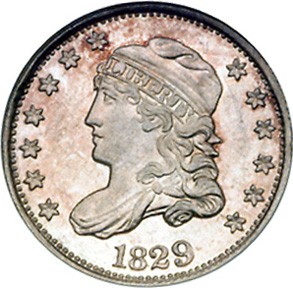
The Capped Bust half dollars may be among the most popular coins of the pre-Seated Liberty coinage era.
Struck from 1807 to 1839, Capped Bust half dollars are large silver coins with a classic design.
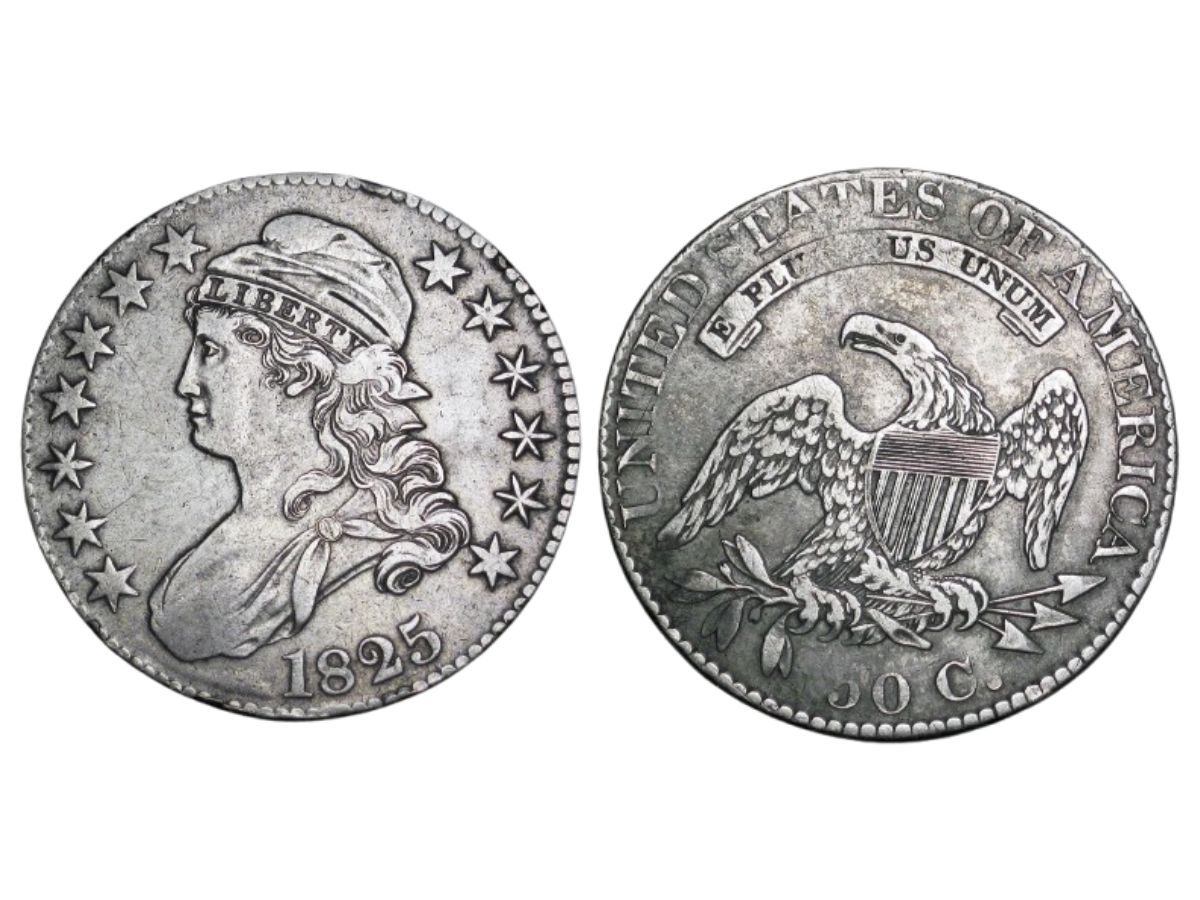
Designed by John Reich, a German immigrant who became a very important coin designer for the United States Mint, Capped Bust half dollars feature:
- an obverse image of Miss Liberty wearing a cloth cap bearing the word “LIBERTY”
- a reverse image of a large eagle
The Capped Bust Half Dollar Design
Capped Bust half dollars are a significant design modification over the Draped Bust half dollars of the late 1790s and early 1800s (from 1796 through 1807, to be exact).
Though both kinds of half dollars show side-profile images of Miss Liberty.
Here are the differences:
- The Capped Bust design features the word LIBERTY on the representative figure of Liberty herself.
- The Capped Bust design shows Miss Liberty facing left (versus right for the Draped Bust design).
- Miss Liberty’s hair on the Capped Bust design is curlier than the hair on the Draped Bust design.
3 Types Of Capped Bust Half Dollars
The Capped Bust half dollar design has 3 distinct “types”:
- Type I (1807 to 1836) – Lettered edge says “FIFTY CENTS OR HALF A DOLLAR”, 32.5 mm size
- Type II (1836 to 1837) – Reeded edge with “50 CENTS” on the reverse, 30 mm size
- Type III (1838 to 1839) – Reeded edge with “HALF DOL.” on the reverse, 30 mm size
By the way, the reeded edge design of 1836 through 1839 Capped Bust half dollars has the same ridges on the edge as seen on our modern half dollar.
It’s possible to divide the Capped Bust half dollar into further categories — especially if accounting for the slight variations in lettered edge characters:
- From 1807 to 1814, the lettered edge says “FIFTY CENTS OR HALF A DOLLAR.”
- From 1814 to 1831, a star is added between the words “DOLLAR” and “FIFTY” (to divide the end and beginning of the phrase if being read on the edge of the coin from left to right).
- From 1832 to 1836, vertical lines are found between each of the words.
Tips For Collecting Capped Bust Half Dollars
Capped Bust half dollars are a common inclusion in a 19th-century type set and are commonly collected on their own.
In fact, it’s safe to say Capped Bust half dollars have a bit of a following all their own!
Many coin collectors pursue a collection of nothing but Capped Bust half dollars — however, collecting a date set can be a challenge, as many dates are hard to find.
One of the peculiarities of the Capped Bust half dollar series is the large number of varieties found. Virtually every date has at least a couple (and often many more) known variations in the shape of letters or numerals and other minor aspects of the design itself. Some of these varieties can be very expensive and difficult to obtain.
The New Orleans mint (“O” mintmark) is the only branch mint that produced Capped Bust half dollars.
Back in the day, Capped Bust half dollars represented a significant portion of a person’s daily wages.
While half dollars did circulate in pocket change, many of them were traded between banks. Therefore, a large number of early half dollars didn’t see much circulation. This accounts for the fact that it’s still possible to find some Capped Bust half dollar specimens in high grades, including uncirculated grade.
How Much Are Capped Bust Half Dollars Worth?
The price of a typical, well-worn Capped Bust half dollar is anywhere from about $60 to $150.
Uncirculated Capped Bust half dollars have values of around $1,200 and up.
Here’s a look at some of the scarcer dates and their values:
- 1807 “Bearded” Liberty – $4,000+
- 1812 over 1 with large 8 – $2,500+
- 1817 over 4 – $150,000+
- 1830 with large lettering – $1,500+
- 1836 with reeded edge and “50 CENTS” on the reverse – $1,500+
- 1839 with small letters on the reverse – $15,000+
*Values are for Capped Bust half dollars in Good-4 grade.
Leave a Comment