


Rare U.S. Dimes List
Rare dimes are valuable collectibles that many coin collectors hope to find.
Of course, finding rare dimes is easier said than done… let me tell you!
I’ve actually managed to find some 90% silver dimes, a few minor error dimes, and the like. However, I’m still looking for some truly rare and valuable dimes.
Maybe you’ll have better luck than I’ve had so far!
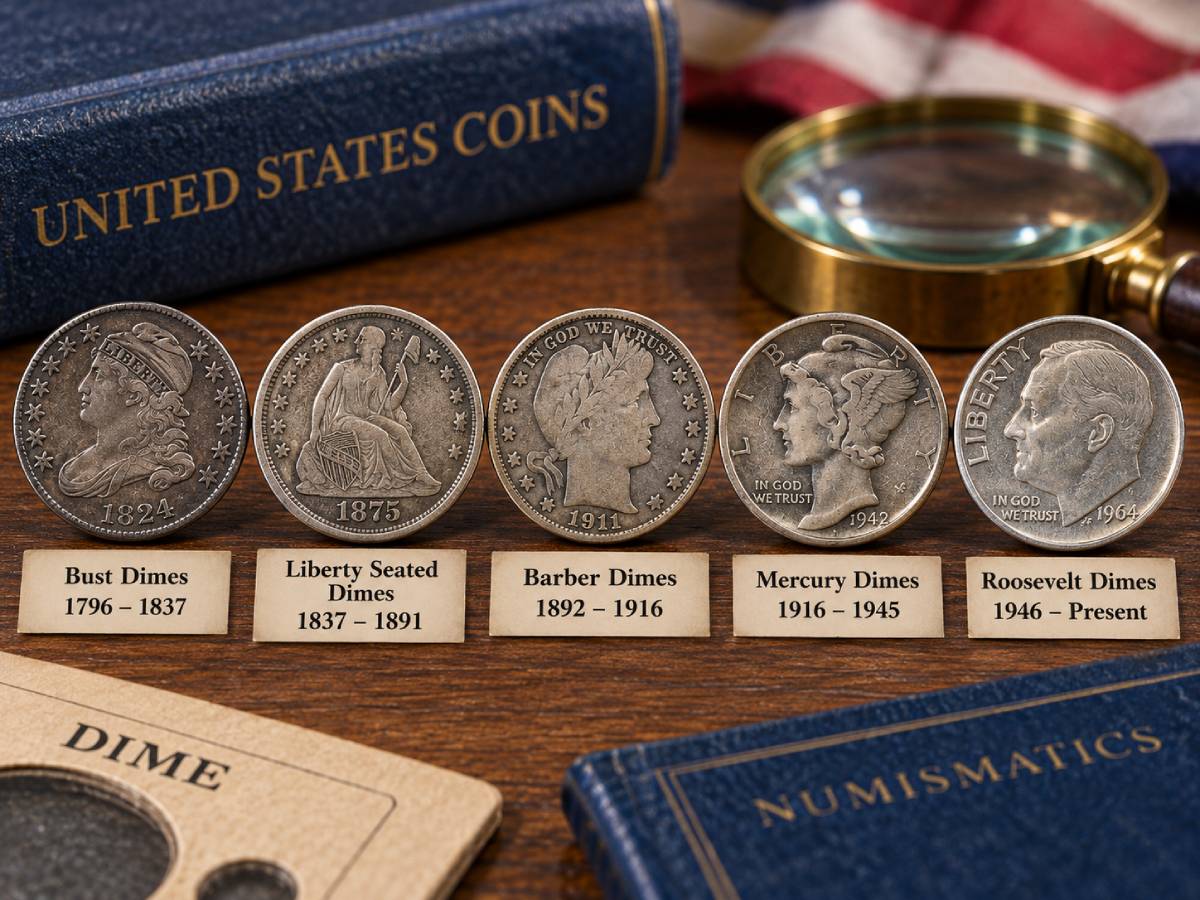
In this article, you will find:
- Rare Roosevelt dimes from 1946 to the present
- Rare Mercury dimes from 1916 to 1945
- Rare Barber dimes from 1892 to 1916
- Rare Liberty Seated dimes from 1837 to 1891
- Rare Bust dimes from 1796 to 1837
First, here’s my video about scarce and rare dimes that you might find in pocket change:
What Are The Rarest Dimes By Year?
OK, are you ready to start searching for the really rare dimes — those that are worth $100 or more in Good condition or better?
Break out the coin loupe and start checking your change!
Here’s a list of rare dimes by year, and their current value…
Rare Bust Dimes (1796-1837)
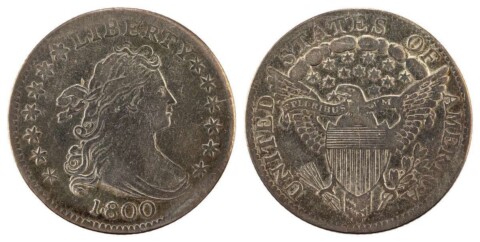
- All Draped Bust dimes (made before 1809) — $750+
- 1809 Capped Bust dime — $800+
- 1811, 11 Over 09 Capped Bust dime — $200+
- 1814 STATESOFAMERICA Capped Bust dime — $250+
- 1820 STATESOFAMERICA Capped Bust dime — $200+
- 1822 Capped Bust dime — $2,000+
- 1824, 4 Over 2, Pointed 1 — $350+
- 1827 Flat Top 1 in 10C. Capped Bust dime — $200+
- 1828 Large Date, Curl Base 2 — $110+
- 1829 Curl Base 2 Capped Bust dime — $5,000+
Something to think about when you’re looking at these early dates: Draped Bust and early Capped Bust dimes were struck before the Mint started using a closed mechanical collar to keep the coin perfectly round during production. That means you’re going to see completely natural variations in diameter and edge thickness between two coins of the exact same year. Don’t mistake a slightly wide or out-of-round edge for a modern error or a fake. Back then, the planchets rolled through an open coin rimming machine before they even hit the coining press, and this effectively made each early specimen structurally unique!
Rare Liberty Seated Dimes (1837-1891)
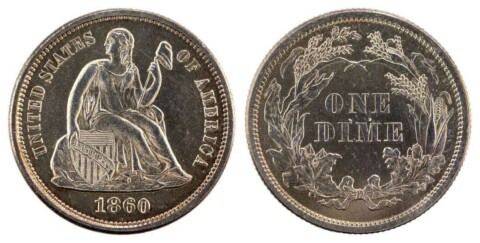
- 1838-O Liberty Seated dime — $100+
- 1843-O Liberty Seated dime — $150+
- 1844 Liberty Seated dime — $150+
- 1846 Liberty Seated dime — $175+
- 1856-S Liberty Seated dime — $250+
- 1858-S Liberty Seated dime — $150+
- 1859-S Liberty Seated dime — $250+
- 1859, Obverse of 1859 with Stars, Reverse of 1860 Liberty Seated dime — $5,000+
- 1860-O Liberty Seated dime — $500+
- 1861-S Liberty Seated dime — $150+
- 1862-S Liberty Seated dime — $150+
- 1863 Liberty Seated dime — $650+
- 1864 Liberty Seated dime — $300+
- 1865 Liberty Seated dime — $400+
- 1866 Liberty Seated dime — $700+
- 1867 Liberty Seated dime — $550+
- 1870-S Liberty Seated dime — $200+
- 1871-CC Liberty Seated dime — $2,500+
- 1872-CC Liberty Seated dime — $1,300+
- 1873-CC Liberty Seated dime — $1,500,000+
- 1873 doubled die Liberty Seated dime — $500+
- 1873-CC Liberty Seated dime — $2,800+
- 1874-CC Liberty Seated dime — $7,500+
- 1878-CC Liberty Seated dime — $150+
- 1879 Liberty Seated dime — $175+
- 1880 Liberty Seated dime — $135+
- 1881 Liberty Seated dime — $150+
- 1885-S Liberty Seated dime — $500+
When searching through mid-1800s dates, look for the arrow varieties: Pay close attention to the years 1853 through 1855, and again from 1873 to 1874. The Mint placed little arrows on both sides of the date numerals during those specific years to denote weight changes for the dime. In the 1850s, the price of raw silver rose so high that Congress ordered the Mint to reduce the coin’s weight to keep people from melting them down for profit! A minor uptick in weight from 2.49 grams to 2.50 grams led to the arrows returning to the dime for a short period in the mid-1870s. The arrows served as a temporary visual cue to notify the public and bank tellers that they were handling a dime with a modified silver weight standard.
Rare Barber Dimes (1892-1916)
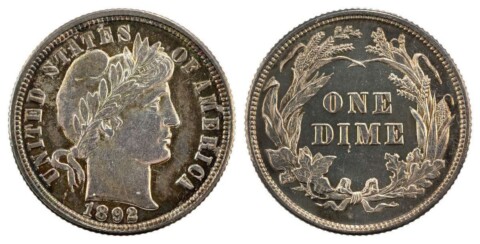
- 1893 3 Over 2 Barber dime — $135+
- 1894-S Barber dime — $1,000,000+
- 1895-O Barber dime — $400+
The truth about grading Charles Barber’s 19th-century coinage: His Liberty portrait on the dime featured a high-profile headband that stood out as one of the highest points on the coin. Because of that design, Lady Liberty’s brow took the brunt of the wear in everyday pocket change. When you’re attempting to separate generic junk-silver pieces from high-premium survivors, look at the word “LIBERTY” cut into that headband. On heavily circulated examples, those letters are among the very first details to wear flat. Finding an early date with a crisp, fully readable inscription is tough — so if you spot all 7 letters clearly, you’re holding a winner.
Rare Mercury Dimes (1916-1945)
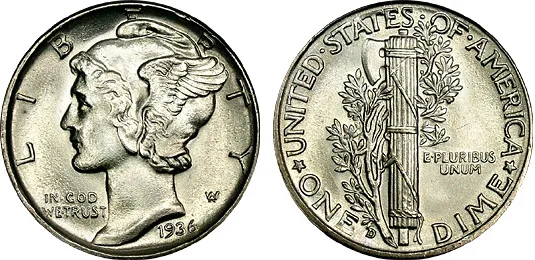
- 1916-D Mercury dime — $1,200+
- 1942, 42 Over 41 Mercury dime — $300+
- 1942-D, 42 Over 41 Mercury dime — $350+
A helpful tip when you’re looking at these old dimes: When trying to figure out if you’ve landed a premium strike versus a standard circulated coin, you’ll want to flip the Mercury dime over and examine the reverse. Focus your coin loupe on the horizontal binding bands that hold the center of the fasces bundle (the bundle of wooden rods tied tightly around an ax) together. Advanced collectors hunt for the Full Bands (FB) designation — meaning those individual twin straps are completely separated by a clean, deep split with absolutely zero blending. Due to die wear and strike pressure, the metal didn’t always flow perfectly around those tiny reverse channels — making a well-struck, fully separated band configuration something of a condition rarity that can instantly send a dime’s value through the roof!
Rare Roosevelt Dimes (1946-present)
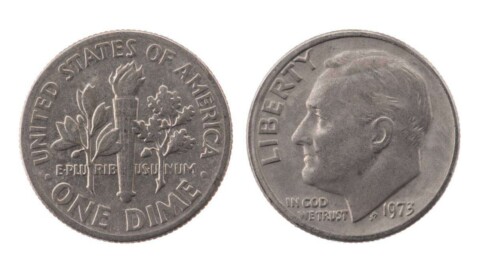
- 1968 No-S Roosevelt dime — $10,000+
- 1970 No-S Roosevelt dime — $500+
- 1975 No-S Roosevelt dime — $500,000+
- 1982 No-P Roosevelt dime — $125+
- 1983 No-S Roosevelt dime — $500+
There’s a major point of confusion regarding modern “No-S” dime errors: You’ll see these coins listed online for massive premiums, but you have to check how the coin was originally packaged. The U.S. Mint didn’t accidentally let a normal, business-strike dime sneak out of the San Francisco coining hoppers into bank boxes destined for circulation. These legendary transitional mistakes happened strictly inside the specialized proof sets and occurred because Mint workers forgot to stamp the “S” onto the proof dies before production began. So, if you find a standard scratched-up clad dime without a mintmark, it’s just a common Philadelphia pocket survivor — not a high-dollar “No-S” proof rarity!
Tips To Help You Find Rare Dimes
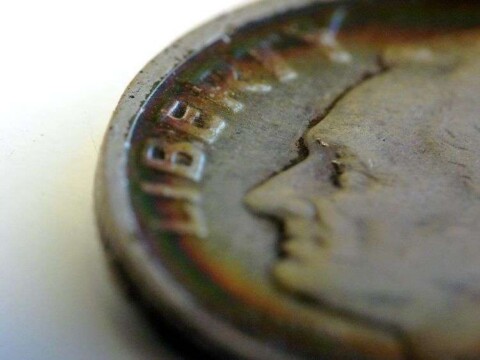
A lot of us are looking for coins in our pocket change, and that’s a great way to start your search for the great rarities. But that’s not the only place to find dimes that are rare!
- Check rolls of dimes for old and valuable pieces — You can buy a roll of dimes from any bank or financial institution for $5 (the face value of the 50 dimes in the roll). Searching through coin rolls is how I’ve found many scarce and valuable coins!
- Search the reject bins of CoinStar machines — These devices which convert loose change into cash (or cash vouchers) are found in grocery stores, big-box retail chains, and other places. They have provided jackpots for many keen-eyed collectors.
- Don’t forget your local coin dealer — You can cherrypick some excellent finds at a coin shop — because, sometimes, rare coins are hiding in plain sight! That’s especially the case with less-obvious rare coins, like some of the obscure Liberty Seated dime varieties.
- Look through old proof sets for the no-S dimes — You really don’t stand a good chance of finding these in pocket change, but you have a legit hope of finding them after combing through bunches of old proof sets. You’ll find bins of these at coin shops and flea markets… even at yard sales and estate sales.


Leave a Comment