




Where are all the 1975 quarters?
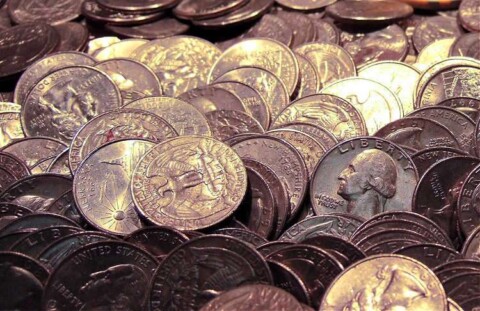
It’s a question so many people ask when they’re searching through their pocket change.
Why can’t anyone find a 1975 quarter dollar?
Did the U.S. Mint make quarters dated 1975? If so, how many 1975 quarters were made to begin with? Was it so few that there just aren’t any 1975 U.S. quarters left?
Are 1975 quarters worth a lot more than face value and, thus, the reason why you can’t find them? Because everybody removed them from circulation?
The Case Of The Missing 1975 Quarter
The absence of the 1975 U.S. quarter isn’t apparent to new collectors at first.
In most cases, those who collect quarters start looking for them in pocket change — pulling quarters, one by one, as the dates they need turn up.
These collectors are generally oblivious to there being no 1975-dated quarter… at first. Then, they start realizing that they can’t seem to find any 1975 quarters in their spare change. It happens to be the only date missing from their collection of other quarters from the 1970s.
Hmm…
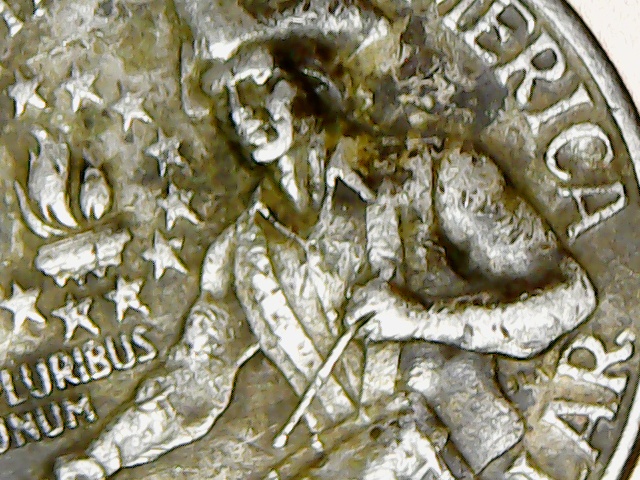
In some cases, these collectors will have already found a 1976 Bicentennial quarter. Bicentennial quarters were struck to commemorate the 200th anniversary of the signing of the Declaration of Independence. They bear a special 1776-1976 dual date feature on the obverse (head’s side) with colonial drummer boy design on the reverse (tail’s side).
Collectors will also invariably find a 1974 quarter and a 1977 quarter. A whopping 1.1 billion quarters were struck at the Philadelphia and Denver Mints (combined) in 1974, with those two mints striking another cumulative 725 million quarters in 1977.
But the 1975 quarter… how many of those were made? And how much is a 1975 quarter worth?
Here’s Why The 1975 Quarter Isn’t Worth Looking For
I’ve got news for you… 1975 quarters do not exist.
That’s right, there is no U.S. quarter dated 1975.
Why not?
Because in 1975, the United States Mint was striking the Washington quarter with the 1776-1976 date!
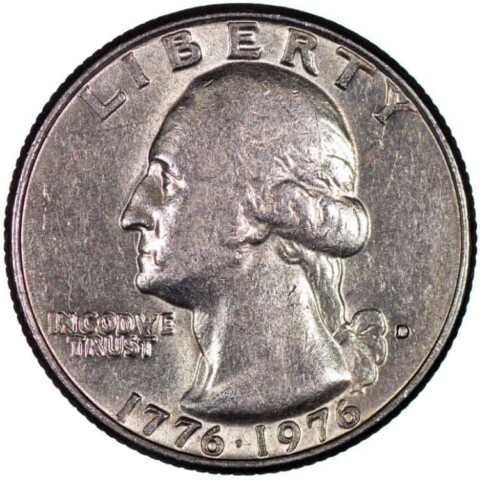
You see, United States Bicentennial coins were approved by Congress in 1973. And the provisions of the bill permitted the U.S. Mint to strike quarters, half dollars, and dollar coins with the 1776-1976 date and special commemorative designs after July 4, 1975 and prior to January 1, 1977.
OK, so the U.S. Mint could strike 1975 quarters, half dollars, and dollar coins from January 1, 1975 through July 4, 1975. Why didn’t they?
There were concerns that the U.S. Mint would not have enough time to strike 1975-dated quarters, half dollars, and dollars in plentiful quantities if given basically just the first half of 1975 to produce them. This limited production could have made those coins scarce and likely for removal from circulation by collectors. (There was a big concern for the nation’s supply of quarters — which the U.S. Mint was trying to increase at the time.)
So, U.S. Mint officials lobbied Congress to fix the law that would require them to produce 1975-dated quarters (and half dollars and dollar coins) during the first half of that year. And a measure was signed by President Gerald Ford permitting the U.S. Mint to continue producing quarters, half dollars, and dollar coins bearing the 1974 date until the beginning of Bicentennial coin production after July 4, 1975.
Is There A Way To Tell 1776-1976 Quarters Struck In 1975 Apart From Those Made In 1976?
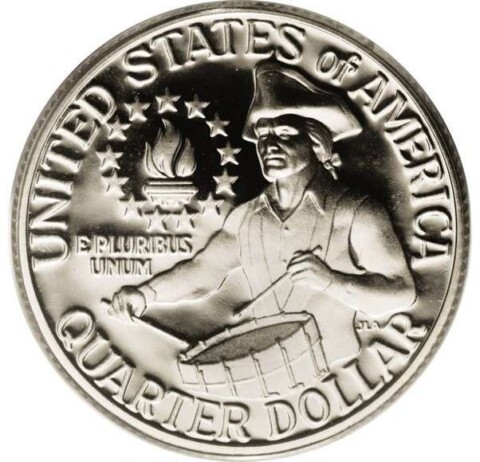
The short answer is NO.
There is no way to tell 1776-1976 Bicentennial quarters produced in 1975 apart from those that were struck in 1976.
In all, the U.S. Mint made more than 1.6 billion Bicentennial quarters between the Philadelphia and Denver Mints — and beyond the “D” mintmark on the quarters hailing from Denver, these coins are virtually indistinguishable in any other way.
In other words, the only quarters you need to fill the gap between those bearing the 1974 date and 1977 date are Bicentennial quarters.
How Much Is A 1976 Bicentennial Quarter Worth?
A lot of people get excited when they find a 1776-1976 Bicentennial quarter in circulation.
At first, some folks think they’ve found a really old 1776 quarter. But this is impossible — because the U.S. Mint didn’t even begin making quarters until a generation later, in 1796. And those early U.S. quarters look nothing like the Washington quarters of today.
So, should you keep every 1976 Bicentennial quarter you find? Are they worth keeping at all?
How much is a Bicentennial quarter worth? Is a 1776-1976 Bicentennial quarter worth anything above face value?
Here’s the scoop on today’s 1976 Bicentennial quarter value…
If you find a 1976 Bicentennial quarter in loose change with any wear at all and it has either no mintmark (from the Philadelphia Mint) or a “D” mintmark (from the Denver Mint), it’s worth only face value — 25 cents, nothing more.
Only Bicentennial quarters that come from the San Francisco Mint (with an “S” mintmark) OR are uncirculated are worth more than face value:
- A typical uncirculated 1776-1976 Bicentennial quarter with either no mintmark or the “D” mintmark is worth between 40 cents to $1.25.
- A proof 1976-S Bicentennial quarter with copper-nickel clad composition (these have an orange stripe around the edge of the coin) are usually worth $1.25 to $2.50.
- And a 40% silver 1976-S Bicentennial quarter (these don’t have any orange stripe around the edge) are generally worth $3 to $5 in uncirculated or proof condition.
Yes, Old Washington Quarters Are Still Worth Collecting!
While you can’t find any Washington quarters with the 1975 date and you probably won’t get rich saving 1976 Bicentennial quarters, this doesn’t mean building a collection of U.S. quarters from pocket change isn’t worth the effort.
If you like collecting old Washington quarters from circulation, you are likely to find many interesting things in your loose change:
- Washington quarters have been made since 1932. For the first 3 decades, they were made from a 90% silver composition.
- Since 1965, U.S. quarters have been made from a copper-nickel clad format.
- With the exception of the colonial drummer boy design in 1975 and 1976, the heraldic eagle design was used on the reverse of all U.S. quarters from 1932 through 1998.
- Since 1999, the U.S. Mint has been striking the Washington quarter with various commemorative designs honoring different states, landmarks, people, places, and things.
Here’s a good summary of the value of U.S. quarters:
- Several dates are getting tough to find (even among the clad quarters) — which makes their value increase.
- All Washington quarters made before 1965 contain a 90% silver composition and are worth much more than their face value.
- Washington quarters from 1982 and 1983 are becoming more valuable — especially in really nice condition.
- Also, there are many U.S. quarter errors to look for — including the 1965 silver Washington quarter worth thousands of dollars and the rare 1970 Washington quarter error struck on a Canadian quarter!
The key takeaway here?…
Washington quarters are worth collecting, and many have values worth a lot more than just 25 cents. If you know what to look for, you can score big bucks. Good luck!





Leave a Comment