

Start Here

Values

Buying & Selling

Rare U.S. Coins

How To's

Myths & History

The Ultimate Guide To Bicentennial Coin Values & Errors (1776-1976)

by Joshua McMorrow-Hernandez

More than 20 years before the 50 State Quarters and 30 years before the Presidential Dollar series, the United States had a circulating commemorative coin program that lasted 2 years and proved popular among the masses.

The Bicentennial coin designs appeared on U.S. circulating quarters, half-dollars, and dollar coins in made in 1975 and 1976. I’m going to share more about this historic commemorative coin program that remains so popular with American coin collectors.
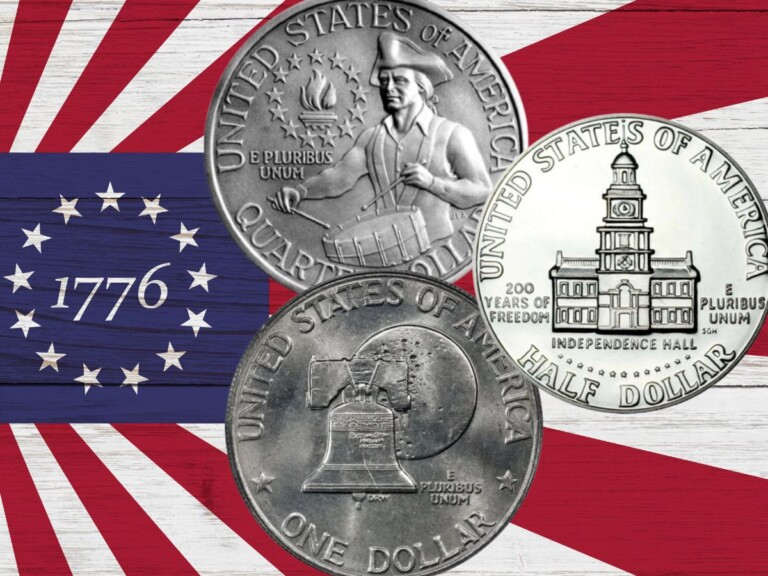
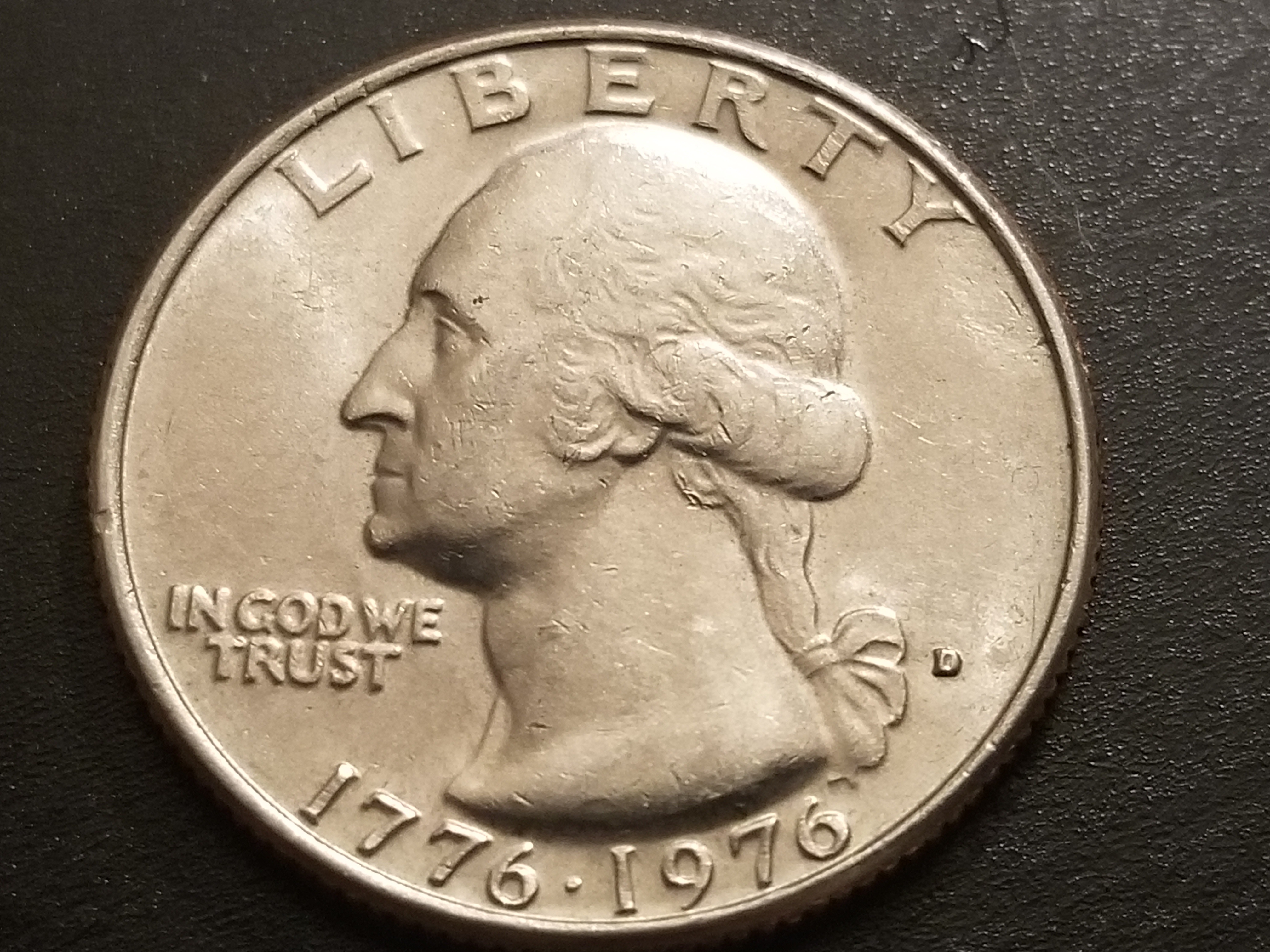
1976 Bicentennial coins (quarters, half-dollar, and dollar coin)

History Of Bicentennial Coins

In 1970, the United States American Revolution Bicentennial Commission proposed the idea of minting special coins to commemorate our nation’s Bicentennial.

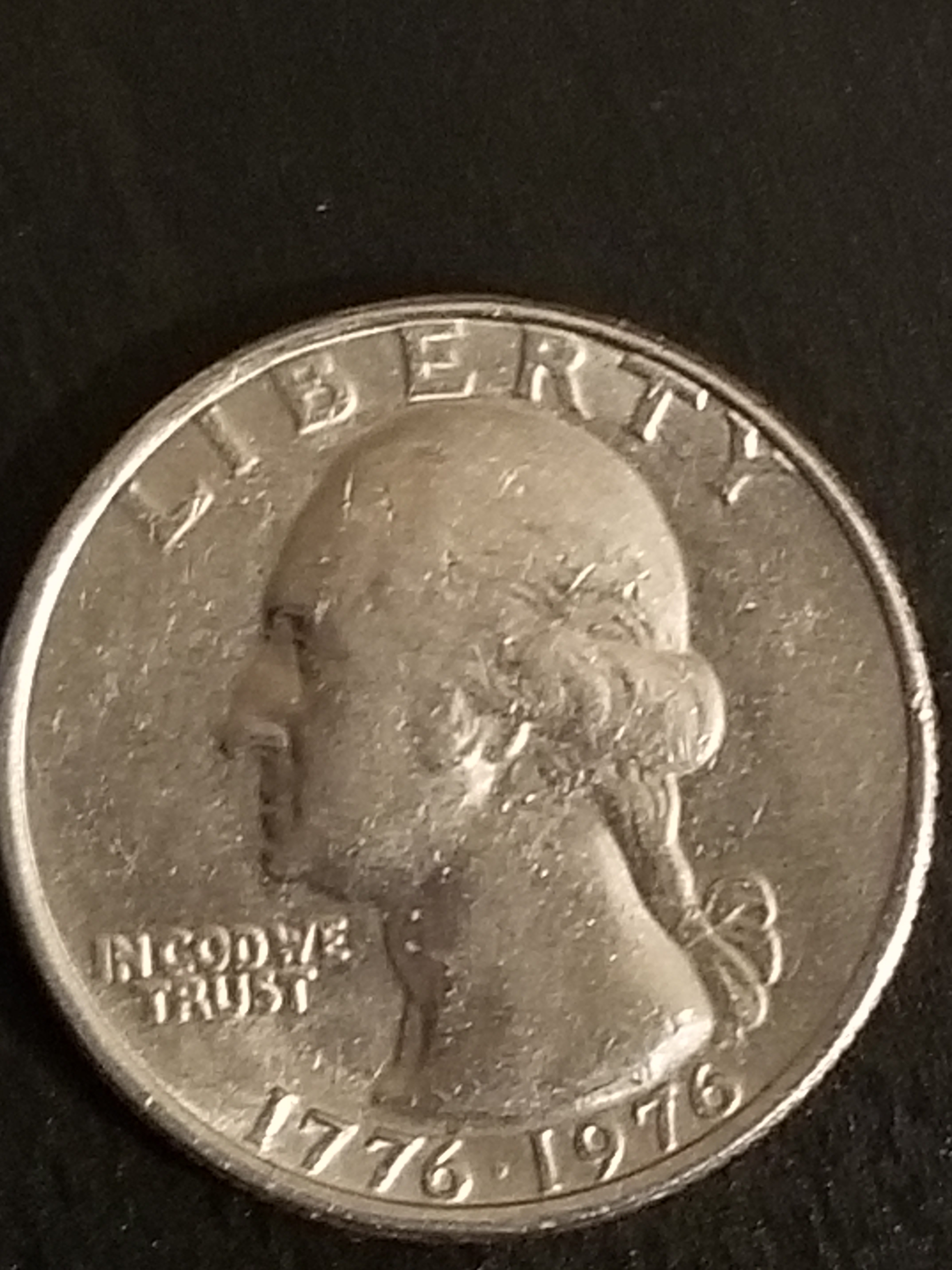
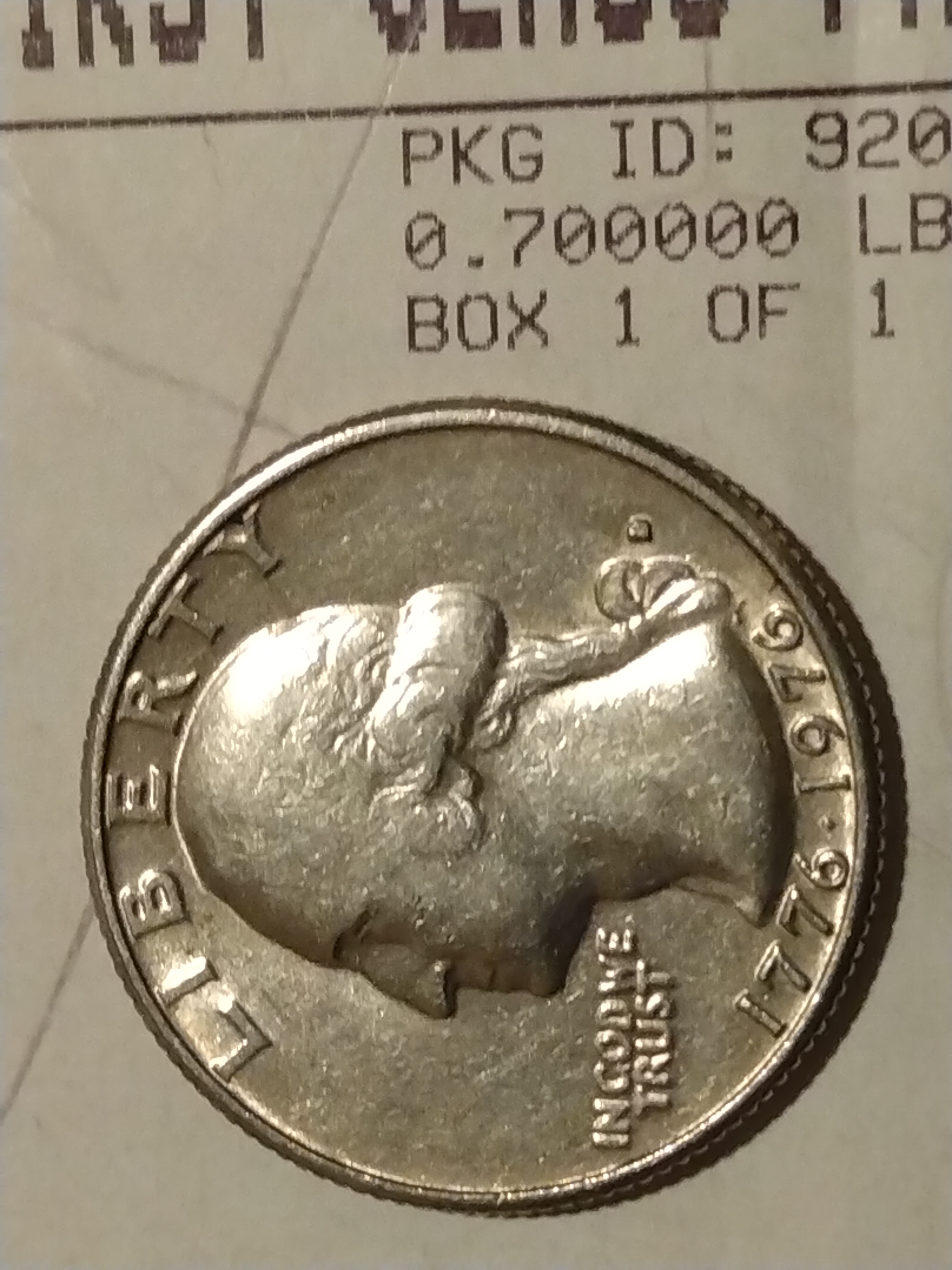
After pitching the idea to President Nixon and deciding to what extent the special commemorative coin program should reach (both in terms of denominations involved and how the coins should be distribute), the House Committee on Banking and Currency proposed on July 24, 1973 that the U.S. should strike double-dated commemoratives (1776-1976) for quarters, half-dollars, and dollar coins.

Furthermore, it was declared that there be an open design competition for a special image on the reverse side of these coins, and that the final designs be ready for release into circulation on July 4, 1975.

By December 1973, when the design contest closed, some 900 designs had been submitted.

In March of 1974, the designs selected were:

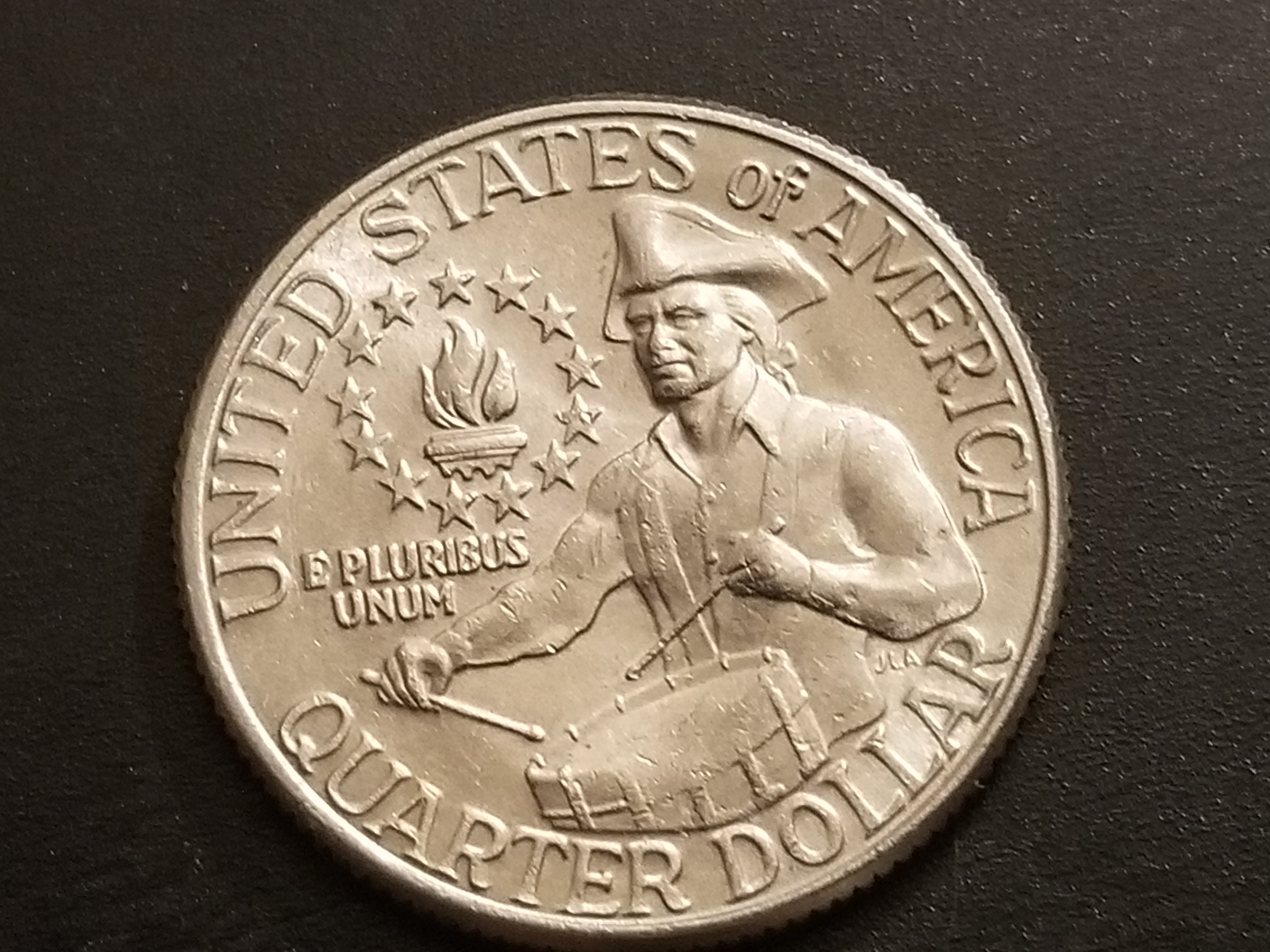
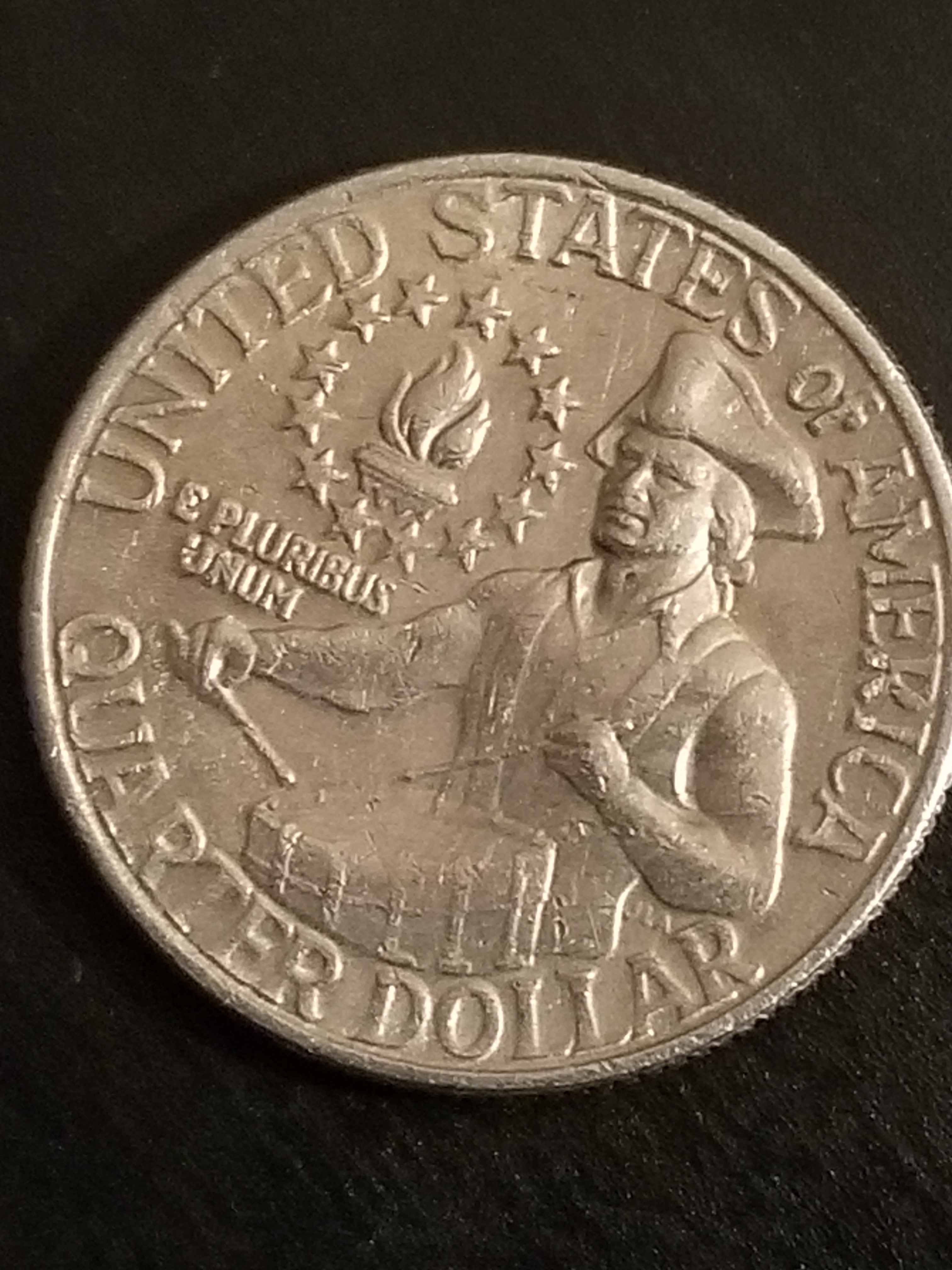
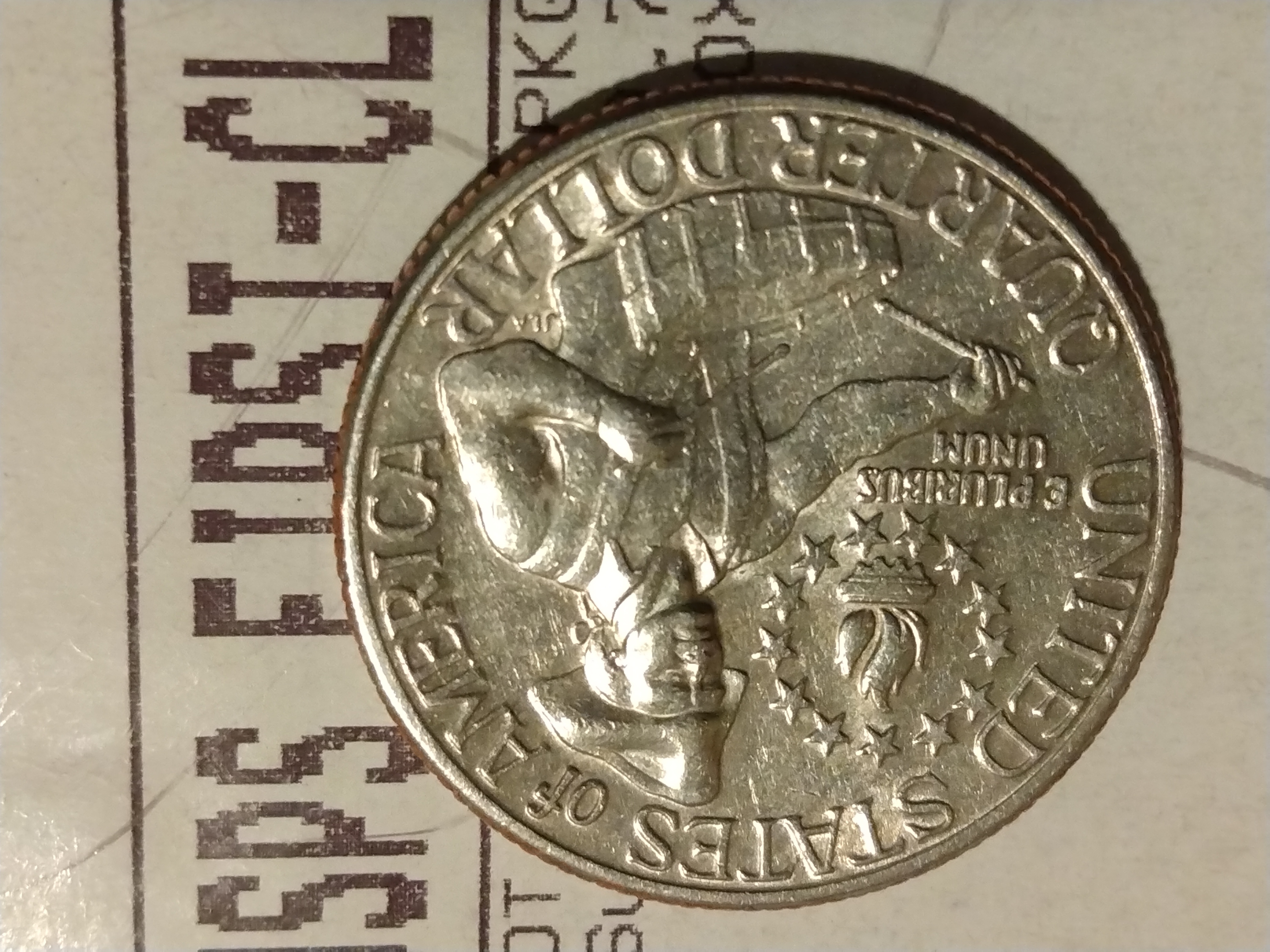
  • Jack L. Ahr’s Revolutionary drummer boy for the quarter
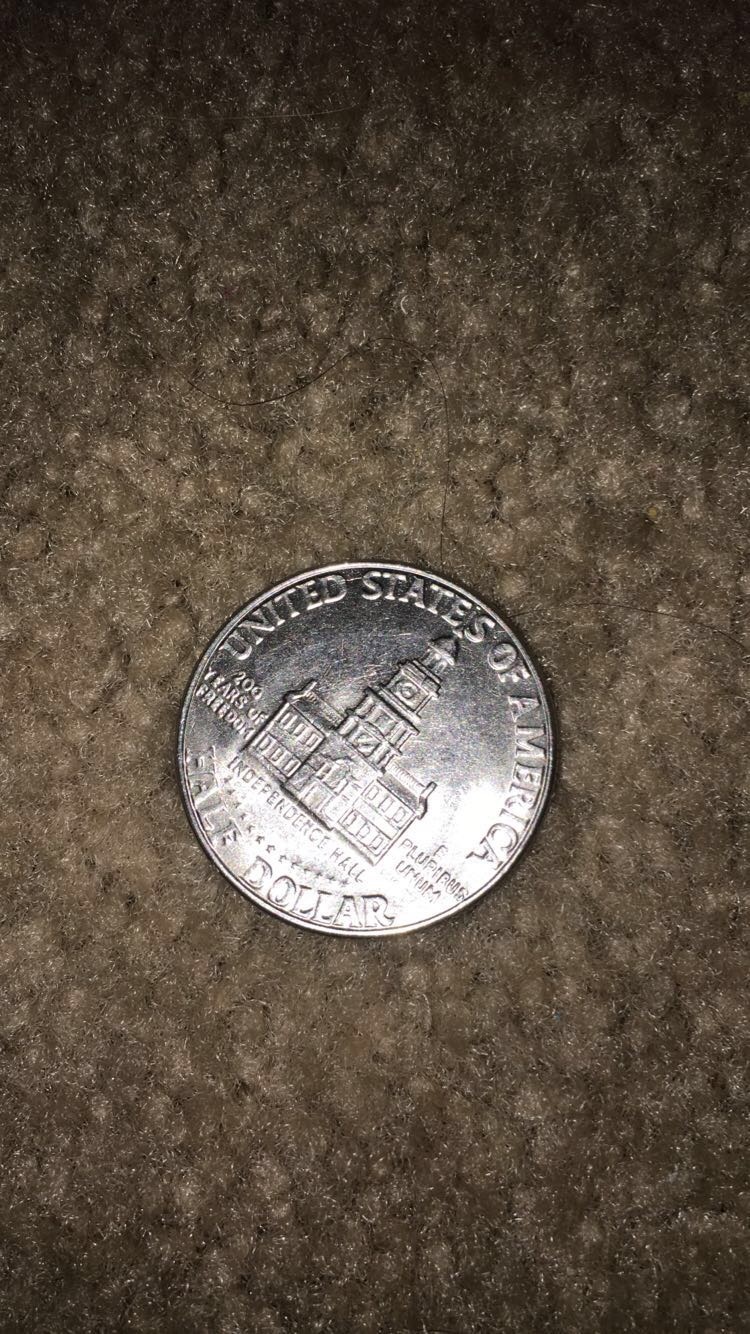
  • Seth Huntington’s rendering of Independence Hall for the half-dollar
  • Dennis Williams’ patriotic image of the Liberty Bell and the moon (on which the U.S. had made several landings from 1969 into the early 1970s) for the dollar coin

How Many Bicentennial Coins Were Minted?

Hundreds of millions of Bicentennial coins were struck during 1975 and 1976 — both in the regular copper-nickel clad composition for circulation and in a 40% silver clad composition for collectors.

The silver Bicentennial coins were sold in mint sets and proof sets. These mint sets and proof sets were first sold in 1975 and remained U.S. Mint offerings into the mid-1980s.

The U.S. Mint ended up melting millions of unsold silver Bicentennial coins!

Bicentennial Coin Varieties

During the 2-year minting of Bicentennial coins, the Philadelphia, Denver, and San Francisco Mints struck uncirculated versions of all 3 denominations. Plus, the San Francisco Mint struck proof versions in both copper-nickel clad and silver.

Making things even more interesting, the U.S. Mint refined the reverse lettering on the Bicentennial dollar coin for 1976. Thus:

  • There exists a “Type I” and a “Type II” Bicentennial dollar in the case of the copper-nickel clad regular strikes and proofs.
  • There is only a “Type I” Bicentennial dollar for the silver clad uncirculated and proof offerings.

The Current Value Of Bicentennial Coins

Generally speaking, all circulated (worn) copper-nickel clad Bicentennial coins are worth face value.

However, I have noticed more and more coin dealers in recent years paying a very small but still-meaningful markup of 5 to 20 cents over face for lightly worn copper-nickel Bicentennial dollars.

Typical uncirculated copper-nickel Bicentennial quarters are usually worth less than 50 cents.

Uncirculated Bicentennial half-dollars are generally worth 75 cents to $1.

Type II uncirculated Bicentennial dollars are worth around $2 to $3.

Type I uncirculated Bicentennial dollars tend to bring in $1 to $5 more than their Type II counterparts.

Bear in mind these price quotes apply only to average-quality coins of the above mentioned grades. You may have exceptional-quality uncirculated coins that would command a premium above the values listed here. Or, your Bicentennial coins may have unsightly imperfections which would lower the value of your coins.

The Current Value Of Bicentennial Sets

Regular 1975 and 1976 mint sets, which contain the 12 regular-strike coins minted in those years (the cent, nickel, dime, quarter, half-dollar, and dollar each from the Philadelphia and Denver Mints) are selling for around $8 to $9.

The San Francisco-produced silver mint sets which sell for around $45 to $60, depending on the quality of the coins.

Regular 1975 and 1976 copper-nickel proof sets sell for $7 to $10.

Silver 1976 proof sets can be found for $40 to $50.

Rare Bicentennial Coin Errors To Look For

The most fascinating, verified Bicentennial quarter error is the legendary “double denomination” error, where 1976 Bicentennial quarters were accidentally struck directly on top of already minted dimes and dollar coins. This includes a spectacular, one-of-a-kind 1976-S Proof quarter mistakenly struck over a 1967 Roosevelt dime — creating a dual-date coin showing bits of both the 1967 and 1776–1976 dates. This coin sold at auction for thousands of dollars.

With regard to Bicentennial half dollar errors, be sure to look closely at the design details. Since the Mint was hammering these out as fast as humanly possible to keep up with the public demand, heavy mechanical grease, metal shavings, and debris would frequently pack tightly inside the tiny crevices of the steel coin dies. When the die slammed down onto the half dollar blank, that compressed gunk physically blocked the metal from flowing. On the best “struck-through grease” varieties of the 1976 half dollar, you will find copies where parts of the date “1776-1976” or the words “IN GOD WE TRUST” are completely invisible (or look like ghostly phantom shapes). So you’ll want to check the surface texture under a light: if the missing letters are totally smooth and flat, it’s a real Mint error. If the area looks scratched or gouged, someone just scraped it off in their garage.

If you’ve got a Bicentennial dollar coin, you aren’t looking for a Mint mistake — you’re looking for a total design pivot that collectors love! As I said above, when the Mint first started punching out these giant dollars in 1975, they used what we call Type 1 lettering. Flip your dollar coin to the back and look at the words “UNITED STATES OF AMERICA.” On a Type 1, the letters are wide and blocky. The Mint soon realized the wide font was causing some strike issues and relatively early in production moved toward a more refined, serifed font (serifs are the little feet at the ends of many letters). The presence of the finer lettering indicates a Type 2 dollar. Type 1 Bicentennial dollars are much scarcer than their Type 2 counterparts and therefore carry much stronger premiums in general.

Are Bicentennial Coins Still In Circulation?

While the Bicentennial quarter, half-dollar, and dollar coins were all intended for circulation and did see use in commerce, only the Bicentennial quarters remain in everyday circulation (and even these have been getting harder to find in recent years).

It’s possible to get Bicentennial half dollars and Bicentennial dollars from some banks, but your best bet for finding either the half-dollar or dollar Bicentennial coins will be at your local coin dealer.

If you’re looking to get ahold of uncirculated or proof Bicentennial coins, consider shopping for them via a coin dealer or online. Bicentennials are still highly collectible patriotic commemoratives.

A List Of All U.S. Coins Currently In Circulation

Other U.S. Bicentennial Coins

  • U.S. Congress Bicentennial Coins (1989) — $5 gold coin, $1 silver dollar, and 50-cent half dollar
  • Library of Congress Bicentennial Coins (2000) — $10 coin, $1 silver dollar
  • West Point Bicentennial Coins (2002) — $1 silver dollar coin
  • Lewis & Clark Bicentennial Coins (2004) — $1 silver dollar coin
  • Abraham Lincoln Bicentennial cents (2009) — Log Cabin/Birth-Early Life penny, Formative Years penny, Professional Life penny, Presidency penny

Do you have a 1776-1976 Bicentennial coin? Think there might be something unique about it? Post a photo of your coin in the comments below and I’ll try to help!

PUBLISHED July 16, 2026
UPDATED September 2, 2026

Joshua McMorrow-Hernandez

Numismatic Specialist

Hi, I’m Josh! I’m the Editor here at the US Coins Guide. My love for coins began when I was 11 years old. I primarily collect and study U.S. coins produced during the 20th century.

I’m a member of the American Numismatic Association (ANA) and the Numismatic Literary Guild (NLG). I have won multiple awards from the NLG for my work as a coin journalist. I’m also the editor at the Florida United Numismatists Club (FUN Topics magazine), and author of Images of America: The United States Mint in Philadelphia (a book that explores the colorful history of the Philadelphia Mint). I’ve contributed hundreds of articles for various coin publications including COINage, The Numismatist, Numismatic News, Coin Dealer Newsletter, Coin Values, and CoinWeek.

I’ve authored over 1,000 articles here at the US Coins Guide (many with over 50K shares).

I welcome your coin questions!

59 responses to “The Ultimate Guide To Bicentennial Coin Values & Errors (1776-1976)”

  1.  Avatar
    Anonymous

    denise my name is steven and i have the same coin and have been try verry hard to find out what is up with it

    1.  Avatar
      Anonymous

      Hello, Denise and Steven —

      What you have are novelty pieces. To date, no such coin has been authenticated as a genuine U.S. Mint error.

  2.  Avatar
    Anonymous

    Kate,

    Great point. The lettering on the 1776-1976 dated Eisenhower dollars actually got a little slimmer, and serifs (little feet) were added to the ends of the letters.

    The lettering remained unchanged for the Bicentennial quarters and half dollars.

  3. Dutch Avatar
    Dutch

    I have been asking about my 1976 bicentennial Half dallor, with no mintmark . I understand 234,308,000 were struck with mintmarks .Four three-piece sets (Quarter Dollar, Half Dollar, and Dollar) were struck as Proofs but without mintmarks. One set went to then-President Gerald Ford, another to the American Revolution Bicentennial Commission administrator, John W. Warner, another to Treasury Secretary William E. Simon, and the other to Gerald Ford’s appointment secretary, Anne L. Armstrong. Did some one brake up a set or am I looking at a different coin … What would one of those be worth ?

    1.  Avatar
      Anonymous

      Hi, Dutch —

      The mintage number you give — 234,308,000 — refers to the number of Philadelphia Bicentennial half dollars. In fact, these contain no mintmark, because half dollars made in Philadelphia before 1980 didn’t contain mintmarks. The coin you have is therefore a regular-issue 1976-dated Kennedy half dollar. As for value, if it’s been worn, it’s worth only face value. If it has no wear, it’s value is 75 cents to $1.

      Incidentally, there were 287,565,248 1976-dated Kennedy halves with D mintmarks, and about 22,000,000 with S mintmarks.

  4. Fred Avatar
    Fred

    Hello, My question is this coin iam looking at had date on the top side 1776 and bottom 1976.On the side of the dates there is an american eagel between two american flages.On the other side u shapes symbol with a circle and a cross inside the circle.It looks to be copper or glod plated. Do you know the worth?

    1.  Avatar
      Anonymous

      Thanks for your question, Fred —

      I would have to see the coin to give you a better idea of its exact value, but it sounds like from your description that it’s a bronze medal. Bicentennial medals were often produced by the thousands. Such pieces tend to be worth $5 to $10.

  5. Khoffman83 Avatar
    Khoffman83

    Have a 1976 Denver mint dollar. Seems the sides were punched a little hard as the indentions come past the edge of the coin. Does this happen often on these coins?

    1.  Avatar
      Anonymous

      Hi, Khoffman —

      Hmm… Do you mean the design looks like it’s hanging off the edge of the coin or the reeded edge (the little lines on the edge of the coin) appear to come up past the rim?

  6. GuestLuis Avatar
    GuestLuis

    i have a bicentennial 1776-1976 quarter the size of a nickel, on the head side it says “copy”, is it worth something?

    1.  Avatar
      Anonymous

      Hi, Luis —

      What you have is simply a replica and is not numismatically valuable.

  7. LS Avatar
    LS

    How do you tell the difference between a proof bicentennial Quarter, Half or Dollar minted in Silver Clad or Nickel Clad?

    1.  Avatar
      Anonymous

      LS,

      Because both copper-nickel clad and silver clad bicentennial proof coins have the ‘S’ mintmark, you’ll have to rely on the color of the coin as well as the weight to determine the two apart.

      Copper-nickel clad coins (including proofs) have a distinctive orange ring around the edge of the coin. Silver clad coins have a grayish ring, or sometimes the ring is barely distinguishable. Also, there is the weight difference:

      40% silver quarter: 5.75 grams
      Copper-nickel quarter: 5.67 grams
      40% silver half dollar: 11.50 grams
      Copper-nickel half-dollar: 11.34 grams
      40% silver dollar: 24.59 grams
      Copper-nickel dollar: 22.68 grams

  8. Amy Allsup Avatar

    my eight year old son has recently startd an interest in bicentenial coins… i have gathered in the past few months about 35 dollars worth of quarters and on biecentenial dollar and half dollar… is this a good investment for him in the future?

    1.  Avatar
      Anonymous

      Hi, Amy —

      There were tens of millions of Bicentennial coins (quarters, halves, and dollars) made. At this time, they’re worth only face value if worn and a minimal amount above face value if in mint condition.

      While these really aren’t valuable coins now, it’s possible (not guaranteed) that, as time goes on, Bicentennial coins may gain in value.

      I suggest hanging onto the coins for now if that’s what your son enjoys; what’s really important is that he’s found a type of coin he enjoys. His coin collecting interests will likely change as the years go on. If they do, he’ll at least have a stock of coins ot use to either trade in for others.

  9. Rmadone Avatar
    Rmadone

    We recently found a Liberty Head Gold Coin. The right side of the woman’s head(face) is visible and it has stars around the front with no date. It has “Liberty” written on her coronet.

    The back has United States of America across the top,thirteen stars underneath it, then an eagle with wings up, left side of his head showing. The eagle has a shield, tree branch in right foot with thirteen leaves and looks like 13 arrows in left foot. it has “Bicentennial 1776-1976” at the bottom.

    I couldn’t find any examples like it. Is this an authentic coin? Is it valuable?

    1.  Avatar
      Anonymous

      Rma,

      The United States Mint did not make such a coin for circulation. I doubt that it’s fake, though. It sounds like you’re describing some type of a bronze medal. I can tell you that such medals are usually worth around a few dollars…

  10. Cvkelsey11 Avatar
    Cvkelsey11

    I have a circulated silver bicentennial quarter. All I can find about prices on bicentennial quarters is that the regular ones are just worth face value. None of the price listings mention the silver ones. Are they just worth face value also, or more?

  11. Jessica Avatar
    Jessica

    I have a bicentennial quarter there is 2 letters under the arm but i cant tell what they are maybe a KA or HA can anyone tell me what they are and if it highers the value?

  12. JoshuaTheFunTimesGuide Avatar
    JoshuaTheFunTimesGuide

    Hi, Jessica –

    Those letters were etched in by somebody outside the U.S. Mint; because your coin was altered, it actually keeps the value at around face (25 cents), which it would have been even without the addition of those letters.

    1. Michael John Avatar

      uh actually im looking at one right now and it isnt etched in Josh its upraised and it’s on mine as well to be honest i can actually decipher the letters on mine and it’s not 2 but 3 letters Jessica the letters are JLA and they stand for Jack L. Ahr the guy who designed the quarter

  13. rin Avatar
    rin

    I have a biencenntel quater

  14. Maria sparks Avatar
    Maria sparks

    I have 4 1943 silver pennies how can I tell if they are copper or steel
  15. kaitlyn Avatar
    kaitlyn

    My dad has a solid bronze coin that says america’s bicentennial, that he found in the yard. It does not have any value amout on it. Its a 1976 coin with a quote on the back that says ” on July 4, americans celebrated the most significant event of the bicentennial, the 200th anniversary of the signing of the declaration of independence.” If anybody knows what it is, or what it is worth please let me know.

  16. Ruben Guadian Avatar
    Ruben Guadian

    Hello I got an Ike 1976 silver dollar but I am puzzled because the coin is silver and the rim looks like a 90% coin, but I don’t think there is 90%. What can you tell me about it. What percentage do you think it is, and what value would you give it.

    1. JoshuaTheFunTimesGuide Avatar
      JoshuaTheFunTimesGuide

      Hi, Ruben —

      You are correct – the U.S. Mint made only 40% silver Ike dollars. Some 40% silver U.S. Mint coins sometimes don’t show obvious copper banding on the edges.

      That being said, your pieces looks great and is presently worth around $8 to $10.

      Best,
      Josh

      1. Ken Lopez Avatar
        Ken Lopez

        I have the same coin as his but you can notice the copper banding on the edges. How much is it worth?

        1. JoshuaTheFunTimesGuide Avatar
          JoshuaTheFunTimesGuide

          Hi, Ken —

          The copper-nickel clad version is worth about $1.05 if worn and $2 and up if it’s uncirculated.

          I hope this info is helpful,
          Josh

  17. David Neilson Avatar
    David Neilson

    Can you give me a close. grade on this coin , an it worth .? Thank you.

    1. JoshuaTheFunTimesGuide Avatar
      JoshuaTheFunTimesGuide

      Hi, David —

      This appears to be an uncirculated copper-nickel Philadelphia Bicentennial quarter worth about 40 cents.

      Nice coin!
      Josh

      1. David Neilson Avatar
        David Neilson

        Thank you ,

  18. becky Avatar
    becky

    I must have been lucky, for I received a bicentennial half dollar coin as change recently. It has some green marking on the face but is in otherwise good condition. Thoughts?

    1. JoshuaTheFunTimesGuide Avatar
      JoshuaTheFunTimesGuide

      Hi, Becky —

      Wow, it’s very difficult to find half dollars in circulation these days. Given the fact your coin is worn, it’s worth only face value but is nonetheless a neat coin to keep if you like Bicentennial coinage. Without seeing a photo of the coin, it’s hard to say what the green marking is, but I can tell you it’s not a mint error. It’s possibly staining, paint, or damage from being kept in a PVC-based plastic holder.

      Great find!
      Josh

      1. becky Avatar
        becky

        Thank you! I have never received any half dollar coins before so when I found the bicentennial one I held onto it. I don’t mind the green marking, I’m just glad I found it!
        Thank for your time and advice, it is exciting to find out about my collection.

        1. JoshuaTheFunTimesGuide Avatar
          JoshuaTheFunTimesGuide

          You’re welcome, Becky!

    1. JoshuaTheFunTimesGuide Avatar
      JoshuaTheFunTimesGuide

      Hi, Jada —

      While half dollars don’t turn up often in circulation, there are millions still sitting in bank vaults and piggybanks, and thus they are generally common. Yours is worth face value, as it is worn, made from non-precious metal (copper-nickel clad), and has no evident errors. It’s still a pretty neat find! We just don’t see these coins in circulation anymore.

      Thank you for your question and coin photo,
      Josh

  19. Michael Cuevas Avatar
    Michael Cuevas

    1947 1 krone any details

  20. Vyonne Cooper Avatar
    Vyonne Cooper

    I have a 1943 penny…..it looks like the ones I have seen is suppose to be worth something….I even did the test see if it would stick to magnet and it didn’t…..I live in Charleston west Virginia….and I was wondering where I should go to see if it is well……yes it belong to my dad….he has had them for years………

    thank you

    1. JoshuaTheFunTimesGuide Avatar
      JoshuaTheFunTimesGuide

      Hi, Yvonne —

      Would you please post a photo of your coin. Before going through the trouble of finding a coin dealer, I’d suggest weighing it and seeing what the results are. A copper 1943 cent weighs about 3.1 grams, whereas a steel cent comes in at 2.7 grams.

      I look forward to hearing from you further!
      Josh

  21. Jackelyn Shelton Avatar
    Jackelyn Shelton

    I have a set of 4 american bicentennial of freedom 1776 1976 large goldish coins that say our 70th year on back and have 1907 1976 first national bank of perryton texas can anyone help me

    1. JoshuaTheFunTimesGuide Avatar
      JoshuaTheFunTimesGuide

      Hi, Jackelyn —

      Would you please post a photo of these coins so we can assist further?

      Thank you!
      Josh

      1. Jackelyn Shelton Avatar
        Jackelyn Shelton

        That is the front of coin

        1. JoshuaTheFunTimesGuide Avatar
          JoshuaTheFunTimesGuide

          Hello Jackelyn —

          It seems from your last comment that you may have posted a photo of the coins in question but I don’t see any photos here. Would you please try to report it?

          Thank you so much!
          Josh

    1. JoshuaTheFunTimesGuide Avatar
      JoshuaTheFunTimesGuide

      Hi, Lydia —

      Hmm… I’m thinking this might be machine doubling, but I don’t seem to see the doubling of the date. Is there a photo of that, please? I’d love to take a look and see if I can match all of this to any attributed doubled die diagnostics for this issue.

      Thank you!
      Josh

        1. JoshuaTheFunTimesGuide Avatar
          JoshuaTheFunTimesGuide

          Hi, Lydia —

          Based on what I am seeing in the photos, this coin has post-Mint damage in the way of nicks and scratches that might somewhat mimic doubling of certain areas of the design but unfortanately are not. I am looking for tell-tale signs that this is a doubled die, which I could tell by finding distinct doubles edges within the date, inscriptions, and design, but I’m afraid I’m not seeing that with this coin.

          Best wishes,
          Josh

  22. adam zhang Avatar
    adam zhang

    why aren’t there bicential sawagea dollars of bicential pennies,dimes,or nickels?

    1. JoshuaTheFunTimesGuide Avatar
      JoshuaTheFunTimesGuide

      Hi Adam,

      Why aren’t there bicentennial pennies, nickels, dimes, or Sacagawea dollars? Congress and the United States Bicentennial Commission considered including special designs on the cent, nickel, and dime along with the quarter, half dollar, and dollar but that measure didn’t pass. The reason there are no bicentennial Sacagawea dollars is because they weren’t around yet when the nation celebrated its bicentennial in 1976.

      Best,
      Josh

      1. Miguel Avatar
        Miguel

        I have a bicentennial Quarter, used but in very good condition. What might it be worth?

        1. JoshuaTheFunTimesGuide Avatar
          JoshuaTheFunTimesGuide

          Hi, Miguel —

          If you found your bicentennial quarter in pocket change and it has either no mintmark or a “D,” even with the slightest amount of wear it’s worth face value. Uncirculated specimens with no wear at all are typically worth 40 cents to $1.25.

          Hope this info helps,
          Josh

    1. JoshuaTheFunTimesGuide Avatar
      JoshuaTheFunTimesGuide

      Hi, Nero!

      In the images, your 1976-D Bicentennial clad quarter appears to be Choice to Gem Brilliant Uncirculated. If so, it’s worth around $1 to $2.

      Best wishes,
      Josh

      1. Nero Zero Avatar
        Nero Zero

        Thanks for the appraisal! Ill keep looking around for other coins

          1. JoshuaTheFunTimesGuide Avatar
            JoshuaTheFunTimesGuide

            Hi, Nero —

            This one appears to have some light wear and/or surface ticks from circulation and is worth face value.

            Best,
            Josh

  23. Robin Martinez Avatar
    Robin Martinez

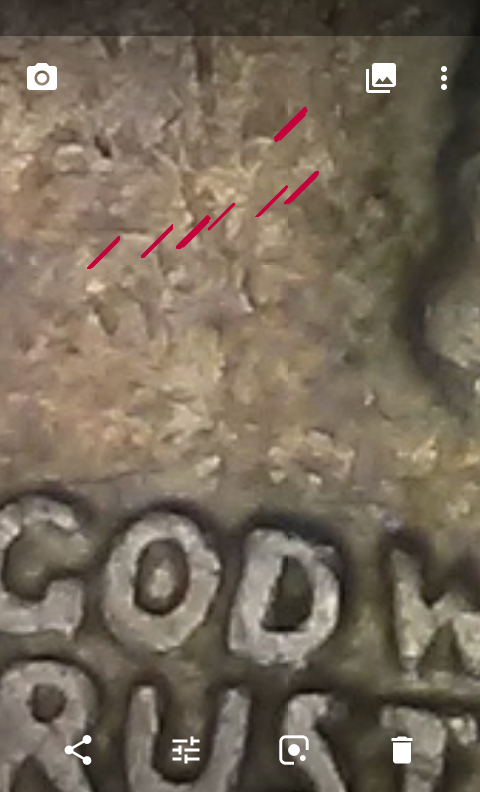
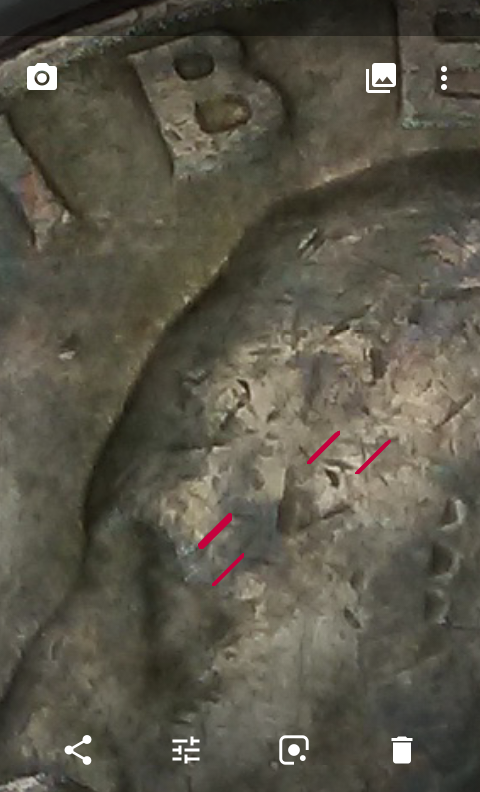
    I have a bicentennial quarter that’s been doubled die can you take a look at it please and tell me what you think .. it also has the AM connected on the back I don’t know if that is part of original design thank would love hear what you think I should do with it https://uploads.disquscdn.com/images/1caea4f28ded47407d83843a5a88e44c06da8df00d058adc4be77028804a1c55.jpg https://uploads.disquscdn.com/images/e1075ce066375a71ea1ecb061f14d729b054559e369d0d940da8b9f5a764cc67.jpg

    1. JoshuaTheFunTimesGuide Avatar
      JoshuaTheFunTimesGuide

      Hi, Robin —

      While your 1976-D Bicentennial quarter may have some light machine doubling, this is attributed to deteriorating dies and is unfortunately not the same thing as a doubled die error. Also, the AM arrangement for AMERICA on this coin is normal — there is no collectible or monetary premium for that as there is on certain Lincoln cents of the 1990s era.
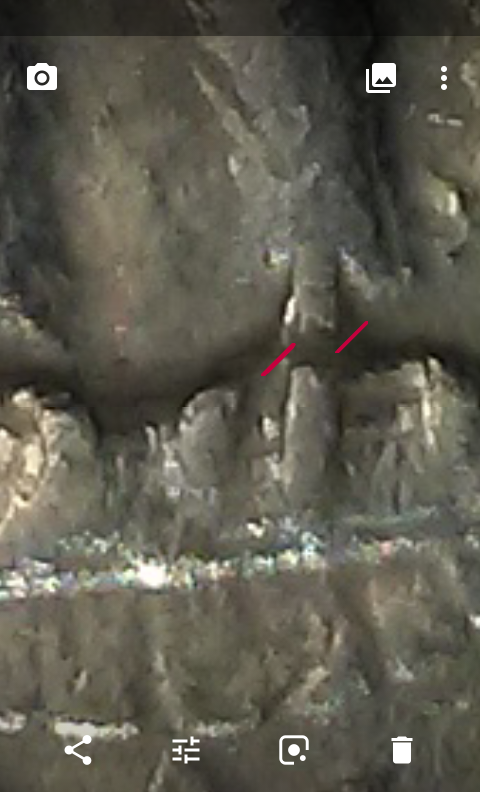
      All in all, this piece is worth its face value due to the circulation wear, though many folks hang onto these pieces for their special design and novelty.

      Best wishes,
      Josh

Leave a Comment

Content Widget