


If you’re looking for info on the 1914 penny value, you’ve come to the right place!
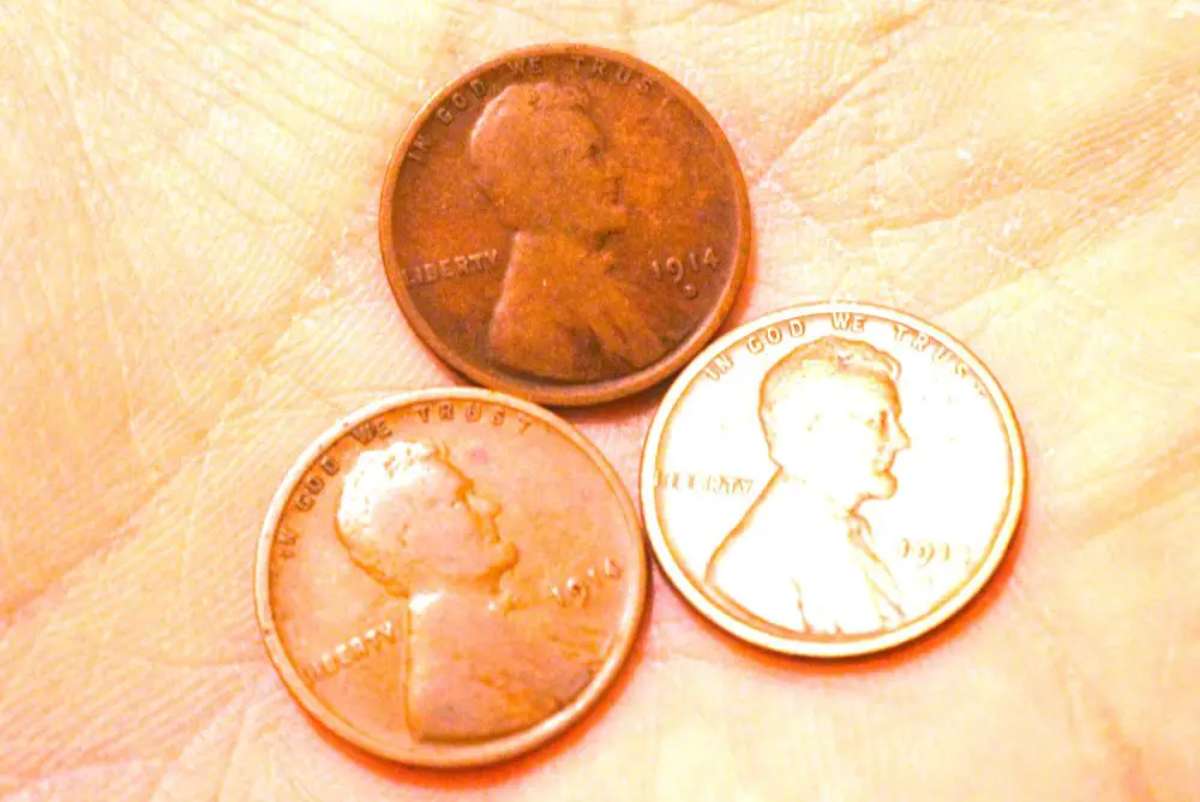
Did you know there are rare 1914 pennies?
Perhaps you have the valuable 1914-D penny or the scarce 1914-S penny.
Here’s more about 1914 pennies and how to find out what yours is worth…
1914 Penny Facts That Collectors Need To Know
1914 pennies are very difficult to find in pocket change these days. I’ve still yet to find one in pocket change or circulation roll searches — after more than 35 years of looking!
While they’re not considered scarce as compared to rare coins — like the 1909-S VDB penny or 1955 doubled die cent — 1914 pennies from the Philadelphia Mint (no mintmark) are nevertheless tough collectibles.
The 1914-D and 1914-S Wheat pennies are very valuable coins:
- The 1914-D penny is a rare key-date coin.
- The 1914-S penny is considered one of the semi-key Lincoln cents.
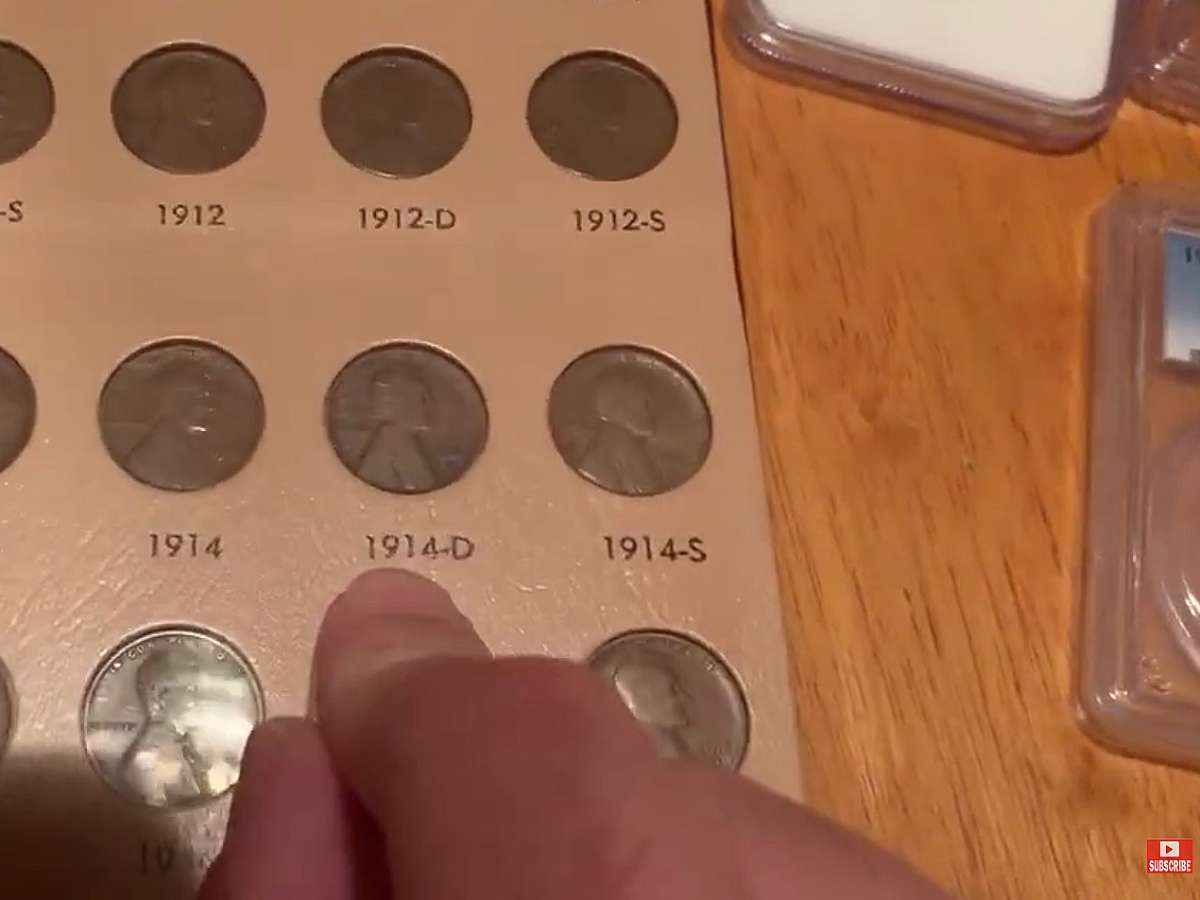
At one time, the 1914-S penny was actually considered a rare date. But over time, coin collectors realized it was the 1914-D cent that was actually scarcer — because fewer of them were made and far fewer were saved in collectible condition.
In general, early Lincoln cents with mintmarks are much scarcer than their Philadelphia-Mint counterparts for at least 2 reasons:
- The Philadelphia Mint made more early Lincoln cents than did the western mints, on average, because most of America’s population was still close to the East Coast in the first decades of the 20th century.
- At the time, coin collectors tended to favor Philadelphia-Mint coins over mintmarked coins, and thus relatively few Lincoln pennies from the Denver and San Francisco Mints were preserved by collectors during that period.
All 1914 pennies are worth more than face value, which is why it pays to look for these coins in your spare change.
Here’s a rundown on the different values for 1914 pennies…
1914 Penny Values (…And Collecting Tips!)
1914 pennies range in value from as little as 50 cents to more than $1,000.
What makes the difference between a 50-cent 1914 penny and one that’s worth 4 figures?
In general:
- 1914 pennies with less wear are worth more money than those with lots of wear.
- A 1914 penny with an “S” mintmark is worth more than one without a mintmark.
- The 1914-D penny is the king of all 1914 Lincoln cents and is the one most coin collectors are looking for.
Here’s a breakdown on what 1914 pennies are worth — and what to look for when you’re shopping for each of them.
1914 penny – 75,238,432 minted; worth 25 cents to $35+
While everyone and their proverbial sibling is searching for the monster 1914-D key date, don’t think the standard 1914 Philadelphia penny is chopped liver! Sure, Philly minted over 75 million of these plain-date cents, so they aren’t technically rare. But because it’s an early 20th-century relic that survived over 100 years of circulation, finding a problem-free example with sharp wheat lines and nice, original chocolate-brown patina is a true victory for any budget collector. Worn ones will comfortably grab you 50 cents to a few bucks, but if you ever stumble on a pristine piece tracking original Mint red (RD) color, the value can easily skyrocket past $35+ at a local coin shop! So, keep your eyes peeled…
1914-D penny – 1,193,000 minted; worth $175 to $1,500+
Because a genuine 1914-D commands an absolute premium, shysters love taking a common 1944-D penny and grinding down the left side of the first “4” to resemble a “1.” To protect yourself, use a 10x loupe to check the spacing between the digits. On a fake 1914-D penny, the gap between the “1” and the second “9” is quite wide. Another diagnostic I love sharing with collectors? See if you can find V.D.B. under Lincoln’s shoulder on the obverse. The Mint didn’t put the designer’s initials on the front (or back) in 1914, but they did in 1944. So, if you see a tiny “V.D.B.” stamped below the shoulder on a “1914-D,” you are holding an altered 1944 fake!
1914-S penny – 4,137,000 minted; worth $15 to $175+
When you’re shopping for a 1914-S, watch out for specimens with a suspiciously bright or uneven coppery sheen. Because these coins spent decades floating around in circulation, finding an honest chocolate-brown (BN) piece with natural, original surface toning and clear wheat lines is much safer than buying a coin that a previous seller harshly cleaned or dipped to make it look falsely uncirculated.
1914 proof penny – 1,365 minted; worth $500+
Remember that a 1914 proof penny doesn’t look like a shiny modern proof with mirror fields. This was the era of the matte proof. These coins were struck using sandblasted dies, giving them a completely grainy, satin-like surface texture with razor-sharp, squared-off rims. Because they may look dull to the untrained eye, many estate liquidators mistake them for standard business strikes, meaning you can occasionally pick a multi-hundred-dollar matte proof out of the bunch if you check for those ultra-sharp edges!
*Values are for problem-free coins in circulated condition unless otherwise specified. Uncirculated 1914 pennies are worth much more than the prices listed here. Coins with much wear are worth closer to the lower ends of the price ranges above, and those with less wear have values on the upper ends of the ranges.
Putting things in perspective…
- A new Dodge Brothers Touring Car cost $500 in 1914, while gas cost just 14 cents per gallon.
- Buying a new home in 1914 cost about $3,500.
- A gallon of milk was 12 cents, while a loaf of bread cost 6 cents.
See? Those 1914 pennies did a lot of hard work back then!
It’s amazing how much inflation has increased the cost of living. And, as you’ve learned in this article, even a 1914 penny is worth more than one cent today.
IMPORTANT: What Is The Grade Of Your 1914 Penny?
To determine the true value of your 1914 Lincoln cent, you first need to know what condition (or grade) your coin is in.
These are the best coin grading apps to use when grading coins yourself.
READ NEXT: A List Of The Most Valuable U.S. Pennies
What’s the oldest or most valuable Wheat penny you’ve ever managed to rescue from a standard bank roll or an unsearched estate collection?
Drop a comment down below and tell me your biggest finds!
If you think you’ve found a “wide-spaced” 1914-D or me to inspect your coin’s mintmark, snap a close-up macro shot and share it below and I’ll do my best to help.
Leave a Comment