
Quick Collector Takeaways
- Check the date and shoulder: An altered 1944-D can masquerade as a fake 1914-D penny. An unusually wide gap between the “9” and apparent “1,” or VDB initials beneath Lincoln’s shoulder, raises immediate concerns.
- Mintage does not tell the whole story: Denver struck 1,193,000 cents in 1914. Despite having more than twice the mintage of the 1909-S VDB, Josh explains that the 1914-D is scarcer in certain uncirculated grades, particularly Red Mint State.
- Understand the price incentive: Josh quotes approximately $150 to $200 and up even for well-worn examples. That video benchmark explains the attraction for counterfeiters; it is not a current appraisal or a guaranteed selling price.
- Inspect with a loupe: Look for disturbed metal near the date, mintmark, and beneath Lincoln’s shoulder. A nominal weight of 3.11 grams is another screening check, but correct weight alone cannot establish authenticity.
Video Breakdown & Chapter Highlights
0:57 — Why the 1914-D Attracts Collectors and Counterfeiters
Josh compares the 1914-D’s production with the much smaller 1909-S VDB mintage, then explains why surviving condition matters more than that comparison suggests. A coin can have a higher original mintage yet be harder to locate with unworn surfaces and retained red color. Its value also creates an incentive to alter inexpensive cents into convincing substitutes.
4:02 — The Altered 1944-D: Date Spacing and VDB Initials
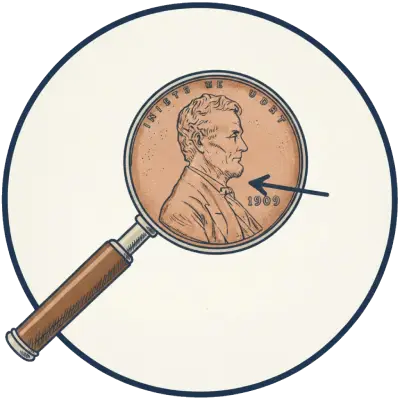
Removing part of the first “4” in 1944 can produce an apparent “1914,” but it leaves suspicious spacing between the “9” and the altered digit. At 5:16, Josh introduces another clue: a 1944-D carries VDB beneath Lincoln’s shoulder, while an authentic 1914-D does not. Missing initials still require scrutiny because someone may have removed them along with altering the date.
7:26 — Tooling Marks, Weight, and the Limits of Home Checks
Scuffs and shaved areas around the date or shoulder can reveal attempts to remove identifying details; Josh’s later recap also calls attention to tooling around the mintmark. He then discusses the 3.11-gram nominal weight and bronze composition as additional checks. These observations can expose problems, but a sophisticated counterfeit may match the expected weight and still require expert examination.
Josh’s Director’s Cut: Practical Numismatic Advice
“I myself would not recommend buying a raw (or unholdered) 1914D Lincoln cent because of the risks involved.”
Josh’s caution carries particular weight because he has collected Lincoln cents for more than 35 years, yet still recognizes the limits of his own inspection. The practical lesson is to use these diagnostics to identify warning signs, rather than treating a passed checklist as an authentication certificate. An altered genuine cent can retain a plausible weight, while a more sophisticated reproduction may avoid the obvious date-spacing mistake.
Before buying, separate three questions: Is the coin authentic, what condition is it in, and does the asking price reflect that condition? Our 1914 penny identification and value guide provides context for comparing the issues. For a substantial purchase, professional authentication addresses uncertainty that photographs, a loupe, and a household scale cannot fully resolve.
There is also an album-building tradeoff. Josh bought his rare cents in third-party holders before removing them years ago for his Dansco album. That personal choice illustrates the appeal of a complete display, but removing a coin separates it from its certified holder. Decide how you want to store and document an expensive key date before making that change.
Historical Context & Mint Specifications
The 1914-D began as everyday spending money, struck five years after the Lincoln cent’s introduction. Circulation wore down details, while handling and exposure changed the copper’s color. Consequently, its original mintage cannot tell collectors how many examples remain unworn or retain red surfaces. Josh’s comparison with the 1909-S VDB demonstrates why scarcity must be considered within a specific grade and color designation.
The designer’s initials provide a useful historical diagnostic. VDB was removed from the wheat reverse during 1909 and did not return until 1918, when it appeared beneath Lincoln’s shoulder on the obverse. An authentic 1914-D therefore belongs to the interval without those initials. Their presence identifies a design inconsistency, although their absence alone cannot prove the coin genuine.
| Series / Denomination | Lincoln wheat cent (1909–1958) / One cent ($0.01) |
| Mint Mark / Key Dates | D below the date: Denver / 1914-D, a regular-issue key date |
| Composition & Weight | 95% copper, 5% tin and zinc / Nominal weight: 3.11 grams |
| Original Mintage | 1,193,000 |
| Designer / Engraver | Victor David Brenner, obverse and wheat reverse / No VDB initials on the authentic 1914-D |