⚡ Quick Collector Takeaways
- Supply and demand: A penny’s rarity matters, but collector demand also influences its value. The 1909-S VDB Lincoln cent is a classic example, with only 484,000 originally struck.
- Condition makes a difference: Two pennies bearing the same date and mintmark can have dramatically different values. An uncirculated example may be worth far more than a heavily worn coin.
- Errors and varieties: The famous 1955 Doubled Die penny can command a substantial premium, while an ordinary 1955 cent generally has only modest collector value.
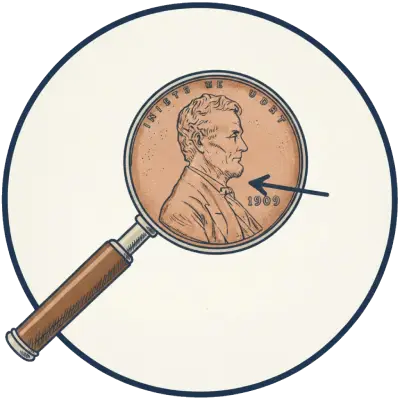
- Inspection tip: Use a coin loupe to examine dates, mintmarks, lettering, and unusual design details. Genuine doubled dies must be distinguished from common machine doubling.
Video Breakdown & Chapter Highlights
[01:32] — Supply, Demand & the 1909-S VDB Penny
Josh begins with the legendary 1909-S VDB Lincoln cent, explaining how its limited production and enduring collector popularity influence its value. He compares this scarce San Francisco issue with more common Lincoln cents and discusses why original mintage, surviving examples, and demand must be considered together when evaluating a coin.
[03:13] — Why a Penny’s Condition Changes Its Value
Next, Josh tackles one of the biggest misunderstandings among beginning collectors: assuming that every coin with a particular date is worth the highest price found online. He explains how wear, preservation, and grading affect market value, demonstrating why a common circulated penny cannot be valued like an exceptional Mint State specimen.
[05:01] — Valuable Errors, Varieties & the 1955 Doubled Die
Using a genuine 1955 Doubled Die Lincoln cent, Josh shows how a recognized die variety can transform an otherwise ordinary-date penny into a valuable collectible. He points out doubling in the date, LIBERTY, and IN GOD WE TRUST, then explains why machine doubling and other misleading forms of doubling should not be confused with a genuine doubled die.
Josh’s Director’s Cut: Practical Numismatic Advice
J
“Basically, there are 3 key determinants that help to go into the value of a coin. That is 1) The supply versus demand. 2) The issue of condition (you know, the state of preservation that the coin is in.) And finally… 3) The absence or presence of errors and varieties.”
The most useful lesson from this video is that a penny’s date is only the beginning of its story. Before deciding whether a coin is valuable, identify its date and mintmark, determine which variety you have, and evaluate its condition. A scarce issue may attract considerable interest even when circulated, while an ordinary-date penny generally needs exceptional preservation or a recognized variety to command a substantial premium.
When searching pocket change or old coin jars, separate potentially interesting pennies before researching prices. Our list of valuable pennies worth keeping provides a practical starting point. Check both sides of each coin under good lighting, and compare unusual features with reliable photographs rather than assuming every irregularity is a valuable mint error.
One especially important distinction is genuine doubled-die lettering versus mechanical doubling. The latter can look exciting under magnification without adding a meaningful premium. Our guide to machine doubling versus doubled dies explains what separates them. And remember: never clean a promising coin to make it look better. Cleaning can permanently damage its surfaces and reduce collector interest.
Historical Context & Mint Specifications
The Lincoln cent debuted in 1909, commemorating the centennial of Abraham Lincoln’s birth. Designed by Victor David Brenner, it became the first regularly circulating U.S. coin to feature a historical president. Early Lincoln Wheat cents were produced in enormous quantities, but certain dates and mintmarks were made in significantly smaller numbers. The 1909-S VDB, with a mintage of just 484,000, illustrates how limited supply and lasting collector demand can create an important key-date rarity.
The 1955 Doubled Die penny represents a different path to collector value. Its distinctive doubled design resulted from the die-making process, not from the coin simply being old or heavily circulated. Together, these two examples show why rarity, preservation, and recognized varieties must be evaluated independently. The following comparison highlights the specific Lincoln cents Josh discusses in the video.
| Series / Denomination | 1909-S VDB Penny: Lincoln Wheat Cent / 1 cent 1955 Doubled Die Penny: Lincoln Wheat Cent / 1 cent |
| Mintmark / Key Date | 1909-S VDB Penny: S / 1909-S VDB 1955 Doubled Die Penny: No mintmark / 1955 DDO |
| Composition & Weight | 1909-S VDB Penny: 95% copper alloy / 3.11 grams 1955 Doubled Die Penny: 95% copper alloy / 3.11 grams |
| Original Mintage | 1909-S VDB Penny: 484,000 1955 Doubled Die Penny: Approximately 20,000–24,000 doubled-die examples estimated |
| Designer / Engraver | 1909-S VDB Penny: Victor David Brenner 1955 Doubled Die Penny: Victor David Brenner |
Collector note: The 1955 Doubled Die figure is an estimated number of variety examples, not the total Philadelphia Lincoln cent mintage for that year. Coin values depend on authenticity, condition, and current market demand.