




This post may contain affiliate links. If you buy thru these links, we may earn a commission at no additional cost to you.
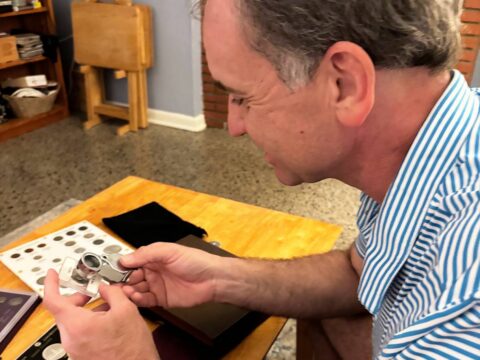
If you’ve been reading my coin articles here on the US Coins Guide, then you’ve seen my responses to questions in the comments.
You’re probably curious where I get my information about coin prices and values.
In my opinion, having several sources is better than just one.
Here are the sources I use to get information about coin prices and values…
My Favorite Resources For Finding Coin Values
I get my information about coin prices from a few different places.
I never like to use just one coin value guide — because doing so limits my ability to find accurate information on some coins.
I believe that getting a consensus of coin price data gives a more thorough picture of a coin’s true value.
Coin Prices Online
Usually, I get my coin pricing data from reputable online sources like the Professional Coin Grading Service website.
Their site has a comprehensive list of coin prices for coins which they have professionally graded.
I find this list highly insightful for the majority of coins and one of the best online coin price guides available!
However, I must keep in mind that many coins do not grade high enough (and are usually not even graded and encapsulated by PCGS) — and those coins won’t be included in this price guide.
Coin Price Books
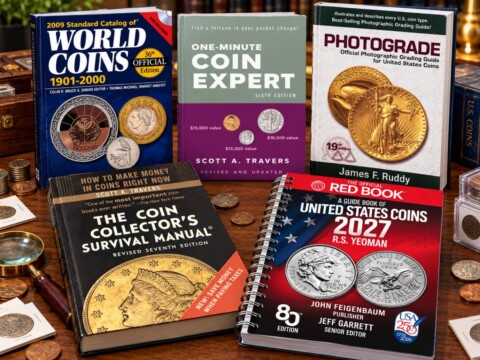
A Guide Book of United States Coins (by R.S. Yeoman and Kenneth Bressett) is one of the most respected publications on the market.
It’s famously dubbed “The Red Book” and is read by new and veteran coin collectors alike. It’s affordably priced, and revised annually.
The Red Book has a virtually complete listing of all U.S. coins dating to the Colonial period (prior to 1793) — and it includes prices for all these coins.
Here are my tips for collecting early American coins, including values and trends.
I like The Red Book for its completeness, reliable pricing data, and respected history.
But one problem with an annual price guide is that it may be quite inaccurate for evaluating coin prices — especially many months after its publication. While some coins have relatively stagnant values, many other pieces experience price volatility. For coins with rapidly changing values (like silver coins), it’s usually better to use a more frequently updated price guide.
Coin Price Magazines
Your local bookstore or newsstand should carry copies of the latest coin magazines.
Most of coin magazines include coin price listings.
While some of coin magazines are compiled a month (or more) before publication, the pricing data itself usually pretty accurate — especially for coins which don’t typically see sudden and sharp price fluctuations.
2 examples of numismatic periodicals that contain updated coin prices:
Bullion Coin Prices
Whenever someone asks about the value of their silver or gold coins, I almost always check with a bullion market updater right away.
Many gold and silver coins are worth more than bullion prices. However, the bullion value is a good base indicator of what you might expect from a coin dealer if you wanted to sell your coins.
Silver and gold prices fluctuate by the minute. To get these values, I check with websites that hourly (or more frequently) update their information.
2 great up-to-date websites I like to use:
Coin Value vs. Coin Worth
You may notice that I often quote a lower coin price than what these sites, books, and magazines say.
Why is that?
Because there’s a difference between “catalog price/value” and the amount you receive if you sell your coins to a dealer (or the amount that it’s worth to someone who might buy your coin).
While every coin dealer offers a different coin price, in general, you can expect to receive somewhere between 50-80% of the catalog value of a coin when you sell it to a coin dealer.
This amount can be higher or lower depending on the coin, the situation, and the coin dealer.
READ NEXT: 5 Important Factors That Determine A Coin’s Value

Leave a Comment