



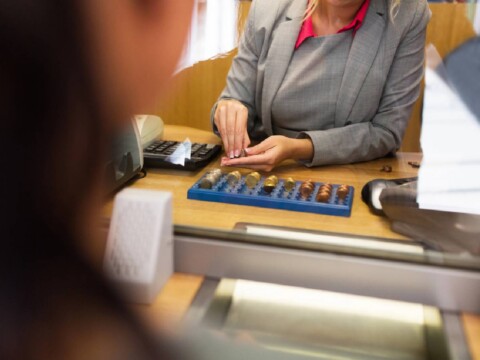
Banks are by far the easiest place to pick up everyday coins!
Virtually any local branch keeps a steady supply of pennies, nickels, dimes, quarters, half dollars, and small-sized dollar coins on hand. And, if you’re lucky, you might score some of the harder to find rare and error coins.
Tellers handle loose currency all day long. As long as you know how to ask, you can trade your cash for coins at exact face value without paying a single penny in markup!
There are just 2 unspoken rules:
- You should have an account at the bank. Some tellers will pull coins from their drawers for you in exchange for cash without requiring you to have an account. However, most banks will refuse to sell large quantities of coins (or boxes of coins) to non-customers. Your best bet is to open a small checking account at the bank you plan to visit most often.
- Never “dump” where you buy! If you buy a large quantity of coins, search them, and then take the ones you don’t want back to the exact same bank, they will quickly cut you off. It’s best to have a “Buy Bank” (where you pay face value for coins) and a separate “Dump Bank” (one that has a free coin-counting machine for the coins you don’t want).
Remember, bank tellers aren’t coin dealers. Sorting through loose tray coins takes extra time (and effort) during a bank teller’s shift — so be patient with them.
Your best bet is to visit during slow mid-morning hours (avoid Friday afternoons and lunch rushes) and always thank them — even if their tray is empty that day.
Once a teller knows that you collect old coins, they’ll often start setting aside interesting coins in their tray specifically for your next visit!
Here’s more about the 4 ways you can buy coins from banks…
#1 – Loose Coins From The Teller’s “Tray” (The Best Hidden Treasure)
When a bank’s customers drop off loose change or deposit old coin jars, the tellers typically place any odd or bulky coins directly into a small compartment inside their drawer. You can ask any bank teller directly if they happen to have the specific coins you’re looking for.
What you can buy:
- Eisenhower dollars, $1 golden dollars, Susan B. Anthony dollars, Kennedy half dollars, as well as old nickels and pennies.
How to ask:
- Simply ask the teller: “Do you have any loose $1 coins, half dollars, or old coins sitting in your tray today that I could buy?”
Many bank tellers are happy to clear them out — because those oversized coins don’t fit into standard coin-counting machine bags or coin rolls!
#2 – Coin Rolls (By Denomination In Paper Wrappers)
The bank is one of the best places to buy rolls of coins. Buying rolls of coins at face value from your local bank is an affordable way to hunt for silver coins, key dates, and rare error coins. Collectors refer to this as “coin roll searching” or “coin roll hunting.”
What you can buy:
- Rolls of coins by denomination (pennies, nickels, dimes, quarters) in paper wrappers.
- When you ask for rolls, tellers will give you one of two types — both have their own unique pros and cons:
- Machine-wrapped rolls are identified by their tight, branded crimping of the paper rolls. These rolls often have silver coins removed via high-speed automated sorting. But they’re great if you’re searching for modern coin errors and West Point “W” mintmark quarters.
- Customer-wrapped rolls are identified by their loose wrappers with hand-folded ends, which are often taped closed before they’re turned in for cash by everyday bank customers. You have a higher probability of finding vintage silver coins and old Wheat pennies — because the rolls bypass commercial filters. The coins often include unsearched, hand-wrapped coins from old coin collections, junk drawers, piggy banks, and coin jars.
How to ask:
- Ask the bank teller: “Do you have a few customer-wrapped rolls of quarters [or pennies, nickels, dimes] in your drawer today that I could buy?” OR “Do you happen to have any rolls of half dollars [or dollar coins] in the vault?”
#3 – Bulk Coin Bags (Sealed Canvas or Plastic Bags)
If you want to search through massive quantities without cracking open individual paper coin wrappers, you can buy bulk coin bags directly from some bank branches.
What you can buy:
- Some banks have coin-counting machines in the lobby or back room. When those machines are emptied, the coins are dumped directly into heavy-duty plastic Federal Reserve bags. As a bank customer, you can order bags of dumped coins at face value — by denomination.
- If you have an account at a larger commercial bank, you could also ask them to order full Mint-sealed canvas bags of specific denominations directly from Brinks, Loomis, or the Federal Reserve.
How to ask:
- Ask a bank teller (or branch manager), “Do you sell the coin-counter bags directly to account holders? Or… can I place a special order for a vault-sealed bag from your armored car delivery?”
#4 – Mint-Wrapped “Ball-End” Boxes (Brick Bundles)
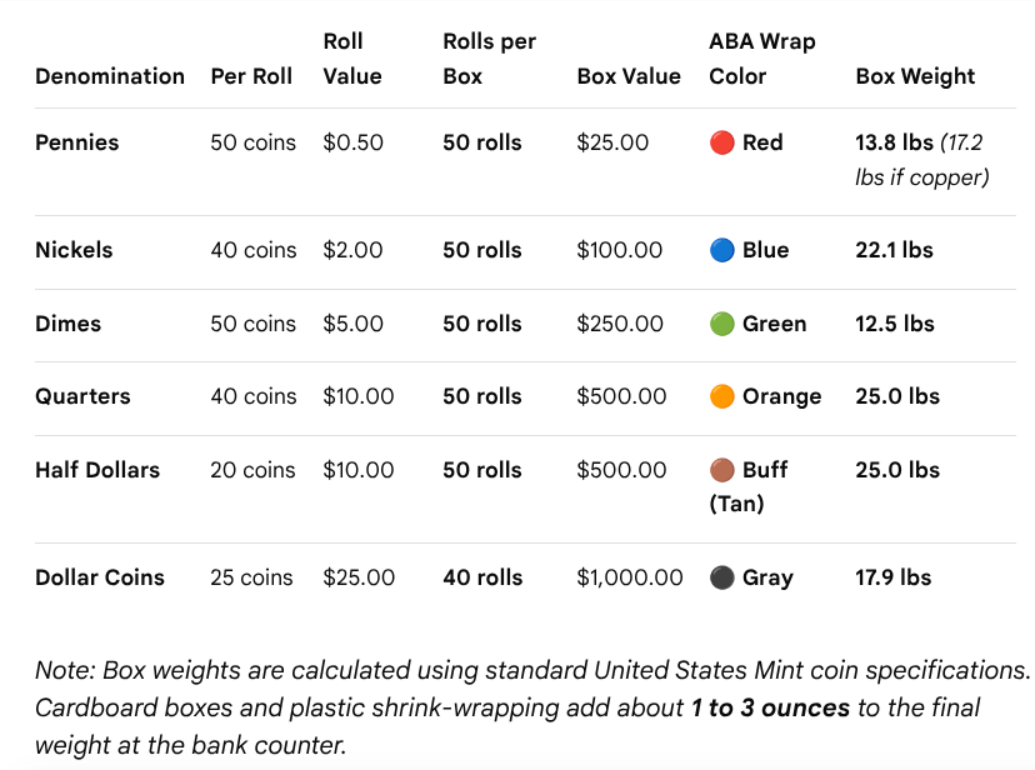
When you buy a full box of pennies, nickels, dimes, quarters, halves, or dollar coins you get untouched factory-sealed paper “ball-end” boxes or clear plastic “shrink-wrapped” bricks delivered directly from an armored car service. Each contains a specific number of individual coin rolls (see chart below).
What you can buy:
- Freshly sealed rolls containing either solid-date uncirculated coins or mixed circulated coins re-wrapped by a transit courier and delivered straight from armored cars. These come in standard bulk quantities: 50 rolls of pennies in a $25 penny box, 50 rolls of nickels in a $100 nickel box, 50 rolls of dimes in a $250 dime box, 50 rolls of quarters in a $500 quarter box, 50 rolls of halves in a $500 half dollar box, or 40 rolls of small-size dollar coins in a $1,000 dollar box.
How to ask:
- You have to plan ahead… Due to strict daily vault limits, commercial tellers rarely hand over full boxes to walk-in customers without prior warning. Request your vault order 1-2 weeks in advance (ideally mid-week when armored trucks make scheduled branch drops). Ask a teller at the customer service desk (not the busy main teller line) to place a custom vault order to match their scheduled armored truck delivery day — and offer to pay any cash-handling fees. TIP: You’ll want to use a business checking account if possible — because most banks view bulk coin ordering as a commercial client service and having a business checking account often waives heavy cash-handling fees.
A summary of what you’ll receive:
REMINDER: Dumping an unsearched (or searched) box back at the same branch will ruin your relationship with that branch. Always use a separate “dump bank” that has a free coin-counting machine instead.
How To Find A “Dump Bank”
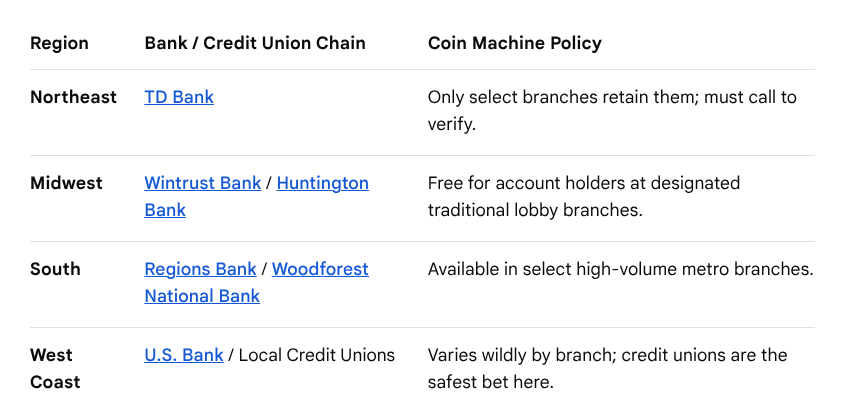
To find a dump bank near you that will accept a large amount of loose coins in exchange for the face value of those coins, you’ll need to find a bank that has a coin-counting machine on site. These are becoming harder to find these days — they’re mostly available at credit unions and smaller regional banks within metro areas.
You basically have 2 options:
- Search for local credit unions — Credit unions are highly localized and much more likely to offer free coin-counting machines to its members than national bank chains. To find credit unions near you, type your zip code into this credit union locator tool: National Credit Union Administration Locator.
- Map out regional banks near you — Regional banks (those which operate in only a few states) tend to use lobby coin counters as a competitive marketing tool to draw in local retail customers. To find such banks near you, search Google for “Regional Banks near [Zip Code].” This chart provides you with some of “the best” regional banks, depending on where you live:
The Bottom Line
Banks should have most of the “common” type coins on hand for you. But if you’re looking for older obsolete coins (like Morgan silver dollars, Peace silver dollars, Buffalo nickels, or Indian Head cents), a bank teller isn’t going to have what you need.
For those, you’ll want to visit a local coin shop or order online from reputable coin dealers. Coin dealers stock everything from low-cost filler coins to rare key-date treasures.
If there aren’t any local coin shops in your area… established online bullion distributors, estate sales, and regional coin shows are great backup options to help you track down the old coins you’re searching for.
READ NEXT: Coin Roll Searching 101: What To Look For By Denomination
Leave a Comment