


Have a 1960 penny and want to know its value?
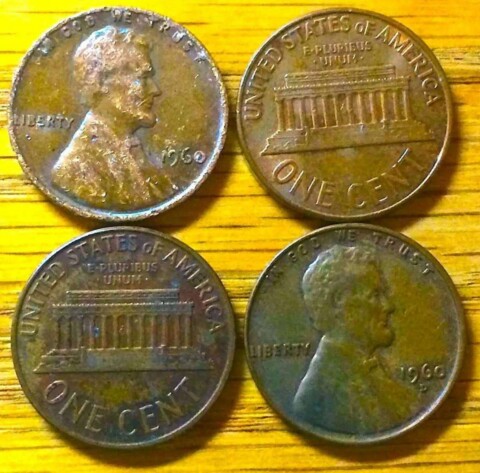
As you’ll soon find out, determining the value of your 1960 penny may take a little work, as there are several varieties of 1960 pennies — and each of these old pennies is worth different amounts!
Don’t worry, I will lay out all of the facts below so you can figure out what variety (or varieties) you have and see how much your 1960 penny is worth.
What Is A 1960 Penny Worth?
Depending on the condition of your 1960 penny and its variety (in the case of 1960 pennies, this is determined by the size of the date) — your coin may be worth anywhere from 3 or 5 cents up to $10 or more.
1960 Penny Values
| Year | Mintage | LARGE Date Value | SMALL Date Value |
|---|---|---|---|
| 1960 No Mintmark (Philadelphia Mint) | 586,405,000 | 20+ cents | $2.50+ |
| 1960-D (Denver Mint) | 1,580,884,000 | 20+ cents | 20+ cents |
| 1960-D D Over D Overdate (Small Date Over Large Date) | Unknown | $200+ | — |
| 1960 Proof Lincoln cent | 1,691,602 | $1.75+ | $18+ |
*Values are for coins in uncirculated condition, unless otherwise noted. Circulated 1960 pennies are worth approximately 2 to 3 cents.
See that “$200+” line in the chart for the 1960-D Small Date over Large Date? That is a bona fide U.S. Mint mistake that gets every collector’s blood pumping. It happened because a worker at the Mint accidentally struck a Large Date date configuration right over a Small Date hub on the master die. If you grab a 10x magnifier and look at the date on your Denver coin, you’ll see a distinct, ghostly double layer. The most obvious giveaway is the “0” — you’ll see the distinct shape of a smaller “0” completely stamped inside the wider, hollow belly of a larger “0”. Keep your eyes peeled for that one!
How To Tell The Difference Between A 1960 Large Date Penny & A 1960 Small Date Penny
Wondering how to tell the difference between a 1960 Large Date penny and a 1960 Small Date penny?
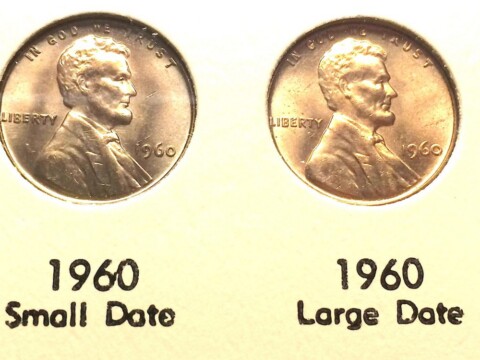
For starters, take a look at this photo:
See the tops of the numerals in the date of the 1960 Small Date penny? Notice how the tops of the numerals (except for the “6”) all form an imaginary straight line?
Now look at the 1960 Large Date penny. See the top of the “9” and how it pops up taller than the “1”?
Those are the differences between a 1960 Large Date and 1960 Small Date penny!
If aligning the top of the numbers feels a bit difficult for you with the naked eye, don’t sweat it. There’s another dead giveaway inside the number “6” itself. Look at the round, hollow loop at the bottom of the “6”. On the common 1960 Large Date, that inner circle is big, wide, and perfectly round. But on the scarce 1960 Small Date, the inside of that “6” is tiny, cramped, and shaped more like a narrow oval (or an egg). If the middle of your “6” looks fat and roomy, it’s a Large Date.
I’ll bet you’ll never look at 1960 pennies the same way again…
1960 Penny Facts
1960 pennies are made from a 95% copper composition. They contain approximately 3 to 5 cents’ worth of the valuable metal. That means all 1960 pennies are worth at least 3 or 5 cents — more or less.
While it’s illegal to melt pennies for their copper value, coin hoarders still save old copper pennies anyway. Why? Because they’re hoping that the United States government will repeal the penny melting ban at some point in the future.
In the meantime, a 1960 penny is worth about double its face value.
The great news for coin collectors? There are still many 1960 pennies in circulation — so you may find some in your pocket change if you look carefully enough for them.
A lot of people ask me how they can be absolutely certain their 1960 penny is real copper and not a modern copper-plated zinc coin from the 1980s or 1990s. It’s simple: toss it on a small digital scale. A real solid-copper 1960 penny will weigh exactly 3.11 grams. Modern cheap zinc pennies only weigh 2.5 grams. If your coin weighs in heavy, you hold a real piece of old-school American copper history!
Do you have a 1960 penny? Think there may be something unique about it? Post a picture of your coin in the comments below and I’ll try to help!
READ NEXT: A List Of The Most Valuable U.S. Pennies


Leave a Comment