



Over the last decade, I’ve been asked, “How rare are 1943 silver pennies?” and “How much is my 1943 silver Wheat penny worth?” more times than I can even remember.
And this is a good thing — I love telling people the story behind 1943 pennies and what they’re worth!
Read on… I’ll also tell you what 1943 silver pennies are actually made from — and we’ll discuss the rare, valuable 1943 copper penny below as well.
How To Spot A Rare 1943 Penny
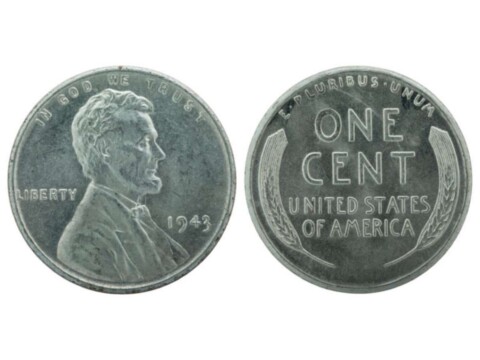
There are a few 1943 rare Wheat pennies, but most 1943 Wheat pennies are not rare.
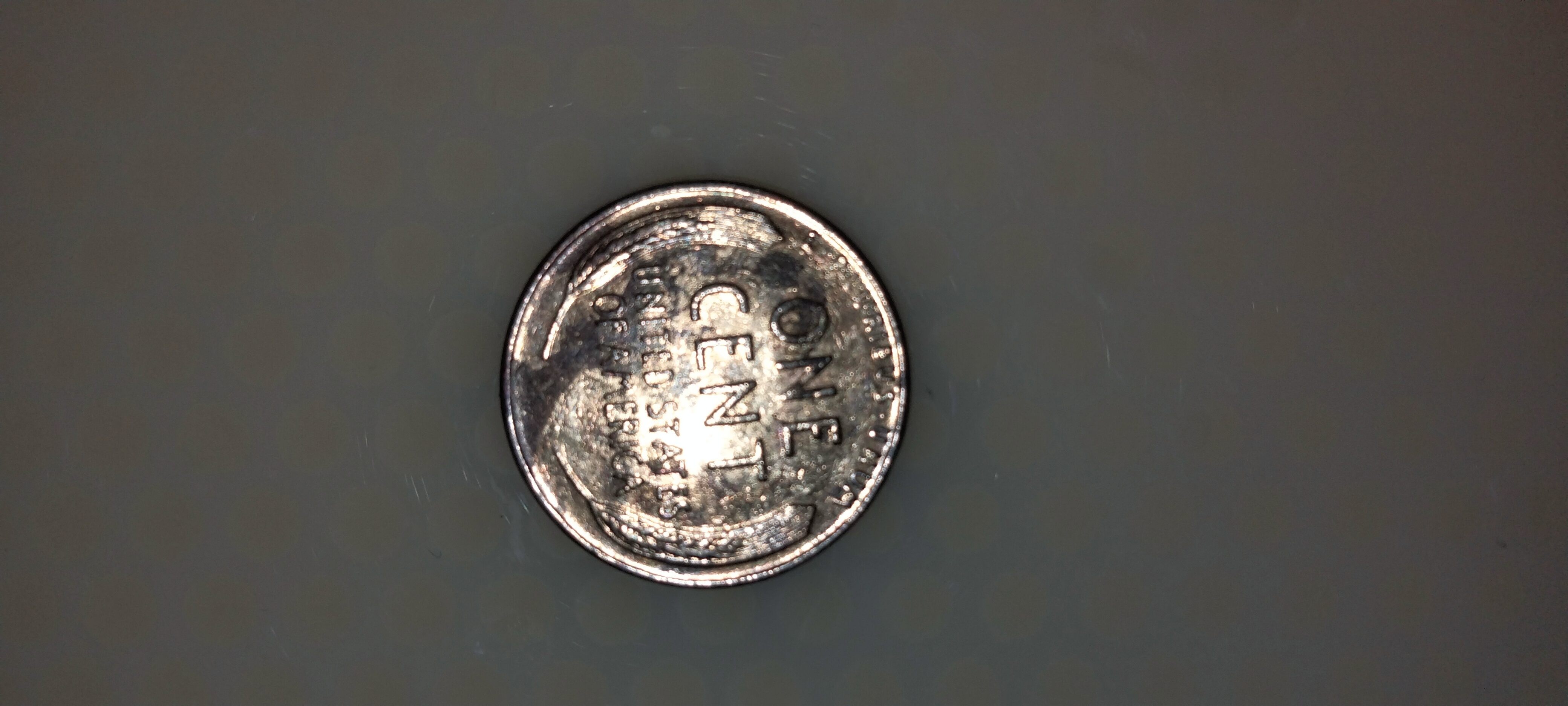
You probably have a 1943 Wheat penny that looks silvery in color, or maybe dark gray — it may even appear rusty.
Here’s how to tell if your 1943 silver Wheat penny is rare or not:
- If it sticks to a magnet, then your 1943 silver penny is NOT rare.
- If it does not stick to a magnet, then your 1943 silver penny IS rare.
Rare 1943 Wheat pennies are made from bronze — they look similar to most other copper pennies from other years. In fact, 1943 copper Wheat pennies are usually worth $100,000 or more!
In a minute, I’ll talk more about the 1943 copper penny and why it’s so rare.
But first, let’s discuss what those silver 1943 Wheat pennies are made from. (Spoiler alert: a 1943 silver Wheat penny is NOT made from silver!)
1943 Silver Pennies Are Made Of Zinc-Plated Steel
When I first got into coin collecting back in the early 1990s, I thought — like so many people who ask me about their coins here — that my silvery 1943 pennies were actually made from silver.
And, sure, that makes sense. Silver has been used in many coins — including dimes, quarters, half dollars, and dollar coins.
Most 1943 Wheat pennies appear to be silver in color.
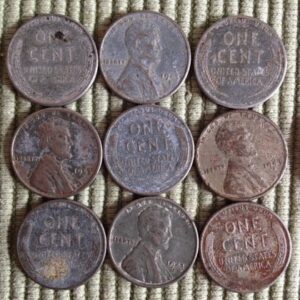
So, what are 1943 “silver” pennies made from? Answer: Zinc-plated steel!
In the early 1940s, when the United States had first entered World War II, our nation needed to ration a variety of important materials to help win the war. Copper was essential for making ammunitions — so the government decided to divert copper from making pennies to manufacturing shell casings.
And the decision was made to strike 1943 Wheat pennies from zinc-plated steel planchets.
Here’s an insider secret about how the Mint actually made these: They took giant sheets of raw steel, plated the top and bottom with a thin layer of zinc, and then punched the round penny blanks straight out of those sheets. Because of that, the outer edges of a genuine 1943 steel penny were completely raw, unplated steel from day one. If you look at a worn 1943 steel cent with a coin magnifier, the faces might look fine, but the smooth outer edge is usually the very first part to rust because that exposed steel had zero zinc protection!
How Many 1943 Steel Pennies Were Made?
More than 1 billion 1943 steel Wheat pennies were made.
Here’s the breakdown by U.S. mint facility:
- 1943 no mintmark steel penny (Philadelphia Mint) — 684,628,670 minted
- 1943-D steel penny (Denver Mint) — 217,660,000 minted
- 1943-S steel penny (San Francisco Mint) — 191,550,000 minted
However, by the end of 1943, much of the public complained about the new steel pennies!
1943 steel Wheat pennies were not a hit for these reasons:
- There were problems with the coins rusting quickly.
- Some vending machines rejected the steel Wheat cents.
- Many people even confused the steel pennies with silver dimes!
Keep your eyes peeled if you’re sorting a pile of 1943-D pennies. The hand-stamped die punches left behind a legendary variety that’s been cataloged as the FS-501. Grab your magnifier and look straight at the “D” mintmark under the date. On a genuine variety piece, you will see a clear, bold secondary “D” splitting away and tracking strongly to the southwest of the main letter. If it looks flat or shelf-like, it’s just machine doubling or other artifacts of strike chatter — but a true rounded southwest split-serif is a premo keeper!
Rare 1943 Copper Pennies
The U.S. government found the solution to the above problem by making the 1944 Wheat penny from spent copper shell casings that were recovered from battlefields after use.
But it turned out a few 1943 Wheat pennies had accidentally been made with leftover copper planchets (prepared coin blanks) from 1942 — and they escaped from the United States Mint!
The first of these was reported within a few years.
Today, 1943 copper Wheat pennies are among the most valuable Lincoln pennies.
Incidentally, a few 1944 Wheat pennies were made with the 1943 steel planchets. These are worth around $85,000 or more!
What Is A 1943 Steel Penny Worth? (aka 1943 Silver Wheat Penny)
If you’ve gotten to this point in the article, you’re probably still curious how much a 1943 steel Wheat penny is worth today.
Remember I said earlier that more than 1 billion 1943 steel Wheat pennies were made?
Well, lots of 1943 steel Wheat pennies still survive today — and that means there are plenty to go around to satisfy the needs of coin collectors.
Here’s the current 1943 steel Wheat penny value:
- Most 1943 steel pennies that you’ll find in circulation are pretty well worn (and many that are worn exhibit rust). These are worth 5 cents to 10 cents.
- A lightly circulated 1943 steel penny is generally worth 20 cents to 50 cents.
- The uncirculated 1943 steel penny value usually ranges from about $1.50 to $5.
- Some well-preserved uncirculated 1943 steel pennies with pristine surfaces are worth more than $100!
Watch out for a huge trap when you’re searching for these online! You’ll see thousands of 1943 steel pennies on marketplaces that look insanely shiny (almost like chrome or mirrors) advertised as “uncirculated.” Many times, these are simply “reprocessed” coins. Unscrupulous sellers take common rusted pennies, dip them in harsh acid to strip the original metal, and blast them with a fresh layer of modern zinc. Look at the edge under a coin loupe — if the edge is completely mirror-shiny and coated instead of showing original dull steel (or if there seems to be wear on high points like Lincoln’s cheek or the wheat leaves) it’s likely been altered and carries zero collector premium!
So now that you know all about the 1943 penny value, did you strike it rich with your 1943 Wheat pennies?
Even if you didn’t, your 1943 steel pennies are still neat coins, and they’re historic relics from the World War II era. There are many valuable, rare pennies out there. Maybe you’ll find one in your pocket change — if you look hard enough.
Keep checking your change, and happy collecting!
More Info About Old, Rare Pennies
In addition to the links I’ve included above, here are some other resources to help you learn more about 1943 Wheat pennies and other old pennies:


Leave a Comment