
⚡ Quick Collector Takeaways
- Look for silver: Circulating Washington quarters dated 1964 and earlier contain 90% silver. Check the edges of every quarter for unusual silver-colored metal.
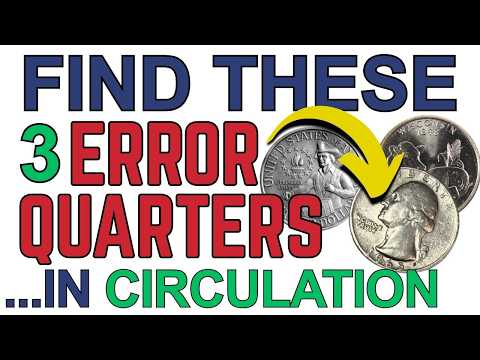
- Check state quarter varieties: The 2004-D Wisconsin Extra Leaf and 2005-P Minnesota Extra Tree varieties are especially interesting finds.
- Watch for valuable mistakes: A genuine 1965 quarter mistakenly struck on a 90% silver planchet can be worth thousands of dollars. Such errors are exceptionally rare.
- Use a magnifier: Inspect lettering, dates, mintmarks, and design details. Set aside unusual quarters for closer examination rather than assuming every odd-looking mark is valuable.
Video Breakdown & Chapter Highlights
[00:54] — Silver Quarters vs. Clad Quarters
Josh and Jeanine begin their quarter roll hunt by discussing the transition from silver to copper-nickel clad coinage. Regular circulating quarters dated 1964 and earlier contain 90% silver, making them desirable finds even when heavily worn. Josh explains why checking older dates is one of the easiest ways to begin searching for valuable quarters.
[02:48] — Minnesota Quarter Errors & Rare 1965 Silver Quarters
The hunt turns to modern varieties, including the 2005-P Minnesota quarter with its unusual extra-tree details. Josh also examines two 1965 quarters and demonstrates how the copper-colored stripe on their edges identifies them as ordinary clad coins. A genuine 1965 silver transitional error requires additional verification, including accurate weight and composition testing.
[06:55] — Valuable Quarters To Look For In Rolls
Josh closes with a practical checklist: pre-1965 silver quarters, rare transitional errors, better-condition 1982 and 1983 Washington quarters, Wisconsin Extra Leaf varieties, Minnesota doubled dies, and the 2009-D District of Columbia doubled die. The emphasis is on recognizing promising coins, examining them carefully, and enjoying the hunt even when a particular roll contains no valuable discoveries.
Josh’s Director’s Cut: Practical Numismatic Advice
“You may not find them in every roll — and that’s okay.”
One of the most important lessons in quarter roll hunting is learning to separate the excitement of finding something unusual from the actual value of a coin. A quarter with a strange mark, different color, or unusual appearance deserves a closer look, but that doesn’t automatically make it a rare mint error. Ordinary circulation damage, staining, and wear can create misleading appearances.
Start with a manageable number of rolls and establish a repeatable inspection routine. Check dates first, examine the edges for potential silver coins, and then inspect the reverse designs for recognized varieties. Keep a magnifier nearby, and compare suspicious coins against documented examples. Our Minnesota quarter error guide illustrates why the exact location and shape of a design variation matter.
There’s also a practical tradeoff between searching large quantities and taking time to understand what you’re finding. Searching more rolls increases your opportunities, but careful inspection helps prevent valuable varieties from being overlooked. For a broader checklist, consult our complete quarter roll hunting guide. The best approach combines patience, curiosity, and realistic expectations about how often genuinely rare coins turn up.
Historical Context & Mint Specifications
Washington quarters entered circulation in 1932, originally as 90% silver coins commemorating the 200th anniversary of George Washington’s birth. Rising silver prices and the increasing demand for circulating coinage eventually led to the Coinage Act of 1965, which eliminated silver from regular circulating quarters. Copper-nickel clad quarters replaced the earlier silver composition, although rare transitional errors resulted when incorrect planchets entered production.
Modern quarter roll hunting also benefits from the enormous variety of designs introduced through the 50 State Quarters Program, which began in 1999. Certain doubled dies and other mint varieties attract collector interest despite the high mintages of ordinary quarters. Scarcity, condition, authentication, and collector demand determine whether a particular find commands a premium. The specifications below provide a useful starting point for distinguishing ordinary Washington quarters from coins deserving additional investigation.
| Series / Denomination | Washington Quarter / 25 Cents |
| Mint Mark / Key Dates | P, D, S; 1964 and earlier silver issues; 1965 transitional errors; 1982–1983 high-grade examples; selected state quarter varieties |
| Composition & Weight | 1964 and earlier: 90% silver, 10% copper; 6.25 g. Standard clad circulation issues since 1965: copper-nickel outer layers over a copper core; 5.67 g. |
| Original Mintage | Varies by year, mint facility, and design. Common circulation issues were frequently produced in the hundreds of millions. |
| Designer / Engraver | John Flanagan (original Washington quarter); various reverse designers for state and later commemorative programs |