
Quick Collector Takeaways
- Save the copper: Most Lincoln cents dated 1981 and earlier contain 95% copper. The Mint transitioned to copper-plated zinc during 1982, so that year requires extra attention.
- Real-world results: Josh searched approximately 1,475 older pennies and set aside dozens of uncirculated examples, several possible minor doubled dies, and other interesting varieties.
- Value beyond face: In the video, Josh estimates ordinary bronze cents at roughly 1.8 to 2 cents in copper content, with uncirculated common examples potentially worth 5 to 10 cents each. These are historical estimates, not guaranteed current selling prices.
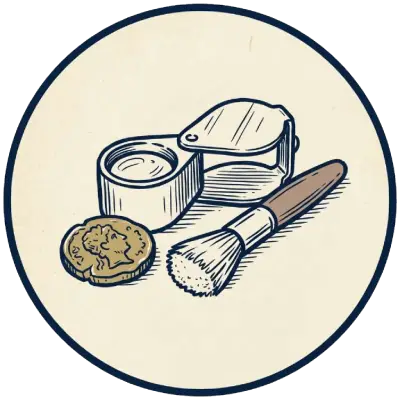
- Inspect before spending: Use a coin loupe to examine dates, LIBERTY, mintmarks, and doubling. A digital scale can help distinguish copper and zinc 1982 cents.
Video Breakdown & Chapter Highlights
[00:00] — Why Save Copper Pennies?
Josh opens a coffee can containing Lincoln cents accumulated through several years of pocket change and coin roll hunting. He explains how the Mint’s transition away from the traditional bronze composition makes older pennies interesting for their copper content, even when they have no rare dates or errors. The key distinction is between the coin’s metal content and the amount a collector or dealer will actually pay.
[01:40] — Uncirculated Pennies Hiding in Pocket Change
Among the coins he saved, Josh identifies older Lincoln cents displaying full original mint luster and virtually no evidence of circulation. He demonstrates how rotating a coin under a light helps reveal uninterrupted luster, including across the design’s high points. His discovery shows why condition deserves attention even when a penny has an otherwise ordinary date.
[02:58] — Doubled Dies, Small Dates & Unexpected Finds
Josh examines 1972 pennies showing possible minor hub doubling, 1960 Small Date cents, and several common Wheat pennies. He also explains the differences between doubled-die varieties and machine doubling while describing the more valuable 1969-S Doubled Die, 1970-S Small Date, and 1982-D Small Date bronze varieties he hoped to find. His search concludes with a privately counterstamped 1976 Kansas penny and a realistic assessment of what his collection is worth.
Josh’s Director’s Cut: Practical Numismatic Advice
“I didn’t make a windfall. I didn’t pay off my home. But you know what, I found some pretty cool coins in circulation for face value — and I think that’s not bad!”
One of the most useful lessons from Josh’s experiment is that copper value alone isn’t the biggest reason to examine older pennies. Sorting nearly 1,500 cents gave him an opportunity to identify coins that deserved closer inspection, including uncirculated examples and possible doubled-die varieties. The ordinary bronze pennies formed the foundation of the collection, but the unusual pieces made the search worthwhile.
Collectors can follow a similar process without investing heavily in equipment. Begin by separating pre-1983 cents, checking 1982 coins individually for composition, and examining better-preserved examples under good lighting. Look closely at 1972 cents for doubled-die diagnostics, but don’t assume every doubled-looking letter represents a valuable variety. Compare suspicious pieces against known diagnostics in our 1972 penny value and doubled-die guide.
There is also an important financial distinction: copper content is not the same as cash profit. Melting U.S. one-cent coins for their metal is generally prohibited under federal regulations, and selling accumulated cents involves dealer discounts, storage, and transportation. For collectors, the better strategy is often to enjoy the search, protect noteworthy finds, and use our guide to valuable pre-1983 pennies to prioritize coins with genuine numismatic potential.
Historical Context & Mint Specifications
For most of the Lincoln cent’s early history, the United States Mint produced pennies using a predominantly copper alloy. Rising production costs eventually made this composition economically impractical. During 1982, the Mint introduced copper-plated zinc cents, reducing the standard coin’s weight from approximately 3.11 grams to 2.50 grams. Both compositions were produced that year, making 1982 especially important when sorting pennies by metal content.
Millions of older bronze cents remained in circulation after the transition. Many were eventually withdrawn from everyday use through private collections, jars, and accumulated pocket change. Although ordinary circulated examples are generally common, coins with original mint luster, authenticated doubled dies, scarce date varieties, or other recognized characteristics can command premiums beyond their metal content. Josh’s experiment demonstrates how careful sorting can uncover these differences without purchasing expensive individual coins.
| Series / Denomination | Lincoln Cent / One Cent |
| Mint Marks / Key Dates | Philadelphia (no mintmark), Denver (D), San Francisco (S); 1960 Small Date, 1969-S Doubled Die, 1970-S Small Date, 1972 Doubled Die, 1982-D Small Date bronze |
| Composition & Weight | Traditional bronze: approximately 95% copper, 5% zinc and/or tin; 3.11 grams. Copper-plated zinc: 97.5% zinc, 2.5% copper; 2.50 grams. |
| Original Mintage | Varies by year and mint; ordinary pre-1983 Lincoln cents were produced in quantities ranging from millions to billions. |
| Designer / Engraver | Victor David Brenner (Lincoln obverse); Frank Gasparro (Lincoln Memorial reverse, introduced in 1959) |