
Native Americans have long been honored on United States coins.
In fact, some of our nation’s most popular coins have featured Native Americans or Native American culture in one form or another.
Since the debut of the United States Mint’s Native American dollar coins in 2009, interest in Native American coins has skyrocketed.
There are, in fact, several U.S. coins in circulation which feature Native Americans.
Here’s a rundown…
Indian Head Pennies
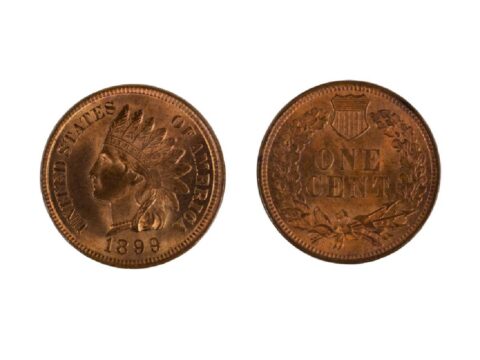
The Indian Head penny may be one of the most popular U.S. coins to honor Native American culture.
Interestingly, the indigenous person on the coin is none other than a representation of a Caucasian Lady Liberty wearing a Native American-inspired feathered headdress!
Indian Head pennies were designed by James B. Longacre and were first released in circulation in 1859.
The last Indian Head penny was struck in 1909 — the year the Lincoln cent was first produced.
Indian Head pennies are generally common, though they do not show up in circulation any more (except for very rare exceptions).
Millions of Indian Head pennies have been struck, and many survive in decent condition.
It is possible to buy a nicely worn, undamaged Indian Head penny for less than $5.
Buffalo Nickels (Indian Head Nickels)
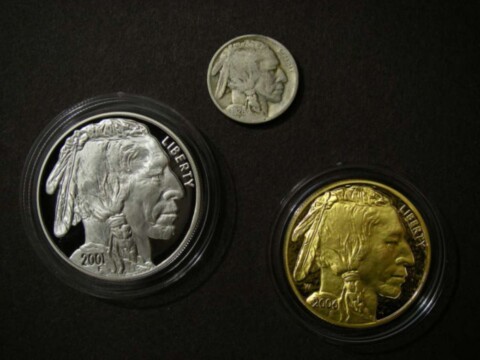
Actually, the Buffalo nickel is also often referred to as an Indian Head nickel, though the term Buffalo nickel seems to have far more popularity.
Buffalo nickels, which were last struck in 1938 (the same year as the first Jefferson nickel), can be had for less than $3.
There have been occasional reports of some people finding a Buffalo nickel in circulation in recent years, but they have been virtually absent from pocket change since at least the early 1980s.
Many who were homeless — or otherwise down on their luck — have used Buffalo nickels as the canvas for artistic coin sculptures. Called Hobo nickels, these carved Buffalo nickels were often exchanged for food, a place to sleep, clothing, and other necessary provisions.
The popular Buffalo (Indian Head) nickel has inspired the U.S. Mint to reinvent the famous Native American coin’s design and place it on an American Buffalo 24-karat gold coin with a $50 face value.
Native American Dollar Coins
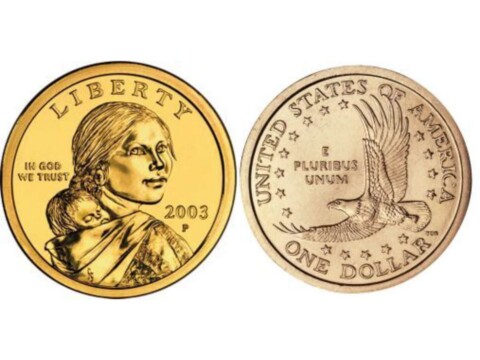
The U.S. dollar coin has featured many Native Americans since the 2000s.
In 2000, the United States Mint released the famous Sacagawea gold dollar. This gold dollar coin, which features an image of the Shoshone woman named Sacagawea (on the coin, she is carrying her infant son, Jean Baptiste), was designed by Glenna Goodacre.
In 2009, the U.S. Mint began striking a series of dollar coins which honors various Native Americans, Native American culture, and Native American achievements.
The Native American dollar coin series was issued to concur with the remaining years of the Presidential dollar coin series.
In 2025, the U.S. Mint released the 2025 Sacagawea gold dollar to honor the 25th anniversary of the first Sacagawea golden dollar struck in 2000.
Other Gold Coins Featuring Native Americans
During the 18th, 19th, and early 20th centuries, the United States struck gold coins for use in everyday commerce. Among these gold coins are a few which feature Native Americans and/or Native American culture.
The Indian Head type $2.50 and $5 gold coins feature the same design as one another. The obverse design, which shows a Native American in a feathered headdress, was struck from 1908 through 1929.
The unique thing about the Indian Head type $2.50 and $5 gold coins is that the designs are incuse. In other words, the design and lettering are actually sunken into the coins, rather than raised above the coins as is the case for other U.S. coins.
Indian Head $2.50 and $5 gold coins are worth $300 to $500.
The $10 Indian Head type gold coin actually features Miss Liberty. However, as is the case with the Indian Head penny, the figure of Liberty on the Indian Head type $10 coin is wearing a Native American war bonnet.
The $10 Indian Head type gold coin was struck from 1907 through 1933 and is valued at $800 to $1,000 for common date versions of the coin.


Leave a Comment