

This post may contain affiliate links. If you buy thru these links, we may earn a commission at no additional cost to you.
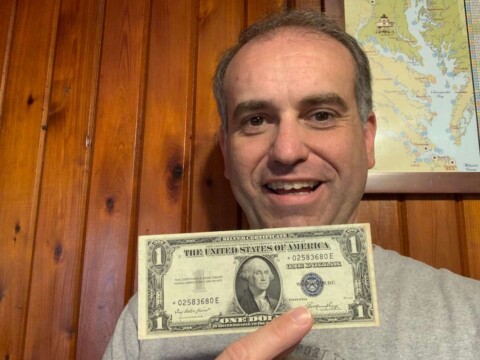
Did you know Series 1935 $1 Silver Certificates are worth more than face value?
It’s one reason I keep all of the old Silver Certificates I come across.
Amazingly, I’ve found Series 1957 $1 Silver Certificates in circulation.
But I hadn’t been able to find any Series 1935 $1 Silver Certificates.
So, when my wife and I were perusing an antique shop one day and I came across a 1935 $1 Silver Certificate, a Star Note at that — for $7 — I just had to buy it!
What Is A 1935 $1 Silver Certificate?
The 1935 dollar bill was issued as a Silver Certificate. The last Silver Certificates were phased out by 1964. They were replaced with $1 Federal Reserve Notes in 1963.
The most common Silver Certificates were issued under Series 1935 and 1957. They were similar in design to a standard dollar bill — with George Washington on the front. The all-seeing eye pyramid and Great Seal designs on the back first appeared in 1935.
The biggest difference between a regular $1 Federal Reserve Note and a $1 Silver Certificate is the additional text below Washington’s portrait on Silver Certificates stating that the bill is worth one dollar in silver and payable to the bearer on demand.
At the time, Silver Certificates could be redeemed for their face value in silver coins. However, Congress discontinued this option in 1968.
Today, all 1935 $1 Silver Certificates are redeemable only at face value for a dollar. So, while they can no longer be redeemed for silver, they are still valid legal tender and are still an accepted form of currency in the United States.
Are 1935 Dollar Bills Rare?
I mentioned that I hadn’t been able to find any 1935 $1 Silver Certificates in circulation — which might lead you to wonder if all 1935 dollar bills are rare.
In fact, most types of 1935 one dollar bills are very common. Billions of them were printed.
These are the factors that make some 1935 dollar bills rare and valuable:
- Certain combinations of signatures
- Particular signatures on Star Notes
- Specimens in top condition
As you would expect, it comes down to knowing what to look for…
Aside from the date (actually known as the “Series,” which may run for many years), you’ll need to look for the signatures of the Treasurer of the United States and the Secretary of the Treasury.
On the 1935 one dollar bills, the signatures are found on the front of the bill — with the signature of the Treasurer of the United States at the bottom left of the bill and the Secretary of the Treasury’s autograph on the bottom right.
What Makes 1935 One Dollar Bills Special?
The 1935 $1 Silver Certificates became the first dollar bills to carry the modern design on the back — with the all-seeing eye over a pyramid on the left and the Great Seal with the heraldic eagle on the right.
There are many hidden symbols and secrets on the dollar bill design that keep people guessing.
Many complex messages and meanings can be found within the design. If you search carefully enough and know what you’re looking for:
The Rarest & Most Valuable 1935 $1 Silver Certificates
Pretty much all 1935 $1 Silver Certificates are worth more than face value, unless they’re torn or otherwise so heavily worn that no collector would want them.
Almost any 1935 $1 Silver Certificate that doesn’t have rips, holes, stains, or some other kind of damage is generally worth at least $2 to $3.
Many are worth much more. And as you will see below, there are some 1935 one dollar bills worth much more than face value — hundreds, even thousands of times more!
1935 Mule Notes
What is a mule silver certificate?
A mule is a cross between a horse and a donkey, and it’s the namesake of a type of error that combines front and back designs that aren’t supposed to be seen on the same note together.
There are 4 kinds of 1935 mule notes. They all involve the size of the little plate numbers for the front and back designs.
For notes printed for Series 1928, Series 1934, and into Series 1935, these little plate numbers (seen in the lower-right segment of the front and back designs) measure 0.5 millimeters high — a half millimeter. They’re very tiny.
For Series 1935-A $1 Silver Certificates, the plate numbers were enlarged to 1 millimeter in height (double the size of the old plate numbers).
However, the Bureau of Printing and Engraving used the back plates for as long as they could, even after the size of the plate numbers had changed. This resulted in some of the 1935 notes that should have been paired with smaller plate numbers being married with the plates having larger numbers.
For example, you might find a 1935-A note with a 1938 serial number and a low plate serial number on the back — this would indicate that it was printed with “back plate 2” in 1938.
At the same time, some 1935-A notes were printed with the smaller-numbered back plates of earlier times.
These mules are scarce, and some that happen to also be Star Notes are rare.
All 1935 $1 Silver Certificate Values
| Description | Minimum Value |
|---|---|
| 1935, Julian/Morgenthau | $2.50+ |
| 1935 Mule (Large Back Plate Numbers), Julian/Morgenthau | $7.50+ |
| 1935 Star Note, Julian/Morgenthau | $40+ |
| 1935 Star Note Mule (Large Back Plate Numbers), Julian/Morgenthau | $425+ |
| 1935-A, Julian/Morgenthau | $2+ |
| 1935-A Mule (Small Back Plate Numbers), Julian/Morgenthau | $4+ |
| 1935-A Star Note, Julian/Morgenthau | $5.50+ |
| 1935-A Mule Star Note (Small Back Plate Numbers), Julian/Morgenthau | $22+ |
| 1935-A “R” On Front in Red (Regular Paper), Julian/Morgenthau | $70+ |
| 1935-A “R” On Front in Red (Regular Paper) Star Note, Julian/Morgenthau | $750+ |
| 1935-A “S” On Front in Red (Special Paper), Julian/Morgenthau | $65+ |
| 1935-A “S” On Front in Red (Special Paper) Star Note, Julian/Morgenthau | $1,400+ |
| 1935-B, Julian/Vinson | $2+ |
| 1935-B Star Note, Julian/Vinson | $15+ |
| 1935-C, Julian/Snyder | $2+ |
| 1935-C Star Note, Julian/Snyder | $3+ |
| 1935-D Wide Reverse, Clark/Snyder | $2+ |
| 1935-D Wide Reverse Star Note, Clark/Snyder | $4.50+ |
| 1935-D Normal Reverse, Clark/Snyder | $4.50 |
| 1935-E, Priest/Humphrey | $2+ |
| 1935-E Star Note, Priest/Humphrey | $3.50+ |
| 1935-F, Preist/Anderson | $2+ |
| 1935-F Star Note, Priest/Anderson | $3.50+ |
| 1935-G, Smith/Dillon | $2+ |
| 1935-G Star Note, Smith/Dillon | $4.50+ |
| 1935-G “IN GOD WE TRUST” on Back, Smith/Dillon | $2+ |
| 1935-G “IN GOD WE TRUST” on Back Star Note, Smith/Dillon | $12+ |
| 1935-H “IN GOD WE TRUST” on Back, Granahan/Dillon | $2+ |
| 1935-H “IN GOD WE TRUST” on Back Star Note, Granahan/Dillon | $4+ |
About Those Names…
You’re probably wondering the full names of the various Treasurers of the United States referenced in the bottom left of the bill and the Secretaries of the Treasury whose autographs are seen on the bottom right.
The full names on the Series 1935 Silver Certificates are as follows…
Treasurer of the United States
- William A. Julian
- George Neese Clark
- Ivy Baker Priest
- Elizabeth Rudel Smith
- Kathryn O’ Hay Granahan
Secretaries of the Treasury
- Henry Morgenthau, Jr.
- Fred M. Vinson
- John W. Snyder
- George M. Humphrey
- Robert B. Anderson
- C. Douglas Dillon
What About 1935 Hawaii & 1935 North Africa $1 Emergency Note Values?
During World War II, the Bureau of Printing and Engraving issued special notes for Hawaii after the 1941 Pearl Harbor Attack, as well as for Armed Forces in Europe and North Africa.
They are all Series 1935 dollar bills that are known as World War II Emergency Notes:
- The 1935 Hawaii $1 Silver Certificates have the word “HAWAII” overprinted on the back in large, black-outlined letters.
- The 1935 North Africa $1 Silver Certificates show a big yellow seal on the front.
Now let’s talk about how much they’re worth…
1935 $1 Silver Certificate Hawaii Emergency Note Value
- 1935-A Hawaii, Julian/Morgenthau — $30+
- 1935-A Hawaii Star Note, Julian/Morgenthau — $200+
1935 $1 Silver Certificate North Africa Emergency Note Value
- 1935-A Yellow Seal, Julian/Morgenthau — $30+
- 1935-A Yellow Seal Star Note, Julian/Morgenthau — $225+
One More Note About 1935 Silver Certificates
Before I leave you here for now, I want to recommend an extremely educational book about Silver Certificates and all types of U.S. paper currency. It’s called A Guide Book of United States Paper Money, by Arthur L. and Ira S. Friedberg.
It might be a little more advanced than what you’re looking for at the moment. But if you ever want a solid reference for finding out more about rare and valuable old dollar bills and other types of vintage paper money, this is absolutely the book to get.
Happy collecting!
Leave a Comment