




When it comes to popular coins with interesting stories, there are few pieces that match the intrigue of this 1883 coin — the No-CENTS Liberty V nickel.
Designed by Charles E. Barber (the same man who designed the Liberty Head ‘Barber’ dimes, quarters, and half-dollars), the Liberty Head nickel was first released in 1883.
However, during the first months of production, the 1883 Liberty Head nickel — a design which has a big Roman numeral ‘V’ on the reverse to symbolize 5 cents — lacked the words ‘FIVE CENTS.’
Unscrupulous individuals made the most of the opportunity, and the story begins…
No-CENTS V Nickels
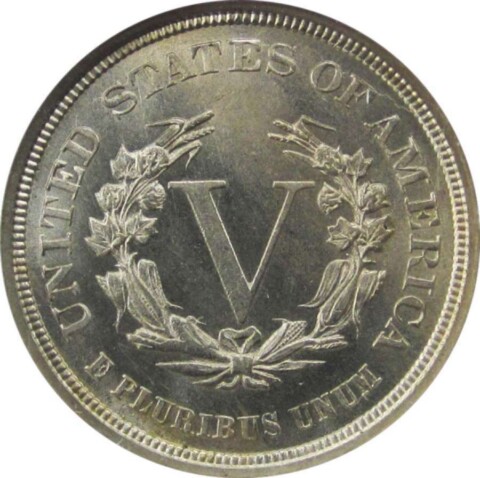
Nothing about the 1883 Liberty nickel is rare.
In fact, with a value of less than $10 in moderately worn grades, it’s among the cheapest dates from the first decade of the Liberty nickel series.
This 1883 nickel draws a fair share of attention for being the first year of issue for the Liberty nickel series — but the most intriguing story behind the 1883 V nickel has to do with how it became known as the ‘racketeer nickel.’
Racketeer Nickels Were Confused With $5 Coins
In 1883, when the V nickel first entered circulation, there was also a $5 gold coin with a design similar to that of the Liberty nickel.
Because the first 1883 Liberty Head V nickels did not contain the words ‘FIVE CENTS,’ and also because the coins are about the same diameter and look somewhat similar to the then-circulating $5 Liberty gold coin, some people took it upon themselves to gold-plate 1883 No-CENTS nickels and try to pass them off as $5 gold coins!
Apparently, this was a somewhat pervasive problem at the time — so the United States Mint quickly added the words ‘FIVE CENTS’ to the reverse of the Liberty nickel under the ‘V’ to ward off any further counterfeiting attempts.
These gold-plated Liberty nickels have been famously dubbed Racketeer nickels.
Many replicas of these can be found on the market today.
Josh Tatum, The Infamous Racketeer Nickel Gold-Plater
In addition to the above controversy, there has been a story circulating for some time that a man named Josh Tatum was one of the most notorious of the Liberty nickel gold platers.
It’s said that he was a deaf mute who gold plated hundreds of 1883 nickels.
Specifically with regard to gold-plated V nickels, he put straight lines on the edge of some of these 1883 No-CENTS nickels (to replicate edge reeding on U.S. coins).
Then, Tatum would go into a store to purchase items that were 5 cents or less and pass off his gold-plated nickels to the cashier as $5 gold coins!
Without saying a word, he would wait for the cashier to return his change, and he would usually get $4.95 in return.
As the story goes, Tatum was tried in a court of law for fraud.
However, the charges were dismissed — because he never actually asked the store clerks to give him the amount of change needed for items bought based on his paying with a 5 dollar coin.
Why not? Because Tatum was deaf and mute. And nobody could testify against him!
Is Josh Tatum Behind The Phrase ‘Joshing You’?
Some attribute the saying “I’m just joshing you” (a phrase which means to fool or mess with somebody) to the story of Josh Tatum.
However, Merriam-Webster’s dictionary states “josh” as meaning ‘to tease good-naturedly’ or ‘to engage in banter’ — which was first used around 1845.
So, did Josh Tatum really give rise to the expression meaning to ‘joke around’? Well, maybe not, but it certainly is a fun example of folk etymology!


Leave a Comment