


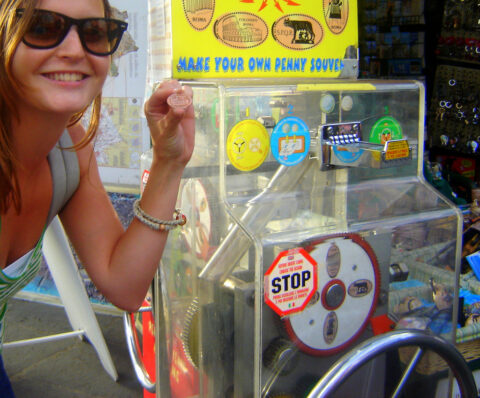
Have you ever stuck a penny in a coin-squashing machine at a theme park, fair, museum, or other tourist attraction?
You know, the kind of machine where you insert a penny along with (typically) 50 cents — then you turn a crank or push a button and out comes your penny. It’s now flattened and imprinted with a new design — but it’s the same old penny!
These kinds of coins are called elongated coins. They are also sometimes called pressed pennies, squished pennies, and squashed pennies.
Elongated coin collecting falls into a category of the hobby called exonumia. Exonumia also includes encased coins, tokens, Hobo nickels, wooden nickels, and other related material.
Now, here’s what you really want to know about the history and legality of elongated coins…
The First Elongated Coins
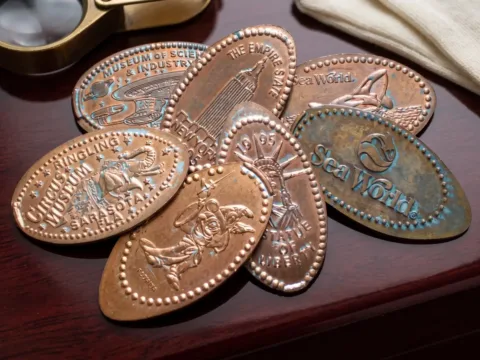
The first elongated coins in the United States were made in Chicago during 1893 for the World’s Columbian Exposition.
These early elongated coins made for the World’s Columbian Exposition were used to commemorate the event.
While coin rollers and coin pressers are easy to find in numerous tourist hot spots today, in the early days, people had to place pennies on train tracks and wait for the train to pass by and squash the coin flat.
This created a canvas for an artist to engrave a design on the flattened coin.
Don’t try that yourself! You could be seriously injured and you could also cause damage to the train and injure its passengers and crew.
Besides, it’s much more fun to watch a penny be flattened right in front of your eyes in the neat coin press machines that are found all throughout the country today.
Elongated Coins As Collectibles
Elongated coins are popular among exonumists.
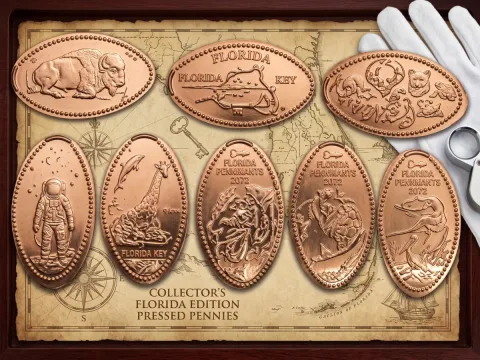
Because there are so many elongated coin machines located across the country (as well as certain parts of the world), the variety of elongated coin designs is vast.
Designs represent a cross section of amusement parks, museums, attractions, and other tourist spots. Therefore, the people interested in elongated coins is not limited to just exonumists. Collectors, historians, and others interested in locations where elongated coins are made will also find these coins important to their collecting interests.
Probably the most notable example of a non-coin collector wanting elongated coins would be somebody who is building a collection of memorabilia from a now-defunct park, museum, or other tourist location.
There are coin collecting clubs, groups, and organizations which focus on exonumia, including elongated coins. There are also coin dealers who buy and sell elongated coins.
Are Elongated Coins Legal?
You might be wondering if elongated coins are legal or not. Well, if you are a fan of elongated coins (and living in certain nations), then you are in luck! Elongated coins are legal, thanks to an aspect of the law which covers law-abiding citizens who just so happen to like mutilated coins.
While coins mutilated for the purpose of counterfeiting are (of course) illegal, as long as a mutilated coin is not being altered with the intent to counterfeit, then all is fine — at least in the United States.
When you enter other nations, beware — coin elongating may not be legal in certain circumstances. For example, in Canada, it is illegal to mutilate the image of the Queen (whose face appears on Canadian coins). Great Britain, however, no longer has such a law.


Leave a Comment